My sister-in-law was in town with her children to attend a family wedding this weekend. The groom was a nephew, a boy by many measures and yet man enough to enlist in the Army and get married.
He arrived in his Army greens, the brass on his lapels shining almost as much as his shaved head. Everyone thought he looked more handsome and healthier than ever before. I asked him about his assignment in Colorado. He said it was okay, but he fully expected to be "downrange" within a year or two. I immediately understood what he meant, and I was surprised with how easily he spoke of it.
His bride was a slim young girl wrapped elegantly in a beaded white gown, shoulder-less to reveal her tattoos. She had a scorpion on her shoulder blade, and it occurred to me that my soldier nephew might just enjoy a few months with his new bride before having to encounter the real thing in Iraq or Afghanistan. It was a happy occasion trimmed with somber realization.
Earlier that day I had taken my own Precious Daughter and two of her little cousins to City Park. We tried out all the features of the playground, then took our skills to conquer the trees. Ancient, heavy trees. The park is loaded with oak trees, many which might recall the distant sounds of battle when General Jackson turned back the British, and when gunboats steamed up the river during the Civil War.
"This tree is falling down," said one of the children happily as he walked on a branch that stretched horizontally along the ground almost as far as it reached up to the sky. "Gravity eventually overcomes all of us," I said to my own amusement. My response neither informed nor interested him and he continued to explore the ancient oak on his own terms.
The heat eventually drove us toward the old casino building where we found food and drinks and ice cream. My Precious Daughter said it had been closed since Katrina, but was glad to find it recently reopened. Almost three years it had been closed. Three years since the hurricane and flood had soaked our city.
An old song tells us "you don't know what you got till it's gone." That's a true enough observation that I'm sure applies anywhere. But here in New Orleans, where the loss is still so real and present, I'd like to think we know better than anyone what we have. And I hope we can appreciate what we have. I know I'm trying.
Tuesday, August 12, 2008


Monday, August 04, 2008
Tidal exchange
Meet and greet, think and drink, listen and learn, orate and organize...
You can do it all at the third annual gathering of NOLA Bloggers later this month.
It's called RISING TIDE III, running from August 22 to 24, right in the middle of New Orleans and the 2008 hurricane season. If you have not signed up yet, now is the time.
Not a blogger? It's okay, nobody will know. Come meet some great people anyway.
This year RISING TIDE features none other than the celebrated author John M. Barry.
Currently a commissioner on the Southeast Louisiana Flood Protection Authority-East, Mr. Barry also just happens to be the author of Rising Tide: The Great Mississippi Flood of 1927 and How It Changed America, the definitive book on the flood that dared America to control the Mississippi River.
And check out the official conference poster created by Greg Peters.
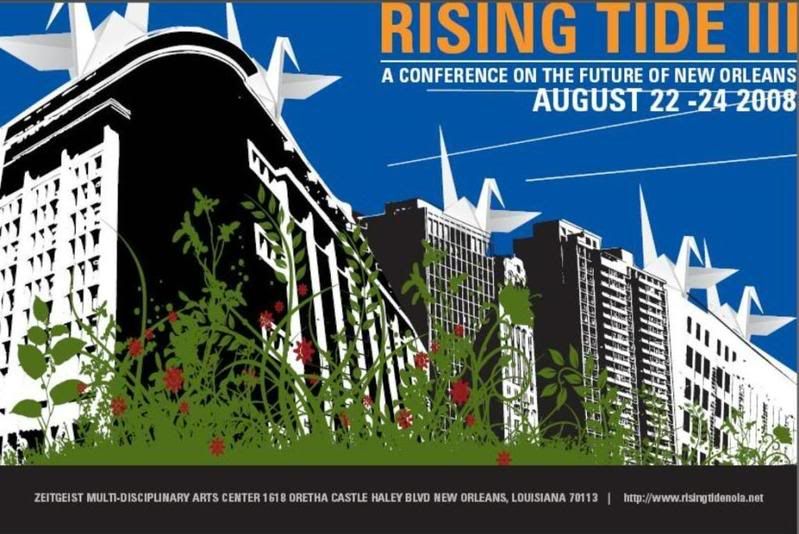
Click on the poster to get all the details. Hope to see you there!
You can do it all at the third annual gathering of NOLA Bloggers later this month.
It's called RISING TIDE III, running from August 22 to 24, right in the middle of New Orleans and the 2008 hurricane season. If you have not signed up yet, now is the time.
Not a blogger? It's okay, nobody will know. Come meet some great people anyway.
This year RISING TIDE features none other than the celebrated author John M. Barry.
Currently a commissioner on the Southeast Louisiana Flood Protection Authority-East, Mr. Barry also just happens to be the author of Rising Tide: The Great Mississippi Flood of 1927 and How It Changed America, the definitive book on the flood that dared America to control the Mississippi River.
And check out the official conference poster created by Greg Peters.
Click on the poster to get all the details. Hope to see you there!
Monday, July 28, 2008
Here's mud in your eye
A recent headline on Yahoo! News decried the loss of soils in the recently flooded states to the north of us. This is particularly significant to us on the southern end of the Mississippi River.
A lot of people have said that we could solve Louisiana's coastal erosion problem by just letting nature do the work for us. We need "The river wild" they say.
But here's a part of the story nobody likes to talk about: sediment load.
That is, how much mud does the muddy Mississippi River contain?
The answer: Not nearly as much as she used to.
Going back as far as 1935 and the birth of the Soil Conservation Service, government at all levels has teamed with private citizens to halt the flow of topsoil washing into the nations' rivers. In recent years EPA has been tightening what is called Total Maximum Daily Load (TMDL) regulations--standards that seek to keep turbidity down.
These and a hundred other well-meaning and beneficial initiatives mean that water flowing past New Orleans today contains just a fraction of mud one would have found in that same water even just a few decades ago.
And what that means is if historically the river was able to build a few hundred square miles of marsh per century, it would take centuries longer to do the same job today.
Would it help to let the river run wild? Yes, but don't count on any help from our neighbors north of the 30th parallel. They need that mud just as much as we do.
A lot of people have said that we could solve Louisiana's coastal erosion problem by just letting nature do the work for us. We need "The river wild" they say.
But here's a part of the story nobody likes to talk about: sediment load.
That is, how much mud does the muddy Mississippi River contain?
The answer: Not nearly as much as she used to.
Going back as far as 1935 and the birth of the Soil Conservation Service, government at all levels has teamed with private citizens to halt the flow of topsoil washing into the nations' rivers. In recent years EPA has been tightening what is called Total Maximum Daily Load (TMDL) regulations--standards that seek to keep turbidity down.
These and a hundred other well-meaning and beneficial initiatives mean that water flowing past New Orleans today contains just a fraction of mud one would have found in that same water even just a few decades ago.
And what that means is if historically the river was able to build a few hundred square miles of marsh per century, it would take centuries longer to do the same job today.
Would it help to let the river run wild? Yes, but don't count on any help from our neighbors north of the 30th parallel. They need that mud just as much as we do.
Wednesday, July 23, 2008
Wetlands for hurricane protection might make cents
A study published in the June 2008 journal of the Royal Swedish Academy of Sciences attempts to calculate the economic value of wetlands as hurricane and storm surge defense features. I first heard of the study online and was fortunate to find the full text of the journal article here.
It is first important to note what this paper is NOT. It is not an engineering analysis; it is an exercise in econometrics. It does not propose any new design methods, nor does it test any of the natural mechanisms by which wetlands can provide storm protection for human populated areas. Early on the authors acknowledge this fact and note that the best empirical studies they find place the storm surge reduction benefit of wetlands at about 3 inches per mile. Regular readers of this blog will likely recognize that factoid.
What the researchers have done is gathered a ream of existing hurricane data, applied some simplifying assumptions to fill data gaps, and crunched the numbers through a series of statistical tests. The result, the authors can claim with some credibility, is that the value of wetlands as hurricane storm barriers can be expressed in dollars.
This is not a new problem. Economists have struggled to quantify the monetary value of natural features for decades. The vexing part of the problem is how to properly and fully equate wild lands and habitats in economic units of dollars used to store and trade wealth in human commerce.
Take any forest, for example. What is it worth? Is it simply the market value of its trees cut down and shipped to the mill plus the going rate for its developed acreage? We know this is not the right answer because forests have ecological value as carbon storage centers and aesthetic value as places humans enjoy seeing in person and in pictures.
Government agencies have for this reason studiously avoided placing economic value on wild lands. If forced to complete in the market of capitalist values, naturally occurring features will almost always lose out to commercial development. Environmental scientists instead have been using other more nature-based measures such as the Wetland Value Assessment and assigning "Habitat Units" in lieu of pure dollars to compare alternative land uses.
The authors of the Royal Swedish study set out to define the relationship between raw acreage of natural features as storm defense systems and the avoided damage from those same storms. First, they obtained a data set of hurricanes that struck the US Atlantic and Gulf coasts since 1980. This data included storm path, intensity and estimates of damage. They found a wealth of scientific and economic data in the Emergency Events Database (www.emdat.be) created and maintained by the World Health Organization, the Centre for Research on the Epidemiology of Disasters, and the Belgian Government.
Next, they needed to calculate the total possible damage of strike locations. By comparing the experienced damage with the theoretical maximum possible damage, the researchers aimed to quantify the value of avoided damage. And this is where the econometric gymnastics kicks in. The authors took statistical data on US and individual state gross domestic product (GDP) and assigned a GDP value to a map of coastal America on a grid resolution of 1 kilometer square. Because GDP data is not readily available in this resolution, they interpolated and assigned GDP value by looking at satellite photographs taken at night. Areas brightly lit were given higher GDP values than dim or dark areas of the country.
Armed with this data, the authors ran the numbers and found some statistically significant relationships. Their primary discovery was that damage in areas near wetlands was reduced proportionally with the quantity of wetlands. Everyone has long acknowledged this fact, but here was proof--expressed in dollars.
The researches went further and attempted to calculate the average annual benefit of wetlands as storm protection. Their conclusion: wetlands save America from billions in storm damage year in and year out.
But let's not get too far ahead here. I have some serious misgivings about the methods employed and with the way the results were tabulated and presented. I will elaborate on some of them here.
1. It is interesting to note that the methods employed here failed to provide satisfactory results in several key instances. For instance, researchers had to limit their analysis to only the US Atlantic and Gulf coasts because of the scarcity of data. They admit to wishing they could apply their skills to the thousands of known disastrous tsunamis, monsoons and other coastal storm events, but found insufficient data to do so. The resulting data set includes just 34 hurricanes out of the nearly 270 major storms to strike the US during the selected period.
2. The researchers initially set out quantify the storm barrier benefits of forested wetlands, too, but found the statistical correlation not significant enough to support their hypothesis. Several widely published papers have touted the benefits of mangrove and cypress swamps in knocking down storm effects. The authors of this study could not validate that claim, and it makes me wonder why they proceeded with their work in spite of that glaring problem.
3. The use of GDP as a measure of potential storm damage leaves much to be desired. GDP is an expression of economic productivity; it says nothing about the present value of homes, businesses and other infrastructure that fall victim to nature's fury. Likewise, the Emergency Events Database records the total estimated damage wrought by storms. This would include wind and rain damages, but it is primarily the storm surge damage that is thought to be muted by wetlands.
4. To convert their calculation of avoided damage into an annually recurring value, the authors developed hurricane return frequencies using a data set with a period of just 25 years. This is hardly a large enough sample to extrapolate reliable return frequencies.
5. The authors conclude their paper with an editorial on the virtues of wetlands far beyond the apparent correlation to protection of human economic activity. They opine how coastal wetlands are "maintained by nature" and that such features are "far more cost-effective than constructed levees." But there is absolutely nothing in this article to support these conclusions. Indeed, the authors themselves note that Hurricane Katrina alone destroyed some 50,000 acres of wetlands.
These are just a few of the shortcomings of the study.
It is also important to note that the study tells us nothing about how and where to build wetlands as part of a storm defense system. The study considers gross acreage in the path of hurricanes assumed to be 100-km wide; nowhere does the study enlighten us as to how we would go about designing a wetlands plan.
I was disappointed that the researchers included the rather colloquial analogy that wetlands function as "horizontal levees." In fact, all physical features exist in three dimensions: earthen levees and wetlands both have length, width and height. The difference is the primary storm defense benefit of levees lies in their height, while the frictional resistance of wetlands is manifest in their area--length and width. But to equate the two, as if to suggest one could substitute some acreage of wetlands for some or all of a levee is ludicrous--if not dangerous.
It is noted that as I was preparing this blog entry, The Times-Picayune ran a story on the study that seized upon the expression "horizontal levees" as if it were a valid scientific result of this study. It is not.
I think the study represents a remarkable effort to quantify the hurricane defense benefits of wetlands in dollars--not an easy task--even if the results seem exaggerated to my eye. As an engineer, I find little in the study to help me understand and design these vital systems. But perhaps the study gives our society the justification and incentive to take wetland preservation and construction seriously as a bonafide contributor in our overall strategy to protect coastal developments. In the end, much research remains to be done before this general appreciation of wetlands can become a plan of action with predictable results.
It is first important to note what this paper is NOT. It is not an engineering analysis; it is an exercise in econometrics. It does not propose any new design methods, nor does it test any of the natural mechanisms by which wetlands can provide storm protection for human populated areas. Early on the authors acknowledge this fact and note that the best empirical studies they find place the storm surge reduction benefit of wetlands at about 3 inches per mile. Regular readers of this blog will likely recognize that factoid.
What the researchers have done is gathered a ream of existing hurricane data, applied some simplifying assumptions to fill data gaps, and crunched the numbers through a series of statistical tests. The result, the authors can claim with some credibility, is that the value of wetlands as hurricane storm barriers can be expressed in dollars.
This is not a new problem. Economists have struggled to quantify the monetary value of natural features for decades. The vexing part of the problem is how to properly and fully equate wild lands and habitats in economic units of dollars used to store and trade wealth in human commerce.
Take any forest, for example. What is it worth? Is it simply the market value of its trees cut down and shipped to the mill plus the going rate for its developed acreage? We know this is not the right answer because forests have ecological value as carbon storage centers and aesthetic value as places humans enjoy seeing in person and in pictures.
Government agencies have for this reason studiously avoided placing economic value on wild lands. If forced to complete in the market of capitalist values, naturally occurring features will almost always lose out to commercial development. Environmental scientists instead have been using other more nature-based measures such as the Wetland Value Assessment and assigning "Habitat Units" in lieu of pure dollars to compare alternative land uses.
The authors of the Royal Swedish study set out to define the relationship between raw acreage of natural features as storm defense systems and the avoided damage from those same storms. First, they obtained a data set of hurricanes that struck the US Atlantic and Gulf coasts since 1980. This data included storm path, intensity and estimates of damage. They found a wealth of scientific and economic data in the Emergency Events Database (www.emdat.be) created and maintained by the World Health Organization, the Centre for Research on the Epidemiology of Disasters, and the Belgian Government.
Next, they needed to calculate the total possible damage of strike locations. By comparing the experienced damage with the theoretical maximum possible damage, the researchers aimed to quantify the value of avoided damage. And this is where the econometric gymnastics kicks in. The authors took statistical data on US and individual state gross domestic product (GDP) and assigned a GDP value to a map of coastal America on a grid resolution of 1 kilometer square. Because GDP data is not readily available in this resolution, they interpolated and assigned GDP value by looking at satellite photographs taken at night. Areas brightly lit were given higher GDP values than dim or dark areas of the country.
Armed with this data, the authors ran the numbers and found some statistically significant relationships. Their primary discovery was that damage in areas near wetlands was reduced proportionally with the quantity of wetlands. Everyone has long acknowledged this fact, but here was proof--expressed in dollars.
The researches went further and attempted to calculate the average annual benefit of wetlands as storm protection. Their conclusion: wetlands save America from billions in storm damage year in and year out.
But let's not get too far ahead here. I have some serious misgivings about the methods employed and with the way the results were tabulated and presented. I will elaborate on some of them here.
1. It is interesting to note that the methods employed here failed to provide satisfactory results in several key instances. For instance, researchers had to limit their analysis to only the US Atlantic and Gulf coasts because of the scarcity of data. They admit to wishing they could apply their skills to the thousands of known disastrous tsunamis, monsoons and other coastal storm events, but found insufficient data to do so. The resulting data set includes just 34 hurricanes out of the nearly 270 major storms to strike the US during the selected period.
2. The researchers initially set out quantify the storm barrier benefits of forested wetlands, too, but found the statistical correlation not significant enough to support their hypothesis. Several widely published papers have touted the benefits of mangrove and cypress swamps in knocking down storm effects. The authors of this study could not validate that claim, and it makes me wonder why they proceeded with their work in spite of that glaring problem.
3. The use of GDP as a measure of potential storm damage leaves much to be desired. GDP is an expression of economic productivity; it says nothing about the present value of homes, businesses and other infrastructure that fall victim to nature's fury. Likewise, the Emergency Events Database records the total estimated damage wrought by storms. This would include wind and rain damages, but it is primarily the storm surge damage that is thought to be muted by wetlands.
4. To convert their calculation of avoided damage into an annually recurring value, the authors developed hurricane return frequencies using a data set with a period of just 25 years. This is hardly a large enough sample to extrapolate reliable return frequencies.
5. The authors conclude their paper with an editorial on the virtues of wetlands far beyond the apparent correlation to protection of human economic activity. They opine how coastal wetlands are "maintained by nature" and that such features are "far more cost-effective than constructed levees." But there is absolutely nothing in this article to support these conclusions. Indeed, the authors themselves note that Hurricane Katrina alone destroyed some 50,000 acres of wetlands.
These are just a few of the shortcomings of the study.
It is also important to note that the study tells us nothing about how and where to build wetlands as part of a storm defense system. The study considers gross acreage in the path of hurricanes assumed to be 100-km wide; nowhere does the study enlighten us as to how we would go about designing a wetlands plan.
I was disappointed that the researchers included the rather colloquial analogy that wetlands function as "horizontal levees." In fact, all physical features exist in three dimensions: earthen levees and wetlands both have length, width and height. The difference is the primary storm defense benefit of levees lies in their height, while the frictional resistance of wetlands is manifest in their area--length and width. But to equate the two, as if to suggest one could substitute some acreage of wetlands for some or all of a levee is ludicrous--if not dangerous.
It is noted that as I was preparing this blog entry, The Times-Picayune ran a story on the study that seized upon the expression "horizontal levees" as if it were a valid scientific result of this study. It is not.
I think the study represents a remarkable effort to quantify the hurricane defense benefits of wetlands in dollars--not an easy task--even if the results seem exaggerated to my eye. As an engineer, I find little in the study to help me understand and design these vital systems. But perhaps the study gives our society the justification and incentive to take wetland preservation and construction seriously as a bonafide contributor in our overall strategy to protect coastal developments. In the end, much research remains to be done before this general appreciation of wetlands can become a plan of action with predictable results.
Saturday, July 19, 2008

Friday, July 11, 2008
A space oddity?
It was 29 years ago today that America's first space station, Skylab, came falling down to Earth. Some people at the office were talking about it and I recalled that it was quite a newsworthy event.
Pat O'Brien's even created a potent cocktail to commemorate the event. They called it the "Skylab Fallout."
But I was surprised to find I was the only person in the group who had ever heard of it.
Surely other people recall getting knocked dizzy in the French Quarter by a Skylab Fallout!
Pat O'Brien's even created a potent cocktail to commemorate the event. They called it the "Skylab Fallout."
But I was surprised to find I was the only person in the group who had ever heard of it.
Surely other people recall getting knocked dizzy in the French Quarter by a Skylab Fallout!
Wednesday, July 09, 2008
Exposed weaknesses
At the Rising Tide 2 conference, writer and panelist Joshua Clark commented that Hurricane Katrina exposed many weaknesses in our lives. I wrote it down back when I first heard it last August, and I've been thinking about it here and there since.
The idea stuck with me.
As an engineer, I recognize how minor flaws can become major problems under certain conditions. A hairline crack in concrete can let in moisture. That moisture can cause rust in reinforcing steel, which in turn exerts pressures that will further crack the encasing concrete.
Weaknesses can go undetected for weeks, months, years, and then... a bridge falls, or a tower crane buckles, or a floodwall bends and bows to failure.
Engineers also understand that loads transfer from one part of a structure to another. If one connection of a truss fails, it might not result in an immediate collapse. The load will be transferred to another connection, much the same way a current of electricity will seek the shortest path to ground, or water the swiftest path to the ocean. This load transfer is automatic and instantaneous.
If the new connection can't hold the load, it too will fail and send the load to the next connection. Sometimes this transfer/failure/transfer cycle happens quickly--resulting in a successive collapse. Sometimes, it goes undetected for a while.
I've been thinking about the load of Hurricane Katrina on us, our lives, our community, and our support system. When something fails to hold up, do the others race in to help? And if the load and stress of this disaster and the rebuilding process pile on, will we stay strong, or will we suffer sudden or rapid successive collapse in our lives?
You could say we've already seen this happen at the District Attorney's office. Inefficiencies, blunders and scandals accumulated and brought down Eddie Jordan's office and career. It started out small, but grew over many months until the ability of the public to stomach the news had been completely diminished. It was a textbook illustration of the expression, "The straw that broke the camel's back."
I also think we see this happening with housing. With so many displaced from their homes, demand for rentals and rental rates are up dramatically. Amazingly the federal government and the city decided this was the time to tear down most public housing projects. The stress of housing has transferred from one market to the next, so that we can truly say there is a housing crisis in New Orleans.
Families feel the strain, too. The recent death of NOLA blogger Ashley Morris shows us how the burdens of life are distributed. The stress and strain was quickly transferred--shared--throughout the Morris family's circle of friends. Several NOLA blogger stepped in mightily to help them bear the load.
And the Morris family survives.
So I think I'd like to add a thought to Joshua Clark's observation. Katrina exposed weaknesses, yes, but she also revealed our strengths.
And not just as a matter of contrast. Just because one floodwall fell over and the one next to it did not is no reason to think that remaining floodwall is somehow representative of an ideal design; it just means it was at least a tiny bit better than the one that fell.
No, I'm thinking that New Orleans is a city of many strengths--strengths that were there all along, but we overlooked them or forgot them in the day-to-day journey of life.
Sense of community, love of neighborhood and civic pride are some examples. Would we say that these have sprung full-grown from our wounded city? Or isn't it more likely we had these things all along? I think it took several feet of flood water to push these powerful sentiments to the surface. And to this day if anybody says a cross word to us about being "stupid to live below sea level" you can bet they'll get both barrels of love right back.
Like travelers on a yellow brick road, we've been through hell and high water just to find out that what we were searching for we had all along.
I know we'll never forget that awful August three years ago, when unforgiving nature exposed and exploited all our weaknesses.
But I also hope we'll remember our discovered strengths, and that it's because of those strengths that we're still here.
The idea stuck with me.
As an engineer, I recognize how minor flaws can become major problems under certain conditions. A hairline crack in concrete can let in moisture. That moisture can cause rust in reinforcing steel, which in turn exerts pressures that will further crack the encasing concrete.
Weaknesses can go undetected for weeks, months, years, and then... a bridge falls, or a tower crane buckles, or a floodwall bends and bows to failure.
Engineers also understand that loads transfer from one part of a structure to another. If one connection of a truss fails, it might not result in an immediate collapse. The load will be transferred to another connection, much the same way a current of electricity will seek the shortest path to ground, or water the swiftest path to the ocean. This load transfer is automatic and instantaneous.
If the new connection can't hold the load, it too will fail and send the load to the next connection. Sometimes this transfer/failure/transfer cycle happens quickly--resulting in a successive collapse. Sometimes, it goes undetected for a while.
I've been thinking about the load of Hurricane Katrina on us, our lives, our community, and our support system. When something fails to hold up, do the others race in to help? And if the load and stress of this disaster and the rebuilding process pile on, will we stay strong, or will we suffer sudden or rapid successive collapse in our lives?
You could say we've already seen this happen at the District Attorney's office. Inefficiencies, blunders and scandals accumulated and brought down Eddie Jordan's office and career. It started out small, but grew over many months until the ability of the public to stomach the news had been completely diminished. It was a textbook illustration of the expression, "The straw that broke the camel's back."
I also think we see this happening with housing. With so many displaced from their homes, demand for rentals and rental rates are up dramatically. Amazingly the federal government and the city decided this was the time to tear down most public housing projects. The stress of housing has transferred from one market to the next, so that we can truly say there is a housing crisis in New Orleans.
Families feel the strain, too. The recent death of NOLA blogger Ashley Morris shows us how the burdens of life are distributed. The stress and strain was quickly transferred--shared--throughout the Morris family's circle of friends. Several NOLA blogger stepped in mightily to help them bear the load.
And the Morris family survives.
So I think I'd like to add a thought to Joshua Clark's observation. Katrina exposed weaknesses, yes, but she also revealed our strengths.
And not just as a matter of contrast. Just because one floodwall fell over and the one next to it did not is no reason to think that remaining floodwall is somehow representative of an ideal design; it just means it was at least a tiny bit better than the one that fell.
No, I'm thinking that New Orleans is a city of many strengths--strengths that were there all along, but we overlooked them or forgot them in the day-to-day journey of life.
Sense of community, love of neighborhood and civic pride are some examples. Would we say that these have sprung full-grown from our wounded city? Or isn't it more likely we had these things all along? I think it took several feet of flood water to push these powerful sentiments to the surface. And to this day if anybody says a cross word to us about being "stupid to live below sea level" you can bet they'll get both barrels of love right back.
Like travelers on a yellow brick road, we've been through hell and high water just to find out that what we were searching for we had all along.
I know we'll never forget that awful August three years ago, when unforgiving nature exposed and exploited all our weaknesses.
But I also hope we'll remember our discovered strengths, and that it's because of those strengths that we're still here.
Tuesday, July 01, 2008
"Those tiles will be replaced"
That's what Entergy V.P. Rusty Burroughs said. His letter of apologies and promises was printed in the newspaper.
And so two months later, NOLA Blogger Oyster goes back to check and finds...
ENTERGY HAS DONE NOTHING.
And so two months later, NOLA Blogger Oyster goes back to check and finds...
ENTERGY HAS DONE NOTHING.
Friday, June 27, 2008
Back on track
I don't know who had the idea or made it happen, but they deserve praise.
This week the streetcars returned to Carrollton Avenue. For the first time since Hurricane Katrina tried to drown New Orleans, you can ride a streetcar from Claiborne Avenue to Canal Street via the world famous St. Charles Avenue streetcar line.
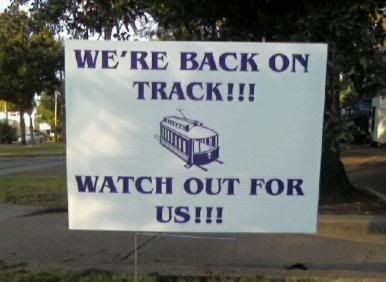
And somebody had the wisdom and forethought to put up these signs.
Automobiles cross paths with the streetcars at each of dozens of cross streets cutting across the neutral ground. After an absence just shy of three years, automobile drivers have likely fallen out of the habit of looking out for the streetcars. Hopefully these signs will remind drivers to be on the lookout.
This is positive and proactive and I like it.
Compare this to the stoplight camera scheme.
In the past few months the City of New Orleans and its neighbor in Metairie both installed cameras at intersections to catch drivers crossing through red lights. The goal, government officials said, is to improve public safety. Additional revenue brought by fines, government officials said, is just coincidental to the plan.
But what are the rules about crossing under a yellow light? Is anyone really sure? Ask any two drivers about traffic light rules and you'll get three different answers about what is legal and illegal when it comes to yellow and red lights. Where is the effort to educate the driving public of what is safe and unsafe? Where is the public education on the correct rules for traffic lights?
Apparently, nobody thought it necessary to provide information. They just put up cameras and started mailing invoices. The plan, it seems, is that once a driver is forced to write a check, he'll learn.
This is why I was so pleased with the "Back on Track" signs. They inform and educate in order to promote safety, and that is the way it should be.
This week the streetcars returned to Carrollton Avenue. For the first time since Hurricane Katrina tried to drown New Orleans, you can ride a streetcar from Claiborne Avenue to Canal Street via the world famous St. Charles Avenue streetcar line.
And somebody had the wisdom and forethought to put up these signs.
Automobiles cross paths with the streetcars at each of dozens of cross streets cutting across the neutral ground. After an absence just shy of three years, automobile drivers have likely fallen out of the habit of looking out for the streetcars. Hopefully these signs will remind drivers to be on the lookout.
This is positive and proactive and I like it.
Compare this to the stoplight camera scheme.
In the past few months the City of New Orleans and its neighbor in Metairie both installed cameras at intersections to catch drivers crossing through red lights. The goal, government officials said, is to improve public safety. Additional revenue brought by fines, government officials said, is just coincidental to the plan.
But what are the rules about crossing under a yellow light? Is anyone really sure? Ask any two drivers about traffic light rules and you'll get three different answers about what is legal and illegal when it comes to yellow and red lights. Where is the effort to educate the driving public of what is safe and unsafe? Where is the public education on the correct rules for traffic lights?
Apparently, nobody thought it necessary to provide information. They just put up cameras and started mailing invoices. The plan, it seems, is that once a driver is forced to write a check, he'll learn.
This is why I was so pleased with the "Back on Track" signs. They inform and educate in order to promote safety, and that is the way it should be.
Monday, June 09, 2008
Cats at home
Hurricanes Katrina and Rita were tough on a lot of people, but they were also tough on our animals. You could say that for our pets Callie and Smudge, it was a complete cat-astrophe!
(Okay, okay, a very bad pun. Last one, I promise.)
Callie and Smudge are our two remaining cats. Prior to the storm we had four cats and took every one of them with us when we fled town in the middle of the night almost three years ago. Packed into cat carriers, stacked on the back seat next to our Precious Daughter, I think it's safe to say they were pretty traumatized in those first days.
They did not watch the round-the-clock news coverage of the storm, the wall failures, the flooding, the failed relief effort, the bodies abandoned around the city, the desperate cries of help from the Superdome and convention center. They could not comprehend the enormous force of nature bearing down upon the city nor the necessity of driving away in the middle of the night. It must have scared the heck out of them.
If even a slender parallel can be drawn between the experience of our cats with the suffering of our neighbors here, it would be in the uncertainty. After the flood, thousands of displaced citizens were herded onto busses with no indication of where they were going or what awaited them once they got there: I imagine this is what our cats experienced, too.
We evacuated with four cats, but we gave two away. In those first few days when we realized we could not go home--we had no home to go to--we were very fortunate to have several options as we were invited to stay with close relatives. But we knew having so many pets would be a burden on our hosts. We knew that the coming months of moving from place to place would be difficult on our older cats. A difficult decision, but we put two of our cats up for adoption in Dallas. They're still there.
Our journey with the two remaining cats took us from Texas to Virginia and back to New Orleans where we've lived in two temporary homes until we finally settled in our new house just in the last few weeks.
I've blogged about my furry friends before, as at each stop in our journey they've had to learn, adjust and adapt to their new surroundings. They seem to have handled it well. How can I tell? They eat and sleep and seem to be in every way the same cats we've had for these several years.
Here at the new house, it's not just a new place. It's filled with all new furniture and beds and bedding. I had thought it would take them a while to adjust since almost everything here is new and strange. Well, there's US, but you know what I mean.
And as expected, they did slink cautiously around for the first day and hid under the bed for most of the next two days. But it wasn't long before they were lounging on our new king-sized bed as if they had been born into such privilege.
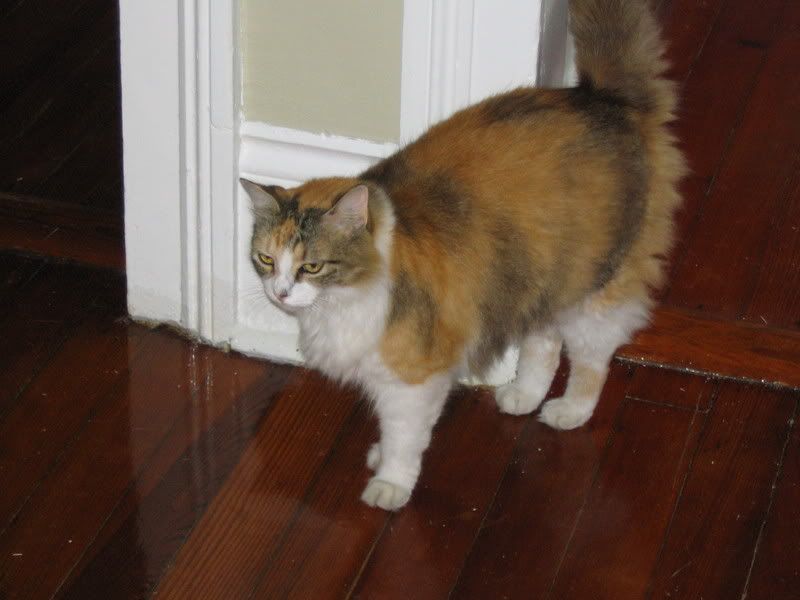
Callie, with her exquisite long and puffy coat of calico-spotted fur, looks especially content when she rolls halfway on her back and stretches her paws out over her head. It's tempting to want to rub her soft white belly when she does this, but anyone who approaches is quickly rebuffed with a warning glare of her golden eyes.
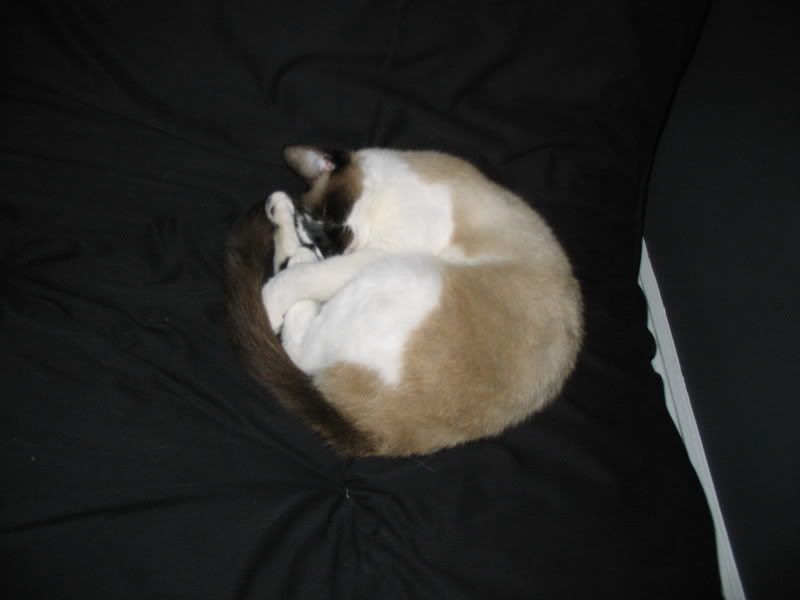
Smudge, always the more passive of the two, prefers to curl her thin body up in a tight spiral when she's taking a power nap. She's a short-hair Siamese, and her favorite sleeping pose is to coil her brown tail around her mostly white body and put a paw over her closely-set blue eyes.
Seeing them this way on the bed or enjoying the cool hardwood floors, I know they're comfortable. I know that they've accepted (yet again) the place their keepers have carried them to. I know they feel at home and they're happy to be here.
And I can tell you that it makes me feel cat-egorically happy, too.
(Oops! Just couldn't stop myself.)
(Okay, okay, a very bad pun. Last one, I promise.)
Callie and Smudge are our two remaining cats. Prior to the storm we had four cats and took every one of them with us when we fled town in the middle of the night almost three years ago. Packed into cat carriers, stacked on the back seat next to our Precious Daughter, I think it's safe to say they were pretty traumatized in those first days.
They did not watch the round-the-clock news coverage of the storm, the wall failures, the flooding, the failed relief effort, the bodies abandoned around the city, the desperate cries of help from the Superdome and convention center. They could not comprehend the enormous force of nature bearing down upon the city nor the necessity of driving away in the middle of the night. It must have scared the heck out of them.
If even a slender parallel can be drawn between the experience of our cats with the suffering of our neighbors here, it would be in the uncertainty. After the flood, thousands of displaced citizens were herded onto busses with no indication of where they were going or what awaited them once they got there: I imagine this is what our cats experienced, too.
We evacuated with four cats, but we gave two away. In those first few days when we realized we could not go home--we had no home to go to--we were very fortunate to have several options as we were invited to stay with close relatives. But we knew having so many pets would be a burden on our hosts. We knew that the coming months of moving from place to place would be difficult on our older cats. A difficult decision, but we put two of our cats up for adoption in Dallas. They're still there.
Our journey with the two remaining cats took us from Texas to Virginia and back to New Orleans where we've lived in two temporary homes until we finally settled in our new house just in the last few weeks.
I've blogged about my furry friends before, as at each stop in our journey they've had to learn, adjust and adapt to their new surroundings. They seem to have handled it well. How can I tell? They eat and sleep and seem to be in every way the same cats we've had for these several years.
Here at the new house, it's not just a new place. It's filled with all new furniture and beds and bedding. I had thought it would take them a while to adjust since almost everything here is new and strange. Well, there's US, but you know what I mean.
And as expected, they did slink cautiously around for the first day and hid under the bed for most of the next two days. But it wasn't long before they were lounging on our new king-sized bed as if they had been born into such privilege.
Callie, with her exquisite long and puffy coat of calico-spotted fur, looks especially content when she rolls halfway on her back and stretches her paws out over her head. It's tempting to want to rub her soft white belly when she does this, but anyone who approaches is quickly rebuffed with a warning glare of her golden eyes.
Smudge, always the more passive of the two, prefers to curl her thin body up in a tight spiral when she's taking a power nap. She's a short-hair Siamese, and her favorite sleeping pose is to coil her brown tail around her mostly white body and put a paw over her closely-set blue eyes.
Seeing them this way on the bed or enjoying the cool hardwood floors, I know they're comfortable. I know that they've accepted (yet again) the place their keepers have carried them to. I know they feel at home and they're happy to be here.
And I can tell you that it makes me feel cat-egorically happy, too.
(Oops! Just couldn't stop myself.)
Wednesday, June 04, 2008
Storm driven
Massachusetts gets it:
New rules requiring sturdier construction of coastal homes may help protect against wind damage - but at a cost
Texas does not:
Texas building codes lag behind Gulf neighbors
Discuss amongst yourselves.
New rules requiring sturdier construction of coastal homes may help protect against wind damage - but at a cost
Texas does not:
Texas building codes lag behind Gulf neighbors
Discuss amongst yourselves.
Tuesday, June 03, 2008
Eternal vigilance
We were all talking about the high water on the Mississippi River a few weeks ago. Since then, the river stage at New Orleans rose to 17.0, Bonnet Carre Spillway was opened, millions of gallons of water were shunted into Lake Pontchartrain, the river stage finally began to fall, and Bonnet Carre Spillway was closed.
In sum, an exciting and rare event.
But that's not why we paid so much attention. A few weeks ago, nobody was expressing awe at the rarity of the event.
We were worried.
We worried that the Mississippi River levees might not hold, or that the spillway diversion might not be enough, or that if the river ever got loose... Well, let's just say Hurricane Katrina and every other catastrophe in the nearly 300-year history of this city would have been knocked one notch down the list of worst disasters.
But I think all this worrying is good. When we worry, we pay attention. When we worry, we acknowledge the importance of maintaining a strong system of protections, and we encourage thinking about consequences and contingencies.
There's the old expression, "When we fail to plan, we plan to fail."
But even more relevant is this expression from the time of the American Revolution: "Eternal vigilance is the price of liberty."
"Vigilance" as in keeping watch over the state and federal agencies who design, build and maintain the levees, walls and gates. "Vigilance" as in keeping apace with changing technology and scientific understanding of the threats. "Vigilance" as in maintaining the urgency and critical life-safety purpose of the protections.
"Eternal" as in always and forever. When the last load of clay is dumped and spread and compacted on that final levee, the job will still not be done. Maintenance must be ongoing and uninterrupted. Designs must be checked periodically to assure effectiveness under changing coastal conditions. The work must go on.
We all have our parts in this effort. Government will establish standards and enforce rules, and citizens must support and in fact encourage the prosecution of work.
And we who live behind these walls and levees know that if we stop paying attention, all kinds of bad things will happen.
Not "can happen" but "will happen."
If we are not vigilant, money for the required work will get diverted elsewhere. If we are not vigilant, the goal of effective, resilient flood protection will become the goal of bringing in a marginal project on schedule and under budget. If we are not vigilant, the carefully calculated decisions of safety-oriented engineers will be replaced with the whims of policy wonks and accountants, political appointees and the NIMBY neighborhood associations.
Am I preaching to the choir here?
Let's hope so. Let's hope that just shy of three years since that horrible event we're still laser focused on what really counts to this water-tested community. Let's hope we can keep that focus for 30 years or 60 years or 90 years and more, because that's what it will take.
We're eternally vulnerable, so we've got to be eternally vigilant.
In sum, an exciting and rare event.
But that's not why we paid so much attention. A few weeks ago, nobody was expressing awe at the rarity of the event.
We were worried.
We worried that the Mississippi River levees might not hold, or that the spillway diversion might not be enough, or that if the river ever got loose... Well, let's just say Hurricane Katrina and every other catastrophe in the nearly 300-year history of this city would have been knocked one notch down the list of worst disasters.
But I think all this worrying is good. When we worry, we pay attention. When we worry, we acknowledge the importance of maintaining a strong system of protections, and we encourage thinking about consequences and contingencies.
There's the old expression, "When we fail to plan, we plan to fail."
But even more relevant is this expression from the time of the American Revolution: "Eternal vigilance is the price of liberty."
"Vigilance" as in keeping watch over the state and federal agencies who design, build and maintain the levees, walls and gates. "Vigilance" as in keeping apace with changing technology and scientific understanding of the threats. "Vigilance" as in maintaining the urgency and critical life-safety purpose of the protections.
"Eternal" as in always and forever. When the last load of clay is dumped and spread and compacted on that final levee, the job will still not be done. Maintenance must be ongoing and uninterrupted. Designs must be checked periodically to assure effectiveness under changing coastal conditions. The work must go on.
We all have our parts in this effort. Government will establish standards and enforce rules, and citizens must support and in fact encourage the prosecution of work.
And we who live behind these walls and levees know that if we stop paying attention, all kinds of bad things will happen.
Not "can happen" but "will happen."
If we are not vigilant, money for the required work will get diverted elsewhere. If we are not vigilant, the goal of effective, resilient flood protection will become the goal of bringing in a marginal project on schedule and under budget. If we are not vigilant, the carefully calculated decisions of safety-oriented engineers will be replaced with the whims of policy wonks and accountants, political appointees and the NIMBY neighborhood associations.
Am I preaching to the choir here?
Let's hope so. Let's hope that just shy of three years since that horrible event we're still laser focused on what really counts to this water-tested community. Let's hope we can keep that focus for 30 years or 60 years or 90 years and more, because that's what it will take.
We're eternally vulnerable, so we've got to be eternally vigilant.
Subscribe to:
Posts (Atom)