One good thing I've discovered about FEMA: it's a great icebreaker.
Mention FEMA in any social situation and the resulting conversation can go on for hours!
People in New Orleans have always been friendly and talkative. Standing in line at the po-boy shop, riding the streetcar or bus, watching your children at the playground, people here are almost always ready and willing to talk.
But if you really want to get into a hot and heavy gab fest, all you need to say is something like, "How about that FEMA!"
EVERYBODY has a story to tell: with passion, with fire and with great enthusiasm.
And unfortunately for FEMA, everybody's story is about ineptness, incongruity, and insanity.
My own FEMA story includes those themes, too.
A little over a month ago, I blogged about the fun I was having filling out paperwork and groping through the dark forest of FEMA.
Luckily for us, my Darling Wife joined me in the fight. I warned her that no man could slay the dreaded FEMA beast. And she replied in Eowyn-fashion, "I am no man!"
She took the battle straight to the source. I gave her all the files and paperwork I have been accumulating, explained to her the secrets I had learned along the way, and wished her much luck.
FEMA representatives have been keeping hours at the Jewish Community Center on St. Charles Avenue here, and my Darling Wife had heard that speaking to FEMA in person was much more effective than speaking to them on the phone.
Once again, she was right.
The FEMA rep looked up our application on the computer, furrowed his brow and said, "Everything seems to be in order. I have no idea why we haven't sent you any rental assistance yet."
Just to be certain, the FEMA rep called over a colleague, and my Darling Wife told me it was almost comical to watch their puzzled looks from where she sat on the other side of the computer screen.
"We'll tag your file for review," they finally said. "It looks complete, but nobody has taken it to the next step."
One day later, my cell phone buzzed.
"This is an automated message from the Federal Emergency Management Agency," a friendly female voice said. "You will be receiving an electronic fund transfer in the next few days."
Wow! She did it! My Darling Wife had slain the beast! She made the glacier move!
Almost. How much money? The recording did not say. For how many months? The recording did not say.
What the recording did tell me is that FEMA is also sending me important forms that I must quickly fill out and return or risk loosing the benefits I had only seconds before been granted.
More paperwork. How about that FEMA!
Thursday, February 23, 2006


Tuesday, February 21, 2006
News to me
I’m trying to be optimistic, but it’s not easy. Every time I start to see the silver lining, the clouds roll back over for one more pass…
Good News: It’s Mardi Gras in New Orleans. Parades, King Cake, decorations and tourists.
Bad News: Many in America are saying, “Tsk, tsk,” and will use this vital and emotionally regenerating event to write us off as either stupid and frivolous, or recovered and happy.
Good News: The President actually put his money (scratch that—our money) where his mouth is and came out in favor of several billion dollars in Community Development Block Grants. Even after all the deducts and discounts, I think, if I read the rules correctly, we are eligible for some money.
Bad News: The application process for the CDBG will be handled by FEMA. Well, perhaps the money will arrive in time to help pay my daughter’s college tuition.
Good News: The City of New Orleans is now taking applications for demolition of houses to be done under a contract with the Corps of Engineers. This could save us some money and trouble if the city will do it for us.
Bad News: No one at city hall has even the slightest idea of when the dozer will visit my house. Actually, they haven’t demolished any houses yet. They’re just collecting data to be used in negotiating a contract. I guess we’re going to have to do it ourselves after all.
Good News: Three of my neighbors now have FEMA travel trailers set up in front of their damaged homes. This is a sure sign that people are coming back.
Bad News: There still is no electricity on my street, so no one is actually living in the trailers yet.
Good News: The Legislature actually passed a bill that requires people who serve on levee boards to be professional engineers and scientists. And these board members will be nominated by a non-partisan committee of national professional societies and political watchdog groups. This is a first in Louisiana history.
Bad News: Congress asked for a single levee board but the Legislature split the new levee board into two boards. Then to fix their counting failure, the Legislature made the two professional, non-political boards subservient to a thing called the Coastal Protection and Restoration Authority. CPRA is a completely political panel appointed by the levee board presidents who are appointed by the governor. They’re already preparing for the next flood—of federal money.
Good News: The Corps of Engineers is rebuilding levees and floodwalls at a record pace. And why not? For the first time in decades the Corps is fully funded and has the green light to do what needs to be done to accomplish the mission.
Bad News: The Corps is merely repairing the damaged hurricane protection system to its originally authorized level of protection. When the levees in St. Bernard Parish are restored, a storm surge similar to Katrina’s will roll right over those levees and flood the parish just like before. How many people need to die before Congress and the President pledge to build superior hurricane protection?
Good News: It’s late, I’m tired, and my Darling Wife and daughter are already asleep and waiting for me in our warm bed.
Bad News: Nothing wrong with that!
Good night.
Monday, February 20, 2006
By the numbers
Homes destroyed by Katrina and Rita: about 200,000
Federal money already dedicated to Community Development Block Grants (CDBG): $6.2 billion
Additional pledge in CDBG money last week: $4.2 billion
Total CDBG funding, pending Congressional approval: $10.8 billion
Some simple math: $10.8 billion divided by 200,000 homes
Answer: $54,000 per household
Governor Blanco's proposed cap per homeowner: $150,000
Reduction in assistance to those who lived inside a floodplain but did not buy insurance: 30%
Reduction in assistance to those who choose to leave Louisiana: 40%
Occupancy requirement after repair, restoration or relocation of home: 5 years
Friday, February 17, 2006
Nine years
Until you see if for yourself, you just can't understand. The sight, the sound, the smell--none of it can be captured in photographs. The feeling you get being surrounded by it all cannot be broadcast on television. It can't be put into words, either. No way. The scale of it is just too immense, and the emotions are too deep.
I'm talking, of course, about Mardi Gras.
You just can't explain Mardi Gras to someone from out-of-town, or anyone who hasn't done it in person.
A few weeks ago, media editorialists and sarcastic bloggers were in exaggerated shock that New Orleans would actually plan to go ahead with Mardi Gras this year. Isn't this a waste of precious resources? Isn't this a senseless distraction? How can you have a party when the city and its citizens are in total disarray? they apoplectically cried in unison.
The answer I came up with is simple: we can't let New Orleans die. We won't let New Orleans die. And Mardi Gras is a big part of this city. It's part of the economy, the society, the IDENTITY.
We've already lost so much, we need Mardi Gras now more than ever.
I'm blogging about this now because whether you know it or not, Mardi Gras has already started.
On Twelfth Night, the Phunny Phorty Phellows took their traditional street car ride to launch the season. They wore costumes, drank champagne, ate King Cake, and danced to the music of a New Orleans brass band. Afterward, they held a coronation party at world famous Rock'n'Bowl.
And last month, my Darling Wife and I attended the annual ball masque of the Krewe of Caesar.
No, I'm not a member, but my father is. This year, one of the princesses in the court of Caesar Empress XXVII was none other than my Darling Daughter.
Flashback to 1996: Awaiting the arrival of our first child, my Darling Wife and I did not want to know if we would have a boy or a girl. Although some family members were very put off by this, we wanted to be surprised like in the "old" days. We all found out it was a girl on the day she was born.
That same day, my mother called the Captain of Caesar to put my newborn daughter's name on the list for princess.
The whole family has been talking about this, planning it for more than nine years.
We've already lost so much, do you think we would let misfortune and bad weather take Mardi Gras away, too?
Not on your life! The show must go on. Life must go on. Mardi Gras must go on.
Have a piece of king cake and toast the joie de vivre that makes this town special. And have a safe and happy Mardi Gras!
Thursday, February 16, 2006
La la, how the life goes on
Ob-la-di, ob-la-da. Truer words were never spoken.
I've been traveling a lot lately, getting out of New Orleans and seeing how other people live post-K.
A few weeks ago, I went to Tampa for the weekend. I ate curry chicken at a Jamaican restaurant and drank Red Stripe. The place was almost empty. The pizza place next door was packed with college kids. They ran out of beer, so the collegians came over to The Jerk Hut (that's really what it was called) to keep the party going. They liked the beer selection, but they didn't care for the music.
Let me tell you what they have in Tampa: civic pride. They had a street party that weekend, and nobody littered. I saw more than one beer-drinking party-goer go out of his/her way to drop a cup, a can, a plate, into a trash bin. It was almost unbelievable.
On the way from the airport, the cab driver apologized for the condition of the streets. "This street is long overdue for resurfacing," he said. I sat still and waited for the bumps and the jarring jolts that I thought would validate his statement. I felt nothing more than the light clump of the expansion joints as we sped down the highway. Sorry for the condition of these streets? I wanted to tell him I'd buy every street he had in this condition and ship them back to my town.
When I flew back to New Orleans, the city was a wide sea of blue roofs. And I would swear that I could see the trash and potholes in the street from 5,000 feet.
Life goes on, bra.
Earlier this week, I was in Shreveport. The people up there are sympathetic to New Orleanians. They offered me help. "Call your state representative," I said. "Tell them to back the single levee board." They looked sad and said, "Do you really think that will help?"
On the local talk radio station, the subject was rebuilding New Orleans. Callers used words like cesspool, corruption, fiefdom, and they likened the single levee board proposal to rearranging chairs on the deck of the Titanic. They talked a great deal about what would not work, but I didn't hear anything about what would work.
When I got back, I talked to my Darling Wife again about how we would rebuild our house. Ten feet off the ground. Steel-reinforced concrete walls and enough hurricane straps to tie down a jumbo jet. And most importantly, a fireplace. Never had one of those before. Now's our chance. Now is the time to dream and build the home we always wanted.
With a couple of kids running in the yard.
Wednesday, February 08, 2006
Back to business
It appears my blog hit a speed bump on the information super highway. I haven’t been able to post for a few days, and my post about fog on the Mississippi River disappeared. My apologies to my good friends and family who continue to check in on me even though I haven’t posted anything new lately. Let’s hope things are better now.
------------------------------------
We invited our neighbor over for dinner tonight.
Well, actually, he didn’t come over for dinner. He came UP for dinner.
He lives in the first floor apartment, and we live above him.
After I came back to New Orleans, most of my beautiful city was flooded, including my own house, so there was not much to choose from when I started looking for a place to live. I stumbled across this place in the “sliver by the river” that was not only on unflooded, holy high ground, but it was also on the second floor.
It was love at first sight. A pragmatic, utilitarian kind of love, but love nonetheless.
When my Darling Wife, Darling Daughter and I moved in here, we found not only a nice place to live, but nice neighbors, too. The fellow who lives in the first floor apartment is one of those amiable people.
He was living here long before anyone had ever heard of Katrina or spoken that name with such bitterness. He evacuated for a few weeks and came back to a street that looked pretty much the same in a city that was totally changed.
He’s single, and I’m not sure whether my Darling Wife invited him up because she wanted to be neighborly, or if she just felt sympathy for him because he lives alone, or if she wanted to size him up as a potential husband for any of several single women she knows and is always “shopping” for.
No, actually I am sure. It was definitely the last one.
So my Darling Wife served up grits and grilliades this evening, a tonic for the chilly weather that fell upon New Orleans the past two days. Our neighbor takes a healthy portion and says he can’t even recall when he last enjoyed a home-cooked meal. We talk about my daughter’s day at school, the recent roofing work, and finally about him.
Our neighbor works in the music business here. He actually has a degree in music, it turns out, so he’s not just another hack with a loud electric guitar and a bad haircut snarling teenage angst. For the last few years he’s been operating his own recording studio.
I asked him how the music business is going post-K.
Not good, he says. As a matter of fact, it’s not going at all.
He explained that prior to the hurricanes, he was recording and mixing every day of the week. His studio was producing several cds a month. No big names, no blockbuster sellers, but a steady stream of decent work and a fair living.
Since he came back to town, however, his studio is largely unused. He recently finished a new cd for Christian Serpas, he says, but that’s it. The calendar is open from here to next hurricane season.
What will he do now?
He’s going on the road. There are several music showcase/conventions coming up, including one in Austin and one out in L.A. He’ll pack a bag of promo items and see if anyone wants to come record in the city that everyone says is so alive with music, but is literally struggling to keep its head above water now.
We talk a while and he excuses himself well before my daughter’s bedtime. A polite fellow, he’s a man who prefers to be behind the sound board to being in the spotlight. He exits stage left.
My Darling Wife gets right to the point once he leaves: he seems nice, but he doesn’t have a steady source of revenue. She will keep him in mind but won’t recommend him to anyone just yet.
I knew it!
Wednesday, February 01, 2006
Another point of view
For an outstanding critique of the President's State of the Union address from the perspective of us in New Orleans and along the hurricane-ravaged Gulf Coast, you've got to read da po' blog.
It's an excellent blog, so check out some of da po'boy's other posts while you're there.
State of Warmongering Address
Just a short walk from the mighty Mississippi River, I watched the leader of the strongest nation on Earth deliver another State of the Union address last night.
I watched with my Darling Daughter curled up next to me on the sofa. Somehow I had conned her into thinking this was "must see TV." I had accomplished this in part by explaining the Constitutional and traditional significance of the speech.
But she was really more intrigued by my telling her about how the Supreme Court Justices don't clap and how the two major parties would be on opposite sides of the room, clapping only when their party liked what the president was saying.
She wanted see, I think, if democracy would really permit such open dissention and criticism of even the President of the United States.
My Darling Wife was nearby working on the computer, not really watching or listening, but still part of the scene. She would occasionally grumble a comment or a rebuttal to what the president was saying. The president's approval rating with her is negative 254, if you know what I mean.
My girl naturally was more interested in the crowd than in the speaker. She commented on how much they did or did not clap, how they were dressed, and who was smiling and who was frowning.
The speech did not hold her attention. After about thirty minutes of it, she drifted off to her room to read. I'm sure much of it was unintelligible to her, and I confess having the same reaction.
Leadership is all about vision and inspiration. It's all about having these things, and then being able to communicate and share them with others.
The vision articulated by President Bush last night was mostly about waging war. The inspiration he tried to impart was mostly about our military in combat.
There's an old saying that if the only tool you have is a hammer, every problem you encounter will look like a nail. The president looked and sounded like Thor last night, pumping his hammer menacingly over head.
Unfortunately, the problems we are dealing with in New Orleans and other hurricane-devastated areas are nothing like nails. And I know now that he has lost interest in our plight and drifted off to other pursuits, much as my 9-year-old did.
Still, I held on, waiting for the president to talk about the Gulf Coast. I was eager to hear if he would make any new proposals, or at least promise to keep his past promises. But there was nothing. Just a quick, "We feel sorry and we've already sent money so let's move on."
The leader of the strongest nation on the Earth talked for almost an hour about the State of the Union, but spoke barely of the hundreds-of-thousands of citizens displaced and homeless, and of course did not mention that more than 1,300 Americans were killed by Hurricane Katrina. He instead scolded New Orleans for having a poor education system prior to the storm.
Just a short walk from the mighty Mississippi River, in my apartment in the "sliver by the river," I realized that despite what he had emphatically said barely four months ago, the President was indeed going to leave what remains of New Orleans to the "whims of nature."
Monday, January 30, 2006
Quite a distance
Okay, someone has to say it. Someone has to loudly point out that the king has no clothes. Or, perhaps the better metaphor in this case is that someone has to be the turd in the punchbowl.
I guess that’s me.
I’m talking about all this talk about coastal restoration. I’m talking about how a bunch of politicians and environmentalists are linking coastal restoration to hurricane protection.
I’m telling you, it just ain’t true.
The story they’re spinning sure sounds nice. That we in South Louisiana are feeling the pain of nature’s wrath because we have not been good stewards of the land. That South Louisiana didn’t suffer as much a hundred years ago when hurricanes came to visit because there were miles of marsh and wetlands to protect them from high water. That all of this is our own doing, and we better hurry up and fix it before the next hurricane turns toward New Orleans.
It sounds plausible, but like those get-rich-quick-in-real-estate schemes hawked in endless infomercials, the claims just don’t hold up under scrutiny.
Now don’t misunderstand me, I’m not saying that we should not be concerned about coastal erosion. I’m not saying that loss of wetlands is not a problem. I’m not saying we don’t have to be better caretakers of the environment all around us, an environment that supports and sustains us, an environment to which we are inextricably connected.
I am saying that building wetlands and performing coastal restoration has very little to do with hurricane protection.
There’s no dispute that hurricanes “lose steam” when they cross over land. Quite literally, it is the warm water of the Gulf of Mexico that feeds tropical cyclones and can turn a tropical depression into a “Category 5” hurricane in a matter of hours.
Once over land, hurricanes no longer have warm water to power them, and additionally have to contend with dramatically increased friction at the surface. Think of the difference between spinning wind over open water as opposed to a landscape dotted with trees and buildings.
And it should be obvious that rising land will lessen the effects of a hurricane’s storm surge, that slug of highly elevated water that gets pushed ahead of a hurricane. Many cities don’t have to worry about the storm surge because they are elevated higher than any storm surge could reach.
Wetlands, by definition are low-lying areas that spend an appreciable amount of time each year under water and wet. Along the coast of Louisiana, these areas are typically about 1.5 feet above sea level.
The popular notion is that having a lot of wetlands between cities like New Orleans and hurricanes will protect us from the worst of the storm surge. There is some agreement that for small storms, tropical depressions and Category 1 hurricanes, coastal wetlands are an effective barrier.
And why not? Water being pushed inland at a height of 5 feet over land with an elevation of 1.5 feet will feel that land dragging on it. Waves trying to form and break will have little depth to work with and will subsequently not form very high at all. So wetlands are helpful when small storms come calling.
But what about the big ones? What happens when a Category 5 Hurricane, or a monster surge of 24 feet like the one produced by Katrina comes crashing at those wetlands? Well it turns out that wetlands can’t do much. They get covered, buried under that huge storm surge, so that the benefit of friction has only temporary and nominal effect. And the waves get the full height of water in which to form, too, so the waves come crashing as they do in the open sea.
The net result is that wetlands hardly contribute anything to protecting us from major storms.
But don’t take my word for it. The Corps of Engineers has been working on the wetlands problem for many years. They and the Louisiana Department of Natural Resources have teamed up on a number of projects. Many years of study have resulted in reports like the Coast 2050 and the Louisiana Coastal Area Ecosystem Restoration Project.
While these reports have done a yeoman’s job of documenting the ecological and economic importance of wetland protection and restoration, the connection to storm surge protection is tenuous at best. Here is what the Coast 2050 report has to say about it:
Source: Coast 2050 Executive Summary
Now notice the data was collected during Hurricane Andrew, a Category 5 storm when it made landfall, a bona fide "big one."
The data is scarce, but to perfectly Pollyannaish about it, let’s say it's totally true we can get 3.1 inches of storm surge reduction per linear mile of marsh between where we live and where the hurricane comes ashore.
And let’s also say we want to knock down a storm surge from a monster of 20 feet in height to a tame 10 feet in height. That’s 10 feet of reduction at 3.1 inches per mile. The simple math tells us that we would need 39 miles of wetlands out there to make this happen.
That’s quite a distance.
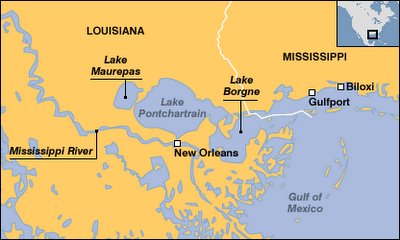
To protect New Orleans East and St. Bernard from the next “big one,” we would not only have to fill the much-despised MRGO--we would have to fill Lake Borgne! And that's IF it really works, which we don't even know if it will.
I’m sorry to have to be the bearer of bad news. I know it really sounds nice that we can be environmentally-minded and save our cities at the same time, but it’s just not true.
Coastal restoration is an admirable, worthy goal. It just has little to do with hurricane protection.
Do you understand now why I keep writing about how much we need those levees? They're our only hope.
I guess that’s me.
I’m talking about all this talk about coastal restoration. I’m talking about how a bunch of politicians and environmentalists are linking coastal restoration to hurricane protection.
I’m telling you, it just ain’t true.
The story they’re spinning sure sounds nice. That we in South Louisiana are feeling the pain of nature’s wrath because we have not been good stewards of the land. That South Louisiana didn’t suffer as much a hundred years ago when hurricanes came to visit because there were miles of marsh and wetlands to protect them from high water. That all of this is our own doing, and we better hurry up and fix it before the next hurricane turns toward New Orleans.
It sounds plausible, but like those get-rich-quick-in-real-estate schemes hawked in endless infomercials, the claims just don’t hold up under scrutiny.
Now don’t misunderstand me, I’m not saying that we should not be concerned about coastal erosion. I’m not saying that loss of wetlands is not a problem. I’m not saying we don’t have to be better caretakers of the environment all around us, an environment that supports and sustains us, an environment to which we are inextricably connected.
I am saying that building wetlands and performing coastal restoration has very little to do with hurricane protection.
There’s no dispute that hurricanes “lose steam” when they cross over land. Quite literally, it is the warm water of the Gulf of Mexico that feeds tropical cyclones and can turn a tropical depression into a “Category 5” hurricane in a matter of hours.
Once over land, hurricanes no longer have warm water to power them, and additionally have to contend with dramatically increased friction at the surface. Think of the difference between spinning wind over open water as opposed to a landscape dotted with trees and buildings.
And it should be obvious that rising land will lessen the effects of a hurricane’s storm surge, that slug of highly elevated water that gets pushed ahead of a hurricane. Many cities don’t have to worry about the storm surge because they are elevated higher than any storm surge could reach.
Wetlands, by definition are low-lying areas that spend an appreciable amount of time each year under water and wet. Along the coast of Louisiana, these areas are typically about 1.5 feet above sea level.
The popular notion is that having a lot of wetlands between cities like New Orleans and hurricanes will protect us from the worst of the storm surge. There is some agreement that for small storms, tropical depressions and Category 1 hurricanes, coastal wetlands are an effective barrier.
And why not? Water being pushed inland at a height of 5 feet over land with an elevation of 1.5 feet will feel that land dragging on it. Waves trying to form and break will have little depth to work with and will subsequently not form very high at all. So wetlands are helpful when small storms come calling.
But what about the big ones? What happens when a Category 5 Hurricane, or a monster surge of 24 feet like the one produced by Katrina comes crashing at those wetlands? Well it turns out that wetlands can’t do much. They get covered, buried under that huge storm surge, so that the benefit of friction has only temporary and nominal effect. And the waves get the full height of water in which to form, too, so the waves come crashing as they do in the open sea.
The net result is that wetlands hardly contribute anything to protecting us from major storms.
But don’t take my word for it. The Corps of Engineers has been working on the wetlands problem for many years. They and the Louisiana Department of Natural Resources have teamed up on a number of projects. Many years of study have resulted in reports like the Coast 2050 and the Louisiana Coastal Area Ecosystem Restoration Project.
While these reports have done a yeoman’s job of documenting the ecological and economic importance of wetland protection and restoration, the connection to storm surge protection is tenuous at best. Here is what the Coast 2050 report has to say about it:
It is commonly acknowledged that barrier islands and coastal wetlands reduce the magnitude of hurricane storm surges and related flooding; however, there are scant data as to the degree of reduction...
Hurricane Andrew gave direct evidence that the physiography of marshes where a storm makes landfall affects the degree to which the storm surge is dampened. The surge amplitude in the Terrebonne marsh system decreased from 9.3 ft above sea level in Cocodrie to 3.3 ft (Swenson 1994) in the Houma Navigation Canal approximately 23 miles due north. This equates to a reduction in surge amplitude of approximately 3.1 inches per linear mile of marsh and open water between Houma and Cocodrie. Similarly, the magnitude of the storm’s surge was reduced from 4.9 ft at Oyster Bayou to 0.5 ft at Kent Bayou located 19 miles due north. This equates to a reduction in surge amplitude of approximately 2.8 inches per linear mile of fairly solid marsh between these sites.
Source: Coast 2050 Executive Summary
Now notice the data was collected during Hurricane Andrew, a Category 5 storm when it made landfall, a bona fide "big one."
The data is scarce, but to perfectly Pollyannaish about it, let’s say it's totally true we can get 3.1 inches of storm surge reduction per linear mile of marsh between where we live and where the hurricane comes ashore.
And let’s also say we want to knock down a storm surge from a monster of 20 feet in height to a tame 10 feet in height. That’s 10 feet of reduction at 3.1 inches per mile. The simple math tells us that we would need 39 miles of wetlands out there to make this happen.
That’s quite a distance.
To protect New Orleans East and St. Bernard from the next “big one,” we would not only have to fill the much-despised MRGO--we would have to fill Lake Borgne! And that's IF it really works, which we don't even know if it will.
I’m sorry to have to be the bearer of bad news. I know it really sounds nice that we can be environmentally-minded and save our cities at the same time, but it’s just not true.
Coastal restoration is an admirable, worthy goal. It just has little to do with hurricane protection.
Do you understand now why I keep writing about how much we need those levees? They're our only hope.
Sunday, January 29, 2006
The Secret Ingredient
We've been hearing a lot about "The Dutch Solution," which I've blogged about before.
A friend recently sent me a link to a speech given here in New Orleans by the Ambassador of the Netherlands to the United States. Late last year, the Ambassador briefly explained the history of his country's struggle with the sea and the immense engineering task they undertook to win that struggle. There's a lot of good information in there.
But what's not in the speech is the engineering. No innovative design techniques, no revolutionary construction methods, no space-age materials or high-tech systems.
That's because the engineering is not the hard part. The means and methods to design, build, operate and maintain a comprehensive, reliable flood protection system are well-known and established.
What the Dutch did that sets their system apart from what we have in the United States has nothing to do with engineering--it's the political process.
Here are some excerpts from the Ambassador's speech that are instructive:
Has anyone in Washington, other than the Louisiana delegation, said, "Never again"?
For years we've been using 1 in 100 years for design. Even FEMA uses the 100 year flood event to set Base Flood Elevations. Can we take a clue from the Dutch on this one?
Water is the enemy and must be controlled, but water is also vital for our environment. We must be prepared to make bold changes to achieve a balance of safety for people and all other living things in south Louisiana.
The Netherlands is about 14,400 square miles in size, less than a third the size of Louisiana. For the last few years the entire civil works program of the Corps of Engineers has been funded at about $4.5 billion spread out over 50 states. The Dutch take flood protection seriously; we clearly do not.
The bottom line: you can't con, bribe, cajole, strong-arm, trick or force people to live and businesses to locate here. Quit fooling around and build significant hurricane protection.
Source: H.E. Boudewijn van Eenennaam, Ambassador of the Netherlands to the United States, Remarks made at the Wyndham New Orleans Hotel, November 27, 2005.
A friend recently sent me a link to a speech given here in New Orleans by the Ambassador of the Netherlands to the United States. Late last year, the Ambassador briefly explained the history of his country's struggle with the sea and the immense engineering task they undertook to win that struggle. There's a lot of good information in there.
But what's not in the speech is the engineering. No innovative design techniques, no revolutionary construction methods, no space-age materials or high-tech systems.
That's because the engineering is not the hard part. The means and methods to design, build, operate and maintain a comprehensive, reliable flood protection system are well-known and established.
What the Dutch did that sets their system apart from what we have in the United States has nothing to do with engineering--it's the political process.
Here are some excerpts from the Ambassador's speech that are instructive:
The 1953 flooding of the Netherlands was, excuse my cynicism, the Perfect Storm. It was a watershed event for my country, perhaps as Katrina will be for the U.S. 'Never again' became our motto. We had a national debate about what we should do, and how to do it. We made a political decision to assign specific water management authorities to specific levels of government. We established administrative processes to monitor the implementation of those authorities. This clear assignment of who does what, when and how is a unique strength of our water policy.
Has anyone in Washington, other than the Louisiana delegation, said, "Never again"?
The end result was ... the most-densely populated and economically-important parts of the country can withstand a storm with a probability of occurrence of 1 in 10,000 years. Other areas are protected at a 1 in 4000 years occurrence or a 1 in 1250 years occurrence. Our lowest level of protection far exceeds Category 5 Hurricane level protection.
For years we've been using 1 in 100 years for design. Even FEMA uses the 100 year flood event to set Base Flood Elevations. Can we take a clue from the Dutch on this one?
To get this protection, we had to shorten our coastline by about 400 miles, or almost 2/3rds. This meant closing off estuaries and changing the water flow in some places. We strengthened our dike engineering standards, and our maintenance routines. We streamlined the authority of our local water boards. In sum, we made physical, technical and administrative changes.
Water is the enemy and must be controlled, but water is also vital for our environment. We must be prepared to make bold changes to achieve a balance of safety for people and all other living things in south Louisiana.
On an annual basis, water protection costs the Dutch Government $500 million per year.
The Netherlands is about 14,400 square miles in size, less than a third the size of Louisiana. For the last few years the entire civil works program of the Corps of Engineers has been funded at about $4.5 billion spread out over 50 states. The Dutch take flood protection seriously; we clearly do not.
Your officials are discussing how to rebuild the Gulf Coast, what level of protection to provide. We have learned that underinvestment in infrastructure may be penny-wise, but also pound foolish. If people or businesses don't feel secure, they won't return. They won't build anew. They won't take entrepreneurial risks. That would be devastating to everyone here tonight and those you represent. It would also prevent the US from maximizing the return on investment already found in this amazing area.
The bottom line: you can't con, bribe, cajole, strong-arm, trick or force people to live and businesses to locate here. Quit fooling around and build significant hurricane protection.
Source: H.E. Boudewijn van Eenennaam, Ambassador of the Netherlands to the United States, Remarks made at the Wyndham New Orleans Hotel, November 27, 2005.
Tuesday, January 24, 2006
The most important thing
In the aftermath of disaster, you find yourself needing a lot of stuff.
Things that you used to have that were ruined in the flood. Services that you used to take for granted before they were lost. Papers that you realize in hindsight you should have taken with you. Photographs and mementos that cannot be replaced and are missed more each day.
But here is what I have learned, and it's totally true.
The most important thing you find yourself needing in the aftermath of disaster is a sewer cleanout.
Seriously.
Once your house is flooded, your furniture ruined, almost all your worldly possessions are covered in mold and mildew--what you find yourself wanting more than anything in the world is for FEMA to let you have one of those drab travel trailers.
Ugly, boxy, sterile and white. Many people would give their eyeteeth for one--they're that eager to get one set up on the front lawn of their flooded homes.
I know a lady who went to the FEMA field office at midnight to get in line to sign up for one of those four-cornered beauties. And she was the sixth person in line! She waited there all night as one would camp out to get front-row seats to a Rolling Stones show, except she was trying to get a rolling box.
When FEMA finally called her many days later with good news, they told her what she needed to have her "dream home" installed at her site: electricity, water and sewer service. When these were ready, FEMA would deliver.
No problem, she thought. Her home was only moderately flood-damaged and all the utilities were present and accounted for.
Except.
It turns out that in order to make the connection from the travel trailer to the sewer line, the FEMA folks like to tie into your existing sewer cleanout. A quick and efficient connection--if you know where it is. And that's where things started to go down the drain.
My friend had no idea where to find the sewer cleanout.
A travel trailer literally just plugs in to an outlet for electricity, and water comes through a garden hose from the house.
But you've got to dig up that sewer cleanout. You've got to know where it is. You've got to be able to find it and uncover it and run a pipe from the dump-side of the trailer to the inlet side of the sewer.
She dug all around her yard with no success. FEMA soon informed her that if she could not locate the sewer cleanout, they would have to give the trailer, her trailer, to someone else.
My friend never even knew there was such a thing as a sewer cleanout, buried and hidden somewhere under her front lawn. But suddenly, it was the most important thing in the world.
Finally, someone suggested she go to the parish utilities office. They keep records of such things. She said they were very helpful, showed her a map and told her where to dig.
Eureka!
My friend now has her cube-ish home, comfortably situated and fully connected in the front of her real home. She, her husband and two children share the queen-sized bed and two bunk beds, a 30" shower and toilet, and a kitchenette-dining-living room combo.
My friend says for the rest of her natural days, no matter where she lives, she will know where the sewer cleanout is.
Monday, January 23, 2006
Driving to the basket
As I drove toward the lakefront, I saw progress. Not victory, not the promise of victory, but progress nonetheless.
It'll have to do for now.
I was on my way to see a basketball game last week at the University of New Orleans. Once upon a time, I lived an easy five minutes from campus. The rushing flood waters of Hurricane Katrina pushed me and the family across town. We now stay in a comfortable apartment in the "sliver by the river."
But it's not home. Occasionally, if I call my Darling Wife from work and say, "I'm heading home," she will ask, "You mean the house, or the apartment?" Home for us is still an ambiguous state of living.
The Privateers were likewise deprived of their home last year. They used to play at Lakefront Arena, the modern multi-purpose facility at the University of New Orleans. It's been the home of Privateers Basketball since the early eighties.
Katrina ripped off large sections of Lakefront Arena's metal siding, exposing the interior to a watery deluge. It will be several more months before the Privateers can go back home.
So for now, for this season, they are playing games at their old gym at the UNO campus. The ground rises considerably near the lake, so only a few buildings at the university were flooded, and those that were are being quickly repaired. That's where I was headed.
I drove up Carrollton Avenue, starting at the Mississippi River--the high ground of the "sliver by the river." The sky was dark, but the street lights and traffic lights were cheerfully bright. Houses along the avenue we mostly lit, too.
Crossing Claiborne Avenue as I continued north, houses, schools and businesses were mostly darkened. Sitting in the middle of the darkness, a Rally's Burgers was open with no one in line, and a single gas station across the street looked fairly busy.
At the corner of Tulane and Carrollton, the friendly neon bowling pin of Rock'n'Bowl cast its bright red light across the empty neighborhood. The street lights were all on, too, which is an improvement from the last time I went by here after nightfall.
Down Carrollton past Canal Street, the ornamental lights that were installed just a few years ago with the installation of the street car tracks were all lit up in a brilliant display. This, too, was a show of progress. But the only thing they illuminated was the uninterrupted rows of lifeless buildings on both sides all the way to City Park. Restaurants, bars, a car dealership, grocery stores, and what used to be some of the prettiest little houses, were all still and silent.
I drove around the traffic circle at Gen. Beauregard's statue, and merged onto Wisner Boulevard for the rest of the trip to Lake Pontchartrain. Again, the street lights glowed in a bright line all the way down, but darkness ruled on either side.
I decided to drive pass by my house, just to see. Why not? It was on the way, and I had plenty of time before the game.
A short detour and I was driving down my street. A single word: darkness. It was like driving through a national forest on a moonless night. No street lights, no porch lights, no lit windows, not even headlights from other cars. I put on my high beams so that I could at least see some of what lay beyond the street curbs.
A boxy white FEMA trailer was propped up on blocks in one neighbor's yard, but it too was dark. With every house and every car and every lawn covered in a brown layer of mud, the brightness of the white interloper was startling. There is no electrical service on my street yet, no sewer service either, so I'm not sure how anyone could live here even in a trailer.
Further down, I stopped in front of my house. Couldn't see it in the darkness, so I turned the wheel and backed around to point my headlights at it.
Silent, dirty, and sad.
And doomed. My Darling Wife and I have already decided not to repair our house. No, it will have to come down so that we can build up. It's not your fault, I said to the house. You were good to us.
I continued on my way to the University of New Orleans campus. The street lights again lit the way once I found Robert E. Lee and Leon C. Simon Boulevards. And the old gym was clean and shiny. A faint smell of fresh paint and varnish from the wood floor was still in the air.
I got a beer and nachos, and watch my alma mater play an exciting game of basketball. It was almost like old times. Almost "normal."
Sadly, the Privateers did not win that night. We clapped and cheered and booed at the refs, but in the end, UNO came up short.
As I drove "home," back to the other side of the city, Coach Towe was on the radio. He congratulated the opponents for an excellent game and talked about the progress of his team in the shadow of the catastrophe that has ravaged our community. Not victory, not the promise of victory, but progress nonetheless.
It'll have to do for now.
It'll have to do for now.
I was on my way to see a basketball game last week at the University of New Orleans. Once upon a time, I lived an easy five minutes from campus. The rushing flood waters of Hurricane Katrina pushed me and the family across town. We now stay in a comfortable apartment in the "sliver by the river."
But it's not home. Occasionally, if I call my Darling Wife from work and say, "I'm heading home," she will ask, "You mean the house, or the apartment?" Home for us is still an ambiguous state of living.
The Privateers were likewise deprived of their home last year. They used to play at Lakefront Arena, the modern multi-purpose facility at the University of New Orleans. It's been the home of Privateers Basketball since the early eighties.
Katrina ripped off large sections of Lakefront Arena's metal siding, exposing the interior to a watery deluge. It will be several more months before the Privateers can go back home.
So for now, for this season, they are playing games at their old gym at the UNO campus. The ground rises considerably near the lake, so only a few buildings at the university were flooded, and those that were are being quickly repaired. That's where I was headed.
I drove up Carrollton Avenue, starting at the Mississippi River--the high ground of the "sliver by the river." The sky was dark, but the street lights and traffic lights were cheerfully bright. Houses along the avenue we mostly lit, too.
Crossing Claiborne Avenue as I continued north, houses, schools and businesses were mostly darkened. Sitting in the middle of the darkness, a Rally's Burgers was open with no one in line, and a single gas station across the street looked fairly busy.
At the corner of Tulane and Carrollton, the friendly neon bowling pin of Rock'n'Bowl cast its bright red light across the empty neighborhood. The street lights were all on, too, which is an improvement from the last time I went by here after nightfall.
Down Carrollton past Canal Street, the ornamental lights that were installed just a few years ago with the installation of the street car tracks were all lit up in a brilliant display. This, too, was a show of progress. But the only thing they illuminated was the uninterrupted rows of lifeless buildings on both sides all the way to City Park. Restaurants, bars, a car dealership, grocery stores, and what used to be some of the prettiest little houses, were all still and silent.
I drove around the traffic circle at Gen. Beauregard's statue, and merged onto Wisner Boulevard for the rest of the trip to Lake Pontchartrain. Again, the street lights glowed in a bright line all the way down, but darkness ruled on either side.
I decided to drive pass by my house, just to see. Why not? It was on the way, and I had plenty of time before the game.
A short detour and I was driving down my street. A single word: darkness. It was like driving through a national forest on a moonless night. No street lights, no porch lights, no lit windows, not even headlights from other cars. I put on my high beams so that I could at least see some of what lay beyond the street curbs.
A boxy white FEMA trailer was propped up on blocks in one neighbor's yard, but it too was dark. With every house and every car and every lawn covered in a brown layer of mud, the brightness of the white interloper was startling. There is no electrical service on my street yet, no sewer service either, so I'm not sure how anyone could live here even in a trailer.
Further down, I stopped in front of my house. Couldn't see it in the darkness, so I turned the wheel and backed around to point my headlights at it.
Silent, dirty, and sad.
And doomed. My Darling Wife and I have already decided not to repair our house. No, it will have to come down so that we can build up. It's not your fault, I said to the house. You were good to us.
I continued on my way to the University of New Orleans campus. The street lights again lit the way once I found Robert E. Lee and Leon C. Simon Boulevards. And the old gym was clean and shiny. A faint smell of fresh paint and varnish from the wood floor was still in the air.
I got a beer and nachos, and watch my alma mater play an exciting game of basketball. It was almost like old times. Almost "normal."
Sadly, the Privateers did not win that night. We clapped and cheered and booed at the refs, but in the end, UNO came up short.
As I drove "home," back to the other side of the city, Coach Towe was on the radio. He congratulated the opponents for an excellent game and talked about the progress of his team in the shadow of the catastrophe that has ravaged our community. Not victory, not the promise of victory, but progress nonetheless.
It'll have to do for now.
Subscribe to:
Posts (Atom)