More than once during the past 11 years, my Darling Wife and I have looked at our Precious Daughter and said, "She's just so wonderful at this moment. I wish she would stop growing and remain like this forever."
A fleeting, silly thought, but a very human one that I guess we all have at one time or another.
But it cannot be so.
Poets and philosophers have explained it over and over: Time marches on. The only constant is change. Nothing gold remains. The times--they are a-changin'.
The nature of nature is change. Things grow, they die and something new grows in its place. Mountains rise and fall. Even the continents are moving, and tides, once thought to be constant, rise and fall over long periods we humans can only barely grasp.
And yet we crave consistency. I've talked to dozens of nature lovers who want nothing more than to "save" the wetlands as they are right now. Or, they want to restore Louisiana's coastal wetlands to the way they were 30, 40, or 50 years ago.
Static, unchanging, frozen wetlands.
Just one problem: ain't gonna happen.
Because even nature itself--if for some reason we meddlesome humans completely abandoned the area--even nature would not build those wetlands and keep them safe in her loving bosom for any appreciable length of time.
We know that as often as every few hundred years, nature's way has been to build the Mississippi River delta up by sedimentation and repetitive flooding, only to abandon what had been created by letting the river jump to another location altogether. In the brief history of south Louisiana (brief on the geologic time scale), the Mississippi River has dallied from one route to the next: from the Maringouin Delta to the Teche Delta, then from the St. Bernard Delta to the LaFourche Delta, and on to the Plaquemines Delta until arriving in its current location adjacent to New Orleans.
Nature is never static.
So anybody who wants to preserve the "natural" environment in exactly its present state is probably being a little naive. Anybody who wants to rebuild the "natural" environment to recreate what it looked like in the past is probably being a little idealistic.
There's just no such thing in nature.
There are some who will tell you that natural forces should be unleashed to build and rebuild natural land formations. They'll chastise anyone who thinks we mere humans can control the environment and engineer it to our personal likings.
And then they'll show you an old map and tell you this is what it must look like. They'll talk about regulating flows and controlling salinity and nutrient loads. They'll show you where the islands will be and where the lakes and ponds belong, because, you know, that's what nature intended so that's what we must forcibly reconstruct.
If you meet someone like this, tell them to set their alarm clock to "Now" so they can wake up. What they are describing is not nature--it's engineering. (And it's human engineering at that!) What they want is to engineer the environment to mimic what nature has done in the past or what they think nature would do in the future.
What they want is static, unchanging, frozen wetlands.
There is no doubt that humans have an impact on the environment. Through invasive population patterns and the ruthless efficiency of our industrialization and consumerism, we have left a huge footprint on the planet.
And there is no doubt that we have the capability to change that. If we want to, we can curb or reproduction, we can decrease our consumption and we can pay attention to the planet that gave birth to us.
I remember there was a speaker at a conference here back in November of 2005--probably the first in the string of rebuilding seminars that followed Hurricane Katrina--had something significant to say about this even then. I remember he said that rebuilding New Orleans was not a struggle of man against nature, because man has his place in the natural order. Viewed correctly, he said it is the struggle of man to live within nature.
I think that's a more realistic view. We are not going to conquer or triumph over nature, but we are not going to surrender to the whims of nature, either. We must find a way to live within nature, to acknowledge what we can and can't do, to pick our battles with the elements wisely, to make informed choices and to remain vigilant of future threats.
We have to learn not to merely live alongside nature; we have to learn to live within nature. I know this is not as easy to do as it is to say. We still have so much to learn--I certainly know I have a lot to learn.
Back at home, I know that my Precious Daughter is growing up, and that the sweet girl she is will not last long. She will continue to change and mature into womanhood no matter how hard we wish she would stop growing. I know I must learn and adapt because as wonderful as the past has been, the future can be even better.
Monday, November 19, 2007


Sunday, November 11, 2007
Level of protection
This is not a new topic. We’ve been talking about this in New Orleans for two years, so you’d think folks would understand it by now.
Okay, so maybe it’s not possible for everyone to get this.
But The Times-Picayune? Why don’t they have this figured out yet?
It’s not that bad if you stick to the simple facts. The so-called 100-year flood is really the 1 percent flood. It’s the elevation of floodwater that has a 1 percent chance of being exceeded in a given year.
Simple but essential. Because that’s the elevation that FEMA will use to establish the Base Flood Elevation. That’s the elevation you must be at or above to be eligible for Road Home and SBA funding for new construction. That’s the elevation you must meet or exceed to be eligible for the National Flood Insurance Program preferred rates.
And as you may have heard, that’s the elevation that is the basis of the ongoing work to build and improve the levees that surround much of the New Orleans area.
So we see how important this is. That’s why it pains me every time I read The Times-Picayune struggling to grasp this basic but powerful concept.
The most recent infraction arrived in front of our FEMA Travel Trailer on Saturday morning. The subject story was just a recap of the WRDA bill and what it means to those of us who live in “that part of the world.”
About five paragraphs down, the paper reminds:
"A 100-year storm is a storm that has a 1 percent chance…"
So far so good.
"…of occurring, or being exceeded,…"
Yes! Important to remind folks of that point.
"…in any given year..."
Outstanding! It’s like watching an Olympic ice skater spinning gracefully through the air.
"…during a century."
CRASH!!!! But the skater hits the ice with a thud and a groan.
During a century?? Where did that come from?
Sorry guys, but basic statistics rely upon predictability that comes from long-term randomly dispersed events. No one can tell you when the next big hurricane is going to hit, but we can certainly know the probability over given periods of time.
If I may get all mathematical on ya'll, the probablility of seeing the 1 percent event in any given 100-year span (or century) is about 63%. Anybody who has my PowerPoint presentation from Rising Tide 2 can check the graph and come up with this answer. Just don't ask The Times-Picayune.
Oh well, perhaps they’ll figure it out in the next two years. Or more.
Okay, so maybe it’s not possible for everyone to get this.
But The Times-Picayune? Why don’t they have this figured out yet?
It’s not that bad if you stick to the simple facts. The so-called 100-year flood is really the 1 percent flood. It’s the elevation of floodwater that has a 1 percent chance of being exceeded in a given year.
Simple but essential. Because that’s the elevation that FEMA will use to establish the Base Flood Elevation. That’s the elevation you must be at or above to be eligible for Road Home and SBA funding for new construction. That’s the elevation you must meet or exceed to be eligible for the National Flood Insurance Program preferred rates.
And as you may have heard, that’s the elevation that is the basis of the ongoing work to build and improve the levees that surround much of the New Orleans area.
So we see how important this is. That’s why it pains me every time I read The Times-Picayune struggling to grasp this basic but powerful concept.
The most recent infraction arrived in front of our FEMA Travel Trailer on Saturday morning. The subject story was just a recap of the WRDA bill and what it means to those of us who live in “that part of the world.”
About five paragraphs down, the paper reminds:
"A 100-year storm is a storm that has a 1 percent chance…"
So far so good.
"…of occurring, or being exceeded,…"
Yes! Important to remind folks of that point.
"…in any given year..."
Outstanding! It’s like watching an Olympic ice skater spinning gracefully through the air.
"…during a century."
CRASH!!!! But the skater hits the ice with a thud and a groan.
During a century?? Where did that come from?
Sorry guys, but basic statistics rely upon predictability that comes from long-term randomly dispersed events. No one can tell you when the next big hurricane is going to hit, but we can certainly know the probability over given periods of time.
If I may get all mathematical on ya'll, the probablility of seeing the 1 percent event in any given 100-year span (or century) is about 63%. Anybody who has my PowerPoint presentation from Rising Tide 2 can check the graph and come up with this answer. Just don't ask The Times-Picayune.
Oh well, perhaps they’ll figure it out in the next two years. Or more.
Thursday, October 25, 2007
Shattered
Every morning I remember.
I remember the house that used to stand on our lot, with blonde brick and large picture windows decorated with our Precious Daughter's art work. I remember the houses that used to stand to the left and to the right, three houses in a long line of suburban homes that filled Vista Park, our three properties now vacant and covered in wild greenery that has taken over the void.
I remember the houses that used to stand across the street on land now leveled and vacant. The Marine family who I still think of as neighbors even though they bought a house 850 miles from here and will not return to New Orleans. The retired dentist and his wife who have both since passed away and who I count as victims of the flood.
As I walk to my car, a glinting catches my eye and I focus on tiny shards of mirror mixed with sand and road grit in the street gutter. Although our house and the houses around it were crushed and carted away many months ago, tiny souvenirs still occasionally present themselves. A cap from a bottle of nail polish. A flattened fork. And today, these glittering pebbles of a shattered mirror.
So much was destroyed here, and in the past two years, a flood of effort to clean it up has followed. Houses throughout the neighborhood have been or are being repaired, rebuilt, or replaced with new homes. But the residue of Hurricane Katrina lingers. How long will it be before it is completely washed away? The stop sign at the corner, still tilting at an improper angle, bears the stain of the waterline that drowned this neighborhood two years ago, broke and scattered the people who made their homes here.
The smashed pieces are a constant reminder--as if I need their help. I won't forget what this place used to be and what happened to the houses, the gardens, and of course, the people shattered by what happened here.
Every morning I remember.
I remember the house that used to stand on our lot, with blonde brick and large picture windows decorated with our Precious Daughter's art work. I remember the houses that used to stand to the left and to the right, three houses in a long line of suburban homes that filled Vista Park, our three properties now vacant and covered in wild greenery that has taken over the void.
I remember the houses that used to stand across the street on land now leveled and vacant. The Marine family who I still think of as neighbors even though they bought a house 850 miles from here and will not return to New Orleans. The retired dentist and his wife who have both since passed away and who I count as victims of the flood.
As I walk to my car, a glinting catches my eye and I focus on tiny shards of mirror mixed with sand and road grit in the street gutter. Although our house and the houses around it were crushed and carted away many months ago, tiny souvenirs still occasionally present themselves. A cap from a bottle of nail polish. A flattened fork. And today, these glittering pebbles of a shattered mirror.
So much was destroyed here, and in the past two years, a flood of effort to clean it up has followed. Houses throughout the neighborhood have been or are being repaired, rebuilt, or replaced with new homes. But the residue of Hurricane Katrina lingers. How long will it be before it is completely washed away? The stop sign at the corner, still tilting at an improper angle, bears the stain of the waterline that drowned this neighborhood two years ago, broke and scattered the people who made their homes here.
The smashed pieces are a constant reminder--as if I need their help. I won't forget what this place used to be and what happened to the houses, the gardens, and of course, the people shattered by what happened here.
Every morning I remember.
Sunday, October 21, 2007
Show us a sign
Driving by Pontchartrain Baptist Church today, I saw this sign:

The church is located yards from the 17th Street Canal breach site in New Orleans. Although repaired and reopened for business, the building may be demolished to make way for the permanent pump station to be built in the next few years.
A lady leaving church told me they pray for everyone--saints and sinners alike.
She did not indicate into which category they would put the Corps of Engineers.
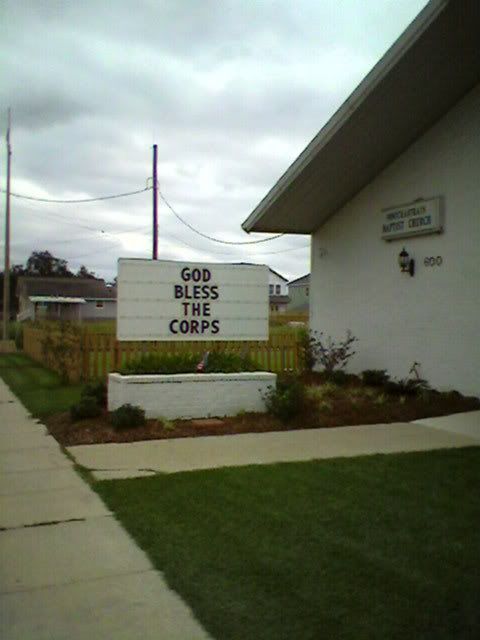
The church is located yards from the 17th Street Canal breach site in New Orleans. Although repaired and reopened for business, the building may be demolished to make way for the permanent pump station to be built in the next few years.
A lady leaving church told me they pray for everyone--saints and sinners alike.
She did not indicate into which category they would put the Corps of Engineers.
Thursday, October 18, 2007
Oh Snap!
Around the Vista Park neighborhood of New Orleans, several houses are under repair or construction. Although I am disappointed that many people are simply repairing slab-on-grad houses without elevating, I have been encouraged to see construction of new homes at safer heights.
The majority of these new structures are modular homes. Typically these houses are placed on walls or piers about 3 feet above adjacent grade--the minimum height according to the advisory base flood elevation for our neighborhood. An improvement, yes, but I sure wouldn't recommend building so low. As long as you're building a new house, I say go as high as you can.
A handful of houses here have done just that, raising their living space 8 or more feet off the ground. Of course, doing so costs more and requires a much more detailed design.
One such house, just around the corner from our FEMA Travel Trailer, was ready to be lifted into place this weekend. The contractor had started from scratch, driving new timber piles and placing a brand new slab for the garage level. They had then formed up about two dozen square concrete columns arranged all along the perimeter and a row right down the middle.
Saturday morning I saw the two halves of the new modular house being trucked in and the large crane towering above the trees and wires ready to lift those pieces into place. We were headed out for the day and I was just a little disappointed that I would not be able to see the house come together.
Late Saturday afternoon we returned to see the crane folded up and ready to leave, but the modular house was still wrapped in plastic on the flatbed trailers. I went over to take a look and met the contractor, a lanky man with a north Louisiana country accent. He scowled when I asked what happened.
"No rebar," he said. "Barely two inches of it."
At first I did not understand what he meant, but then I looked again at the slab and columns and saw that the entire center row of concrete columns had fallen over!

The contractor told me that the first unit was being lowered into position when the columns gave way. They snapped off at the base, breaking cleanly where the cold joint of the column met the slab, each one pulling out the scant two inches of rebar that somebody foolishly thought would be enough to anchor these 9 to 10 feet tall columns.

Luckily no one was hurt as they collapsed like thousand-pound dominoes. Lucky still that this defect was exposed sooner rather than later. Had this house been completed on such poorly anchored columns the first stiff wind would probably pushed the house over to one side or the other, where it could have crushed a neighbor's house.

I've seen a lot of houses near here that have been elevated post-K, mostly pier houses that were lifted and then lowered onto columns constructed in place right under the elevated houses. I don't recall seeing shear walls or even cross bracing on any of them, so these houses rely on the strength of the connection at the base of the column to withstand rotation forces. Let's hope they hired somebody who knew what he or she was doing.

Of course the contractor in this case blamed his subcontractor for the ridiculously shoddy work, but he has every reason to be red-faced, too. He should have made sure that appropriate anchors were placed in the slab, and he should have inspected the columns to make sure the steel was tied together to provide a continuous load path from the anchor straps at the top of each column all the way into the foundation. To his credit, he told me he is going to fix it as quickly as possible at no charge to the owner, and sure enough equipment had arrived Monday to start cleaning up the mess.

The lesson is a good one: hire people who know what they are doing and check everything. Going tall is great for flood protection, but let's not forget that hurricanes pack a punch of wind, too. You don't need a degree in engineering to know that taller houses are going to catch more wind, but perhaps you do need an engineer to properly design for it.
The majority of these new structures are modular homes. Typically these houses are placed on walls or piers about 3 feet above adjacent grade--the minimum height according to the advisory base flood elevation for our neighborhood. An improvement, yes, but I sure wouldn't recommend building so low. As long as you're building a new house, I say go as high as you can.
A handful of houses here have done just that, raising their living space 8 or more feet off the ground. Of course, doing so costs more and requires a much more detailed design.
One such house, just around the corner from our FEMA Travel Trailer, was ready to be lifted into place this weekend. The contractor had started from scratch, driving new timber piles and placing a brand new slab for the garage level. They had then formed up about two dozen square concrete columns arranged all along the perimeter and a row right down the middle.
Saturday morning I saw the two halves of the new modular house being trucked in and the large crane towering above the trees and wires ready to lift those pieces into place. We were headed out for the day and I was just a little disappointed that I would not be able to see the house come together.
Late Saturday afternoon we returned to see the crane folded up and ready to leave, but the modular house was still wrapped in plastic on the flatbed trailers. I went over to take a look and met the contractor, a lanky man with a north Louisiana country accent. He scowled when I asked what happened.
"No rebar," he said. "Barely two inches of it."
At first I did not understand what he meant, but then I looked again at the slab and columns and saw that the entire center row of concrete columns had fallen over!
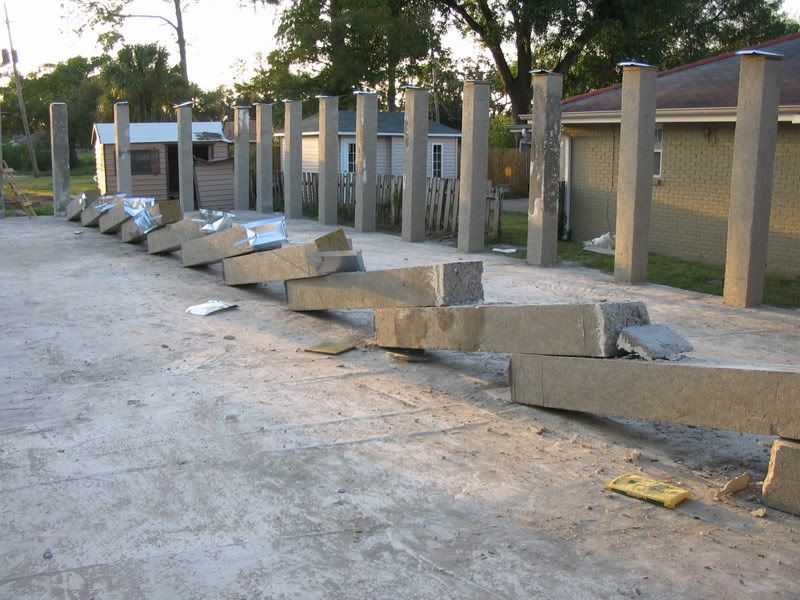
The contractor told me that the first unit was being lowered into position when the columns gave way. They snapped off at the base, breaking cleanly where the cold joint of the column met the slab, each one pulling out the scant two inches of rebar that somebody foolishly thought would be enough to anchor these 9 to 10 feet tall columns.
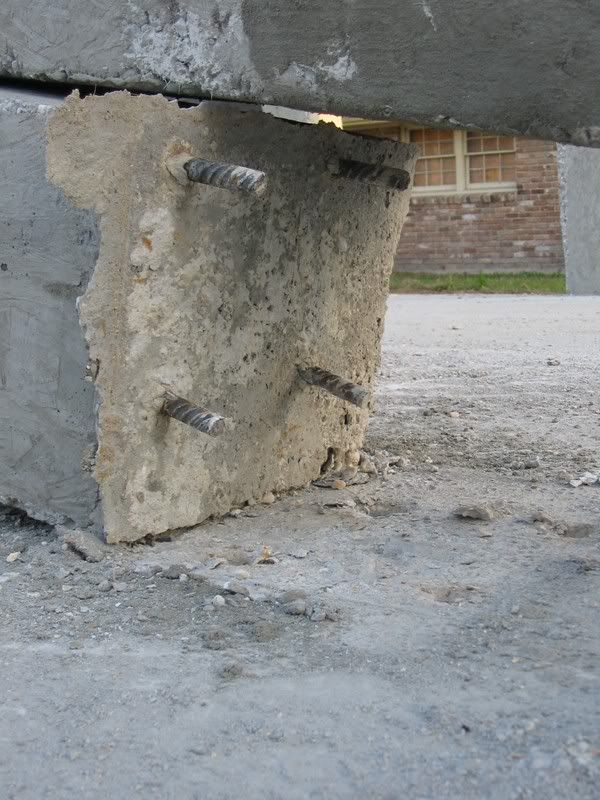
Luckily no one was hurt as they collapsed like thousand-pound dominoes. Lucky still that this defect was exposed sooner rather than later. Had this house been completed on such poorly anchored columns the first stiff wind would probably pushed the house over to one side or the other, where it could have crushed a neighbor's house.
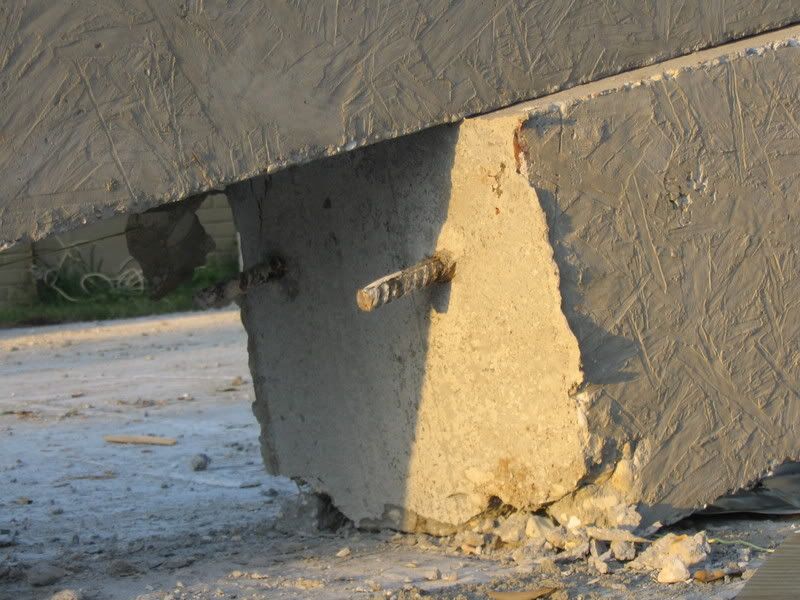
I've seen a lot of houses near here that have been elevated post-K, mostly pier houses that were lifted and then lowered onto columns constructed in place right under the elevated houses. I don't recall seeing shear walls or even cross bracing on any of them, so these houses rely on the strength of the connection at the base of the column to withstand rotation forces. Let's hope they hired somebody who knew what he or she was doing.
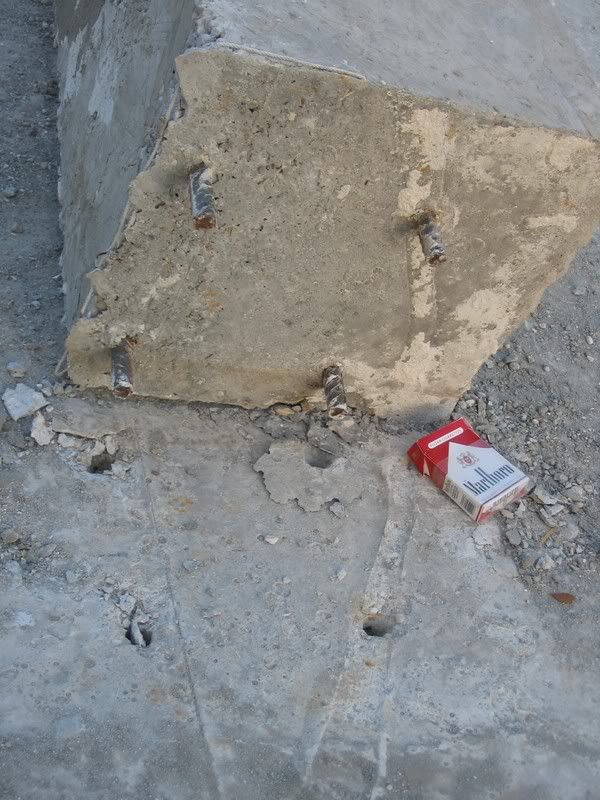
Of course the contractor in this case blamed his subcontractor for the ridiculously shoddy work, but he has every reason to be red-faced, too. He should have made sure that appropriate anchors were placed in the slab, and he should have inspected the columns to make sure the steel was tied together to provide a continuous load path from the anchor straps at the top of each column all the way into the foundation. To his credit, he told me he is going to fix it as quickly as possible at no charge to the owner, and sure enough equipment had arrived Monday to start cleaning up the mess.
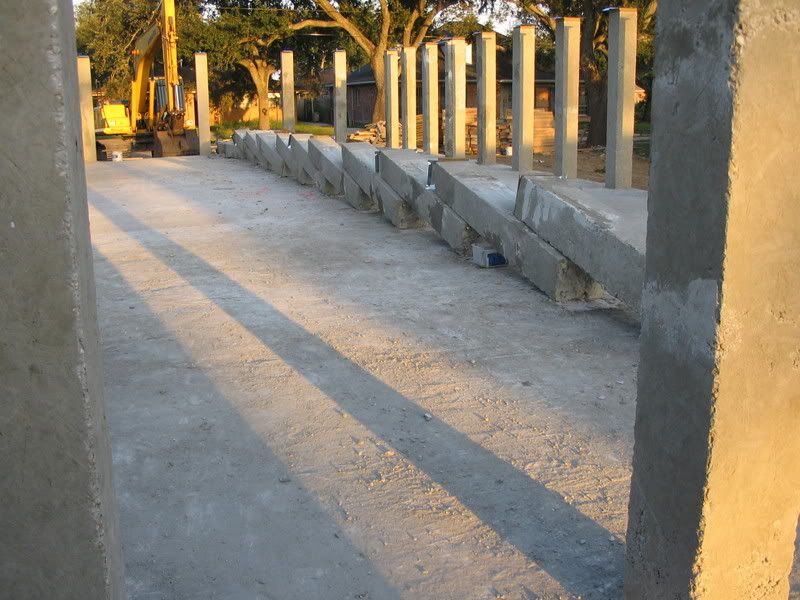
The lesson is a good one: hire people who know what they are doing and check everything. Going tall is great for flood protection, but let's not forget that hurricanes pack a punch of wind, too. You don't need a degree in engineering to know that taller houses are going to catch more wind, but perhaps you do need an engineer to properly design for it.
Tuesday, October 16, 2007
Malcolm Suber offers leadership
We’ve got an election here on Saturday the 20th, and you wouldn’t know it except for the annoying and slick public relations commercials on TV and radio. Like their national counterparts, the plethora of wannabe politicians wrap themselves in images of family and blue-collar workers, all carefully scripted and created to project an image of trustworthiness and commonness.
But we know it’s all fake. We know that it’s all a fabricated veneer like the rich wood grain skin that hides the cheap and unreliable particle board of low-end furniture. I mean, seriously, is there really an iota of difference in the way the ad people are packaging and selling John Georges, Aaron Broussard or Jeb Bruneau?
But then there’s Malcolm Suber, candidate for New Orleans City Council At-Large.
Malcolm is running for the seat vacated by the reprehensible Oliver Thomas, a “public servant” who will forever be remembered as the man who served himself first and foremost.
In stark contrast to the pack of lifelong politicians, Malcolm is a lifelong community activist. Malcolm does not play the political games of saying only focus-group-tested platitudes. Malcolm does not pledge allegiance to the voters while secretly stuffing his pockets with the contributions of rich paymasters.
I met Malcolm at a party uptown last Friday night. It was a meeting of progressive candidates--no Democrats or Republicans were allowed. Just as Cynthia Willard-Lewis and Jackie Clarkson represent the failed politicians of the past, I believe the Democratic and Republican parties are monuments of past power and money-controlled politics that has led our government far too long. It’s the Democrats and Republicans who have led us to where we are right now.
Happy? Satisfied?
I’m not. I’m going to vote for as many non-Republicrats as possible. I’m looking for independents, Greens and Libertarians. If you think this country, this state, and this city are headed in the wrong direction, then let somebody else drive. Don’t just vote for the same people, the same political gangs, and the same well-connected machine of moneychangers.
With Malcolm on the ballot, we have the opportunity to remove the distasteful flavor of corruption and self-enrichment from the council. Malcolm’s slogan is, “No More Sellout Politicians!” and I believe he means it.
Malcolm and I talked about education, about empowerment, about building a community that trusts its police to protect them. I found him to be sincere and forthright in every instance. I'm not going to try to paraphrase his ideas here; I encourage you to visit Malcolm's web page to read for yourself.
No, I did not fully agree with him on every issue. But that’s one of the reasons I will vote for him. Malcolm is not going to just spout empty slogans and patronize values as determined by public opinion surveys. There’s no bait-and-switch here. Malcolm tells the truth about what’s important to him, about what he wants to do about it, about his desire to lead a revolution in this city.
And by any measure, that makes Malcolm a leader.
Isn’t that exactly what we need in New Orleans?
But we know it’s all fake. We know that it’s all a fabricated veneer like the rich wood grain skin that hides the cheap and unreliable particle board of low-end furniture. I mean, seriously, is there really an iota of difference in the way the ad people are packaging and selling John Georges, Aaron Broussard or Jeb Bruneau?
But then there’s Malcolm Suber, candidate for New Orleans City Council At-Large.
Malcolm is running for the seat vacated by the reprehensible Oliver Thomas, a “public servant” who will forever be remembered as the man who served himself first and foremost.
In stark contrast to the pack of lifelong politicians, Malcolm is a lifelong community activist. Malcolm does not play the political games of saying only focus-group-tested platitudes. Malcolm does not pledge allegiance to the voters while secretly stuffing his pockets with the contributions of rich paymasters.
I met Malcolm at a party uptown last Friday night. It was a meeting of progressive candidates--no Democrats or Republicans were allowed. Just as Cynthia Willard-Lewis and Jackie Clarkson represent the failed politicians of the past, I believe the Democratic and Republican parties are monuments of past power and money-controlled politics that has led our government far too long. It’s the Democrats and Republicans who have led us to where we are right now.
Happy? Satisfied?
I’m not. I’m going to vote for as many non-Republicrats as possible. I’m looking for independents, Greens and Libertarians. If you think this country, this state, and this city are headed in the wrong direction, then let somebody else drive. Don’t just vote for the same people, the same political gangs, and the same well-connected machine of moneychangers.
With Malcolm on the ballot, we have the opportunity to remove the distasteful flavor of corruption and self-enrichment from the council. Malcolm’s slogan is, “No More Sellout Politicians!” and I believe he means it.
Malcolm and I talked about education, about empowerment, about building a community that trusts its police to protect them. I found him to be sincere and forthright in every instance. I'm not going to try to paraphrase his ideas here; I encourage you to visit Malcolm's web page to read for yourself.
No, I did not fully agree with him on every issue. But that’s one of the reasons I will vote for him. Malcolm is not going to just spout empty slogans and patronize values as determined by public opinion surveys. There’s no bait-and-switch here. Malcolm tells the truth about what’s important to him, about what he wants to do about it, about his desire to lead a revolution in this city.
And by any measure, that makes Malcolm a leader.
Isn’t that exactly what we need in New Orleans?
Saturday, October 13, 2007
Produce your rights—or lose them
When danger lurks, Dangerblond writes.
What a pleasure it was to read my follow NOLA blogger in The Times-Picayune today. In “Produce your papers, or else?”, Dangerblond exposes the slow shredding of our Constitutional rights by a cynical, paranoid government. And while she unravels some complex legal issues, she delivers this important dose of civil rights medicine with a generous portion of New Orleans sugar.
I read it out loud to my Precious Wife this morning and she enjoyed it. I’m hoping you will like it, too.
What a pleasure it was to read my follow NOLA blogger in The Times-Picayune today. In “Produce your papers, or else?”, Dangerblond exposes the slow shredding of our Constitutional rights by a cynical, paranoid government. And while she unravels some complex legal issues, she delivers this important dose of civil rights medicine with a generous portion of New Orleans sugar.
I read it out loud to my Precious Wife this morning and she enjoyed it. I’m hoping you will like it, too.
Thursday, September 27, 2007
ENR: Engineering News Record
It's a magazine for us engineering and construction types. Not the type of place you'd expect to find a heartfelt story like this one:
"It happens daily in my mind, like that convention they used in old movies of the calendar pages turning to represent time passing. As I drive through different parts of town, the pages flip at lightning speed, and only I know the stories, people’s faces and details that cram the day boxes on the calendar. As the pages flip, my emotions run the gamut – loss, sadness, frustration, anger, stress, fear, relief. I turn onto Fox Drive, which happens to be around the corner from where some friends used to live. They moved to the north shore of Lake Pontchartrain and swore they would never come back to “the parish.” By the time I walk down the driveway, I am exhaling a huge, mind-clearing breath and thinking, this has been a helluva two years."
Read the full story by Angelle Bergeron at:
Two Years Later, Men Still Moved to Tears
"It happens daily in my mind, like that convention they used in old movies of the calendar pages turning to represent time passing. As I drive through different parts of town, the pages flip at lightning speed, and only I know the stories, people’s faces and details that cram the day boxes on the calendar. As the pages flip, my emotions run the gamut – loss, sadness, frustration, anger, stress, fear, relief. I turn onto Fox Drive, which happens to be around the corner from where some friends used to live. They moved to the north shore of Lake Pontchartrain and swore they would never come back to “the parish.” By the time I walk down the driveway, I am exhaling a huge, mind-clearing breath and thinking, this has been a helluva two years."
Read the full story by Angelle Bergeron at:
Two Years Later, Men Still Moved to Tears
Thursday, September 20, 2007
Dawn
000
WONT41 KNHC 201956
DSAAT
SPECIAL TROPICAL DISTURBANCE STATEMENT
NWS TPC/NATIONAL HURRICANE CENTER MIAMI FL
400 PM EDT THU SEP 20 2007
A RECONNAISSANCE AIRCRAFT INVESTIGATING THE AREA OF LOW PRESSURE IN THE EASTERN GULF OF MEXICO FOUND A BROAD CIRCULATION CENTERED ABOUT 115 MILES WEST-SOUTHWEST OF ST. PETERSBURG FLORIDA. THE AIRCRAFT WILL CONTINUE TO INVESTIGATE THE LOW THIS AFTERNOON...BUT THERE ARE NO INDICATIONS YET THAT THE LOW HAS BEGUN TO ACQUIRE TROPICAL CHARACTERISTICS. THUNDERSTORM ACTIVITY WITH THIS SYSTEM REMAINS LIMITED AND DISORGANIZED. HOWEVER...THIS SYSTEM HAS THE POTENTIAL TO BECOME A SUBTROPICAL OR TROPICAL CYCLONE OVER THE NEXT DAY OR SO AS IT MOVES WEST-NORTHWESTWARD OVER THE WARM WATERS OF THE GULF OF MEXICO. ALL INTERESTS ALONG THE NORTHERN GULF COAST SHOULD MONITOR THE PROGRESS OF THIS SYSTEM.
$$
FORECASTER FRANKLIN
----------------------------
The sky was black and only faintly blue on the horizon when I stepped outside this morning. The cats capered happily past me emitting squeaky meows as they ran out to greet the day. Dawn--the eternal symbol of hope and a fresh start, slowly peeled the darkness from New Orleans. Stars faded and disappeared.
I walked down the three steps from the FEMA Travel Trailer and stepped onto the concrete walkway. The walkway extended another 15 or so feet, and then vanished into rubble and dirt and low-cut weeds. Until about two years ago, I would have been walking this concrete path in the other direction at this time of morning. I would have been walking out looking for the newspaper, or perhaps leaving my house to go to work.
But that house is gone.
I am amazed by the sky this morning. We have had several clear, bright days in succession this week. Hot, but not too hot. Humidity practically unheard of for New Orleans. Absolutely wonderful weather.
It will not last, because the nature of nature is change. I know this day will pass. I know this FEMA Travel Trailer will one day be taken away. And perhaps most importantly, I know this time of trial will pass, too.
Despite this fabulous string of beautiful days, my colleagues and friends are worried about the weather right now. All of New Orleans worries. A thunderstorm in Florida with 30 mile per hour winds demands our fearful attention. Once bitten, twice shy I suppose, and Katrina took a huge bite.
We watch the tropical weather reports much more closely nowadays. We have the National Weather Service National Hurricane Center in our list of web page favorites. We study the maps like Allied strategists planning the invasion of France, and sift through the weather reports with the intesity of a baseball fan poring over the box scores.
But for now, the air is still and cool, and the horizon stretches around my neighborhood with ever brightening arms. We must embrace this day, even if it is just the calm before the storm.
WONT41 KNHC 201956
DSAAT
SPECIAL TROPICAL DISTURBANCE STATEMENT
NWS TPC/NATIONAL HURRICANE CENTER MIAMI FL
400 PM EDT THU SEP 20 2007
A RECONNAISSANCE AIRCRAFT INVESTIGATING THE AREA OF LOW PRESSURE IN THE EASTERN GULF OF MEXICO FOUND A BROAD CIRCULATION CENTERED ABOUT 115 MILES WEST-SOUTHWEST OF ST. PETERSBURG FLORIDA. THE AIRCRAFT WILL CONTINUE TO INVESTIGATE THE LOW THIS AFTERNOON...BUT THERE ARE NO INDICATIONS YET THAT THE LOW HAS BEGUN TO ACQUIRE TROPICAL CHARACTERISTICS. THUNDERSTORM ACTIVITY WITH THIS SYSTEM REMAINS LIMITED AND DISORGANIZED. HOWEVER...THIS SYSTEM HAS THE POTENTIAL TO BECOME A SUBTROPICAL OR TROPICAL CYCLONE OVER THE NEXT DAY OR SO AS IT MOVES WEST-NORTHWESTWARD OVER THE WARM WATERS OF THE GULF OF MEXICO. ALL INTERESTS ALONG THE NORTHERN GULF COAST SHOULD MONITOR THE PROGRESS OF THIS SYSTEM.
$$
FORECASTER FRANKLIN
----------------------------
The sky was black and only faintly blue on the horizon when I stepped outside this morning. The cats capered happily past me emitting squeaky meows as they ran out to greet the day. Dawn--the eternal symbol of hope and a fresh start, slowly peeled the darkness from New Orleans. Stars faded and disappeared.
I walked down the three steps from the FEMA Travel Trailer and stepped onto the concrete walkway. The walkway extended another 15 or so feet, and then vanished into rubble and dirt and low-cut weeds. Until about two years ago, I would have been walking this concrete path in the other direction at this time of morning. I would have been walking out looking for the newspaper, or perhaps leaving my house to go to work.
But that house is gone.
I am amazed by the sky this morning. We have had several clear, bright days in succession this week. Hot, but not too hot. Humidity practically unheard of for New Orleans. Absolutely wonderful weather.
It will not last, because the nature of nature is change. I know this day will pass. I know this FEMA Travel Trailer will one day be taken away. And perhaps most importantly, I know this time of trial will pass, too.
Despite this fabulous string of beautiful days, my colleagues and friends are worried about the weather right now. All of New Orleans worries. A thunderstorm in Florida with 30 mile per hour winds demands our fearful attention. Once bitten, twice shy I suppose, and Katrina took a huge bite.
We watch the tropical weather reports much more closely nowadays. We have the National Weather Service National Hurricane Center in our list of web page favorites. We study the maps like Allied strategists planning the invasion of France, and sift through the weather reports with the intesity of a baseball fan poring over the box scores.
But for now, the air is still and cool, and the horizon stretches around my neighborhood with ever brightening arms. We must embrace this day, even if it is just the calm before the storm.
Wednesday, September 19, 2007
Digitize me
I am identified
By my number
My insurance company knows me
By my number
SBA has my paperwork filed
By my number
I have a name
But names do not matter
Road Home can only talk to me
If I can give them my number
The bank is happy to serve me
By my number
The grocery store will give me food
If I give them my number
The more numbers we use
The more numb to humanity we are
I have a name
But I'm nobody without my number
The day is coming soon
When we will all be fully digitized
And the only digit I will give you
Is the middle one
0101000001101100011001010110000101110011
0110010100100000011001100110111101110010
0110011101101001011101100110010100100000
0111010001101000011001010010000001110111
0110100001101001011011100110100101101110
0110011100101110001000000010000001001001
0010000001100001011011010010000001101010
0111010101110011011101000010000001100001
0010000001101100011010010111010001110100
0110110001100101001000000110011001110010
0111010101110011011101000111001001100001
0111010001100101011001000010000001110100
0110111101100100011000010111100100101110
0010000000100000010100000110010101100001
0110001101100101001011000010000001010100
0110100101101101
By my number
My insurance company knows me
By my number
SBA has my paperwork filed
By my number
I have a name
But names do not matter
Road Home can only talk to me
If I can give them my number
The bank is happy to serve me
By my number
The grocery store will give me food
If I give them my number
The more numbers we use
The more numb to humanity we are
I have a name
But I'm nobody without my number
The day is coming soon
When we will all be fully digitized
And the only digit I will give you
Is the middle one
0101000001101100011001010110000101110011
0110010100100000011001100110111101110010
0110011101101001011101100110010100100000
0111010001101000011001010010000001110111
0110100001101001011011100110100101101110
0110011100101110001000000010000001001001
0010000001100001011011010010000001101010
0111010101110011011101000010000001100001
0010000001101100011010010111010001110100
0110110001100101001000000110011001110010
0111010101110011011101000111001001100001
0111010001100101011001000010000001110100
0110111101100100011000010111100100101110
0010000000100000010100000110010101100001
0110001101100101001011000010000001010100
0110100101101101
Monday, September 17, 2007
The view from K-Ville
K-Ville premiers on television tonight. Folks here in New Orleans have been looking forward to it for many weeks.
The K is for Katrina, of course.
But it could just as well be for kennel, which is what it must be like to live in one of those FEMA Travel Trailer cluster parks where people are stored for some future undetermined purpose.
Or it could be for keister, which is where many of us landed after getting thrown out of our homes, our schools and our jobs.
Some of us, feeling abandoned or shortchanged by our fellow Americans, may think K-ville comes from the kiss-off we believe we've been given. I don't think that's the case. To be certain, a few compassionate conservatives have told us to kiss-off, but so many more have been generous that I'd rather think of their example of kindness.
But perhaps K stands for Kingfish, as Louisiana's populist Governor Huey Long was called. His legacy of Robin Hood-style government casts its long shadow over us to this day. Or looking at more recently elected officials, it may be a nod to the kickbacks extracted by greedy politicians such as Oliver Thomas and Edwin Edwards. Scum of their ilk have helped cement our reputation as among the most politically corrupt places in America.
However, I'm sure a few of you will see that K and think instead of the junior senator and his alleged kinky habits. Or of the free display of knockers exposed by drunken, out-of-town women on Bourbon Street.
Please, spare us.
If you read the newspapers, you'll be convinced K-Ville gets its name from the daily killings here, a sad statement of the social breakdown in some segments of the population and of the kill-or-be-killed rules of the drug trade.
I’d like to think that K stands for karma, that mystical principle that says what comes around goes around. The idea that as you sow, so shall you so reap. I see my city struggle in so many ways, and I know that if we deal with each other fairly and honestly, we will all benefit. And I hope that those beyond New Orleans who help us will themselves be helped when they are in need. I don’t wish ill upon anyone, but I strongly wish to see mercy served to those who are merciful.
But sadly, that K is just Katrina, that miserable hurricane that ruined so many lives two years ago. It will be difficult to think or talk of New Orleans without linking us to Katrina for many, many years. The water has been all pumped out and stinky refrigerators are long gone, but the stain and stench of Katrina will remain for a generation.
Perhaps the day will come when we'll have to be reminded what the K in K-Ville stands for.
If we’re lucky.
The K is for Katrina, of course.
But it could just as well be for kennel, which is what it must be like to live in one of those FEMA Travel Trailer cluster parks where people are stored for some future undetermined purpose.
Or it could be for keister, which is where many of us landed after getting thrown out of our homes, our schools and our jobs.
Some of us, feeling abandoned or shortchanged by our fellow Americans, may think K-ville comes from the kiss-off we believe we've been given. I don't think that's the case. To be certain, a few compassionate conservatives have told us to kiss-off, but so many more have been generous that I'd rather think of their example of kindness.
But perhaps K stands for Kingfish, as Louisiana's populist Governor Huey Long was called. His legacy of Robin Hood-style government casts its long shadow over us to this day. Or looking at more recently elected officials, it may be a nod to the kickbacks extracted by greedy politicians such as Oliver Thomas and Edwin Edwards. Scum of their ilk have helped cement our reputation as among the most politically corrupt places in America.
However, I'm sure a few of you will see that K and think instead of the junior senator and his alleged kinky habits. Or of the free display of knockers exposed by drunken, out-of-town women on Bourbon Street.
Please, spare us.
If you read the newspapers, you'll be convinced K-Ville gets its name from the daily killings here, a sad statement of the social breakdown in some segments of the population and of the kill-or-be-killed rules of the drug trade.
I’d like to think that K stands for karma, that mystical principle that says what comes around goes around. The idea that as you sow, so shall you so reap. I see my city struggle in so many ways, and I know that if we deal with each other fairly and honestly, we will all benefit. And I hope that those beyond New Orleans who help us will themselves be helped when they are in need. I don’t wish ill upon anyone, but I strongly wish to see mercy served to those who are merciful.
But sadly, that K is just Katrina, that miserable hurricane that ruined so many lives two years ago. It will be difficult to think or talk of New Orleans without linking us to Katrina for many, many years. The water has been all pumped out and stinky refrigerators are long gone, but the stain and stench of Katrina will remain for a generation.
Perhaps the day will come when we'll have to be reminded what the K in K-Ville stands for.
If we’re lucky.
Wednesday, September 12, 2007
Hang on to your hat
I could hardly believe it.
I was looking at a display for new roofing shingles at Lowe's. I was at the big box since the corner hardware stores are closed on Sunday. I wasn't shopping for shingles, but I was drawn by the pretty display which included large photographs of pretty houses showing off their new roofs.
And in the bullet-list of benefits was the shocking claim that these shingles were designed to withstand winds up to 60 miles per hour.
Sixty. Six-zero.
Who in the New Orleans area is buying these shingles?
Other shingles in the display promised protection up to 70 mph. What??
Doesn't everyone know that a Category 1 hurricane on the Saffir-Simpson Scale has winds from 74 to 95 mph?
And it gets worse. You’ll only get the promised protection if the shingles are installed properly. Although the instructions are clearly written on the label of every pack of shingles, don’t count on a contractor doing a proper installation job. I know of two people who read the instructions on the package and then watched the laborers proceed to do almost everything wrong. Both had to browbeat their contractor into following the proper installation procedures.
So for everyone who bought cheap shingles and had them installed improperly, how much wind can your house withstand? Hope you never have to find out.
Recall how many Blue Roofs you saw after Hurricane Katrina. FEMA reports they installed temporary tarps on nearly 100,000 houses under their "Blue Roof" program following Hurricane Katrina.
And aren't we fond of pointing out how minor the wind damage was in our fair city? Yet look at how many damaged roofs we had. (NOAA reported a maximum surface wind speed at New Orleans Lakefront Airport of 60 mph, with gusts up to 75 mph!)
I guess we know why now. Sixty miles per hour shingles? How crazy is that?
The current building code for the New Orleans area is 130 mph. That's according to the International Residence Code adopted by the State of Louisiana.
So if state law demands 130 mph, the question is not merely who is buying these substandard building materials. The question is also why is Lowe's or anyone else selling 60 and 70 mph shingles?
I suppose you could use them for other than residential construction. You might want to put them on your detached garage or garden shed. You might want to put them on a child's play house.
Sadly, that is not what is depicted in the pretty color photographs in the Lowe's display. They show these substandard shingles on the roofs of upscale homes. That is patently irresponsible and perhaps even dangerous.
We all want "Category 5 Levees"--I hear it on the radio and read it in the paper all the time. But Category 5 hurricanes also have winds of 155 mph or more. What good will tall and strong levees be if the houses just get blown apart by the wind?
How can anyone expect the rest of America to take us seriously when some of us are installing roof shingles that will not even survive a Category 1 hurricane?
I was looking at a display for new roofing shingles at Lowe's. I was at the big box since the corner hardware stores are closed on Sunday. I wasn't shopping for shingles, but I was drawn by the pretty display which included large photographs of pretty houses showing off their new roofs.
And in the bullet-list of benefits was the shocking claim that these shingles were designed to withstand winds up to 60 miles per hour.
Sixty. Six-zero.
Who in the New Orleans area is buying these shingles?
Other shingles in the display promised protection up to 70 mph. What??
Doesn't everyone know that a Category 1 hurricane on the Saffir-Simpson Scale has winds from 74 to 95 mph?
And it gets worse. You’ll only get the promised protection if the shingles are installed properly. Although the instructions are clearly written on the label of every pack of shingles, don’t count on a contractor doing a proper installation job. I know of two people who read the instructions on the package and then watched the laborers proceed to do almost everything wrong. Both had to browbeat their contractor into following the proper installation procedures.
So for everyone who bought cheap shingles and had them installed improperly, how much wind can your house withstand? Hope you never have to find out.
Recall how many Blue Roofs you saw after Hurricane Katrina. FEMA reports they installed temporary tarps on nearly 100,000 houses under their "Blue Roof" program following Hurricane Katrina.
And aren't we fond of pointing out how minor the wind damage was in our fair city? Yet look at how many damaged roofs we had. (NOAA reported a maximum surface wind speed at New Orleans Lakefront Airport of 60 mph, with gusts up to 75 mph!)
I guess we know why now. Sixty miles per hour shingles? How crazy is that?
The current building code for the New Orleans area is 130 mph. That's according to the International Residence Code adopted by the State of Louisiana.
So if state law demands 130 mph, the question is not merely who is buying these substandard building materials. The question is also why is Lowe's or anyone else selling 60 and 70 mph shingles?
I suppose you could use them for other than residential construction. You might want to put them on your detached garage or garden shed. You might want to put them on a child's play house.
Sadly, that is not what is depicted in the pretty color photographs in the Lowe's display. They show these substandard shingles on the roofs of upscale homes. That is patently irresponsible and perhaps even dangerous.
We all want "Category 5 Levees"--I hear it on the radio and read it in the paper all the time. But Category 5 hurricanes also have winds of 155 mph or more. What good will tall and strong levees be if the houses just get blown apart by the wind?
How can anyone expect the rest of America to take us seriously when some of us are installing roof shingles that will not even survive a Category 1 hurricane?
Subscribe to:
Posts (Atom)