It doesn’t look the same. It doesn’t sound the same. It really doesn’t smell the same.
Yet there seemed to be enough about the old house and the old neighborhood for my cats to recognize it in very short order.
My two cats, Smudge the spry Siamese and Callie the long-haired and bulky calico, have traveled much more than most domestic cats have or would even want to. Because of Hurricane Katrina and the record-setting storm surge that she delivered to coastal Louisiana, the cats haven’t seen their old house for more than 10 months.
A few days before we officially moved into our blizzard-white FEMA travel trailer, I thought it would be a good idea to bring them over to start getting them acclimated to their new home. Cats never like to be put into a carrier for a road trip, so their initial reaction to the plan was unfavorable.
Once we arrived, I set the carriers in the trailer and went to work to set up a litter box, food and water. When I opened the carriers, both cats came out almost at once. Smudge, the friendlier of the two, began to explore immediately, meowing all the way. I imagine she was saying, “Hey, what’s that? Hey, what’s this thing here? Hey, Callie, come see! Do you think this is my bed?”
Callie kept low and moved more cautiously than her sister. An uninformed observer might have thought she was on a hunt. Sudden movement or sounds clearly startled her.
We slept that night in what I would loosely call the Master Bedroom; Smudge at my feet and Callie almost on top of my head.
The following morning, I let the cats have a brief look outside—no more than 10 minutes. Here, their roles reversed. Callie wanted to go exploring into the burned shell of our house, while Smudge did not want to leave the steps in front of the trailer door.
I followed Callie as she stepped boldly but carefully into the house. “Do you recognize this?” I asked her. “Does anything here look familiar?” She paid no attention to me, and was quite annoyed when I scooped her up and put her back into the trailer. Smudge was sitting by a window, looking intently at (studying?) the house that used to be her home.
Again that night, we three were on the bed.
On the second morning, I let them wander a little further and stay out a few hours. Around noontime, I found them lying under my flood-damaged car that was still parked in the driveway next to the house. Before New Orleans was flooded it was not uncommon for my cats to spend the afternoons in the shade under my car.
And there they were again. The car, flooded over the roof, has not moved since that awful storm. While the half-inch thick mud and sludge that had covered the walks and drive were shoveled off months ago, the mud remained under the immovable vehicle. I’m sure the mud held more moisture and made it cooler under there than ever before.
And that’s when I knew they understood. I’m sure they remembered the blond bricks and pavement, and they may remember the trees and garden. Two cats, a small but not insignificant part of a New Orleans family, their lives all blown off course by a hurricane, had returned to a place of happiness and comfort, a place they quickly adjusted back into.
The house is a mess, of course, and no one can live there now. But the feeling of being home, the comfort and safety that home entails seemed evident in the way my two little cats quickly readapted to living here. The condition of the building cannot supplant the memories we have of this place. Even the cats feel it.
Welcome home, Smudge and Callie.
Friday, July 28, 2006


Wednesday, July 26, 2006
Post-K Post Office
Perhaps my affinity for public employees is simply because I are one.
Or perhaps I’m just a little more observant, more cognizant that the basic services we rely upon are not delivered by a nameless bureaucracy or an inhuman machine called “government.” These services are provided by people, often good people who do their best to do their best.
Moving back to the old neighborhood is a lot of work, and not simply the manual labor required to tote all our stuff across town. One critical task was to get the mail rerouted to the correct address.
Since October, we’ve had a forwarding request directing mail sent to us at the house to be brought to our apartment in Riverbend. Now we have to reverse that flow.
I first visited the USPS online, where I was able to submit a mail forwarding request from the apartment to the house. But I also needed to cancel the forwarding request from the house to the apartment. Otherwise, my mail could be stuck in an endless “do loop.” I imagined my mail bouncing back and forth between the two until the volume of stick-on yellow address labels caused my mail to clog the automated sorting machines, resulting in a monumental pile-up that backed up the postal system like a hurricane evacuation traffic jam.
Unfortunately, the USPS web page does not allow one to cancel a forwarding order--that requires visiting the Post Office in person. I stopped in at the Post Office on Louisiana Avenue, and they recommended I go to my local Post Office to make sure the carrier received and understood the request.
“And where is that?” I asked, since my “local” post office had flooded in Hurricane Katrina and had not reopened.
They sent me to the carrier station on Florida Avenue, a facility that does not have a storefront because it was never intended to serve walk-in customers. Nevertheless, this is where many people now go to pick up mail if they are still unable to receive mail at a regular address.
(Before I go on, I hope we all take a moment to think about that: more than 10 months after the hurricane and normal mail delivery has not resumed to all areas.)
Anyway, signs around the building directed visitors to locate the door with their zip code for service, and I quickly found mine. I waited a few moments for help, and when the door opened I was greeted by a familiar face.
“Hello, Tim! How’s the family getting along?”
It was my old carrier from before the storm. Mr. Anthony, a tall, friendly man, used to walk the route on my street during what sometimes seems like another lifetime, yet was less than a year ago. Occasionally I would be out in the yard when he came by, and he would stop to talk about family, current events, money and the government.
I am still amazed that he remembered me. Here’s a man who must see a thousand names and addresses a day in the course of his work. How he could remember me, someone who has not been around for many months, someone he only knew by casual acquaintance?
I recalled that he owned several rental properties in the Gentilly neighborhood of New Orleans. “How’d you make out in the hurricane?”
“I lost five houses,” he said. “I’m living in Algiers Point right now. I was just lucky that I bought a house over there to renovate right before the storm.”
“Wow, so you have no spare time!” I said.
He laughed politely, and his close-cut beard looked like it may have turned more grey since the last time I saw him.
I told him we were coming back, and he was quick to tell me about others on the street who were coming back, too. He seemed to know everyone and their plans. I marveled again at his ability with names and addresses.
Near the end of our conversation, he said, “You just have to keep going. No matter what happens, the Lord gives you the strength to keep going.” The African timbre of his voice sounded both sad and defiant in the same moment.
It’s hard to imagine what some people have been through. I’m dealing with just one flooded house and all the insurance, government paperwork and contractors that I can handle on top of family and work. What must it be like to have all that for five houses?
And yet Mr. Anthony remains cheerful and hopeful. He takes pride in his work and clearly thinks of us as customers that deserve friendly, efficient service. Although the postal uniform is not widely considered one of honor (think Cliff on “Cheers” or Newman on “Seinfeld”), this man transcends that stereotype.
I remain hopeful that there are many more like Mr. Anthony in this city: people who will push a little harder when they meet resistance, people who will put forth the effort to do the job right, people who will smile even when every circumstance discourages it.
Or perhaps I’m just a little more observant, more cognizant that the basic services we rely upon are not delivered by a nameless bureaucracy or an inhuman machine called “government.” These services are provided by people, often good people who do their best to do their best.
Moving back to the old neighborhood is a lot of work, and not simply the manual labor required to tote all our stuff across town. One critical task was to get the mail rerouted to the correct address.
Since October, we’ve had a forwarding request directing mail sent to us at the house to be brought to our apartment in Riverbend. Now we have to reverse that flow.
I first visited the USPS online, where I was able to submit a mail forwarding request from the apartment to the house. But I also needed to cancel the forwarding request from the house to the apartment. Otherwise, my mail could be stuck in an endless “do loop.” I imagined my mail bouncing back and forth between the two until the volume of stick-on yellow address labels caused my mail to clog the automated sorting machines, resulting in a monumental pile-up that backed up the postal system like a hurricane evacuation traffic jam.
Unfortunately, the USPS web page does not allow one to cancel a forwarding order--that requires visiting the Post Office in person. I stopped in at the Post Office on Louisiana Avenue, and they recommended I go to my local Post Office to make sure the carrier received and understood the request.
“And where is that?” I asked, since my “local” post office had flooded in Hurricane Katrina and had not reopened.
They sent me to the carrier station on Florida Avenue, a facility that does not have a storefront because it was never intended to serve walk-in customers. Nevertheless, this is where many people now go to pick up mail if they are still unable to receive mail at a regular address.
(Before I go on, I hope we all take a moment to think about that: more than 10 months after the hurricane and normal mail delivery has not resumed to all areas.)
Anyway, signs around the building directed visitors to locate the door with their zip code for service, and I quickly found mine. I waited a few moments for help, and when the door opened I was greeted by a familiar face.
“Hello, Tim! How’s the family getting along?”
It was my old carrier from before the storm. Mr. Anthony, a tall, friendly man, used to walk the route on my street during what sometimes seems like another lifetime, yet was less than a year ago. Occasionally I would be out in the yard when he came by, and he would stop to talk about family, current events, money and the government.
I am still amazed that he remembered me. Here’s a man who must see a thousand names and addresses a day in the course of his work. How he could remember me, someone who has not been around for many months, someone he only knew by casual acquaintance?
I recalled that he owned several rental properties in the Gentilly neighborhood of New Orleans. “How’d you make out in the hurricane?”
“I lost five houses,” he said. “I’m living in Algiers Point right now. I was just lucky that I bought a house over there to renovate right before the storm.”
“Wow, so you have no spare time!” I said.
He laughed politely, and his close-cut beard looked like it may have turned more grey since the last time I saw him.
I told him we were coming back, and he was quick to tell me about others on the street who were coming back, too. He seemed to know everyone and their plans. I marveled again at his ability with names and addresses.
Near the end of our conversation, he said, “You just have to keep going. No matter what happens, the Lord gives you the strength to keep going.” The African timbre of his voice sounded both sad and defiant in the same moment.
It’s hard to imagine what some people have been through. I’m dealing with just one flooded house and all the insurance, government paperwork and contractors that I can handle on top of family and work. What must it be like to have all that for five houses?
And yet Mr. Anthony remains cheerful and hopeful. He takes pride in his work and clearly thinks of us as customers that deserve friendly, efficient service. Although the postal uniform is not widely considered one of honor (think Cliff on “Cheers” or Newman on “Seinfeld”), this man transcends that stereotype.
I remain hopeful that there are many more like Mr. Anthony in this city: people who will push a little harder when they meet resistance, people who will put forth the effort to do the job right, people who will smile even when every circumstance discourages it.
Tuesday, July 25, 2006
We're moving!
Out of the “Sliver by the river.” Away from this oasis on the largely undamaged part of New Orleans.
The travel trailer is ready: we’ve got water, sewer and electricity. We recently got keys.
I told the landlord we would be out by the end of the month. He looked at me in disbelief. “Are you sure?” he asked. “Maybe you should keep the apartment for another month just to give the trailer a try.”
No, we’re quite sure. We have to go back to Vista Park. We want to be there while the new house is being built.
Today I got word that the apartment has been rented for $150 more per month than what we’ve been paying. What we’ve been paying is more than our house note was prior to Hurricane Katrina. We can’t afford to stay long term.
We’re moving this week. Nothing can stop us now.
Am I worried? Of course I’m worried. How will two adults and a little girl fit all their clothes, belongings and their lives into a trailer about the size of a hotel room? How will the cats react to yet another move? Will we be safe living on a street where only about one of six houses is occupied?
The most basic needs and services are in question. Mail? I think so. Trash? I’ve heard once a week. I don’t know if we can even get pizza delivery out here.
On Wednesday, the old house will finally be demolished. We made the decision to tear down many months ago, but we were delayed by the fire investigation. The matter has not been fully resolved between us and the insurance compnay, but they’ve said they don’t object to our proceeding with the demolition.
Wednesday, the 50-year-old house that gave us shelter and joy for some six years will become just more debris from Hurricane Katrina. And when that old house finally comes down, we’ll be less than 30 feet away, living in a three-room cracker box.
Some parts of this city are showing little or no progress. There are whole neighborhoods where hardly a soul lives among the residential carcasses and the silence is damning.
But on at least one lot in one part of town, there are people who are not sitting still.
We’re moving!
The travel trailer is ready: we’ve got water, sewer and electricity. We recently got keys.
I told the landlord we would be out by the end of the month. He looked at me in disbelief. “Are you sure?” he asked. “Maybe you should keep the apartment for another month just to give the trailer a try.”
No, we’re quite sure. We have to go back to Vista Park. We want to be there while the new house is being built.
Today I got word that the apartment has been rented for $150 more per month than what we’ve been paying. What we’ve been paying is more than our house note was prior to Hurricane Katrina. We can’t afford to stay long term.
We’re moving this week. Nothing can stop us now.
Am I worried? Of course I’m worried. How will two adults and a little girl fit all their clothes, belongings and their lives into a trailer about the size of a hotel room? How will the cats react to yet another move? Will we be safe living on a street where only about one of six houses is occupied?
The most basic needs and services are in question. Mail? I think so. Trash? I’ve heard once a week. I don’t know if we can even get pizza delivery out here.
On Wednesday, the old house will finally be demolished. We made the decision to tear down many months ago, but we were delayed by the fire investigation. The matter has not been fully resolved between us and the insurance compnay, but they’ve said they don’t object to our proceeding with the demolition.
Wednesday, the 50-year-old house that gave us shelter and joy for some six years will become just more debris from Hurricane Katrina. And when that old house finally comes down, we’ll be less than 30 feet away, living in a three-room cracker box.
Some parts of this city are showing little or no progress. There are whole neighborhoods where hardly a soul lives among the residential carcasses and the silence is damning.
But on at least one lot in one part of town, there are people who are not sitting still.
We’re moving!
Saturday, July 22, 2006
Criminal activity
I received this disturbing email from our neighborhood group list today:
Who are these people who are stealing from those who are already down?
Stealing is a crime, but the penalty depends largely on what is stolen and how much it costs. Thus, under the law, stealing an automobile is a different violation than stealing cable television. And stealing a candy bar carries a much lower penalty than stealing millions of dollars from the company pension fund.
Stealing of this type has a special name: looting. And looters, in my humble opinion, should be shot on the spot.
Hi,
This is Lisa on Fairmont Drive. I just got a call from my neighbor across the street, her house had the copper pipes stolen out of it in the last 2 days. SHe also said she can tell the neighbors' house had their new pipes taken from underneath the house. This block is pretty busy, there's trailers everywhere and these houses were still looted. I saw the TP today saying that murder rate is down since the National Guard came to NO. I haven't heard anything about the looting situation in other parts of town. Just wanted to pass the info to everyone rebuilding.
Lisa
Who are these people who are stealing from those who are already down?
Stealing is a crime, but the penalty depends largely on what is stolen and how much it costs. Thus, under the law, stealing an automobile is a different violation than stealing cable television. And stealing a candy bar carries a much lower penalty than stealing millions of dollars from the company pension fund.
Stealing of this type has a special name: looting. And looters, in my humble opinion, should be shot on the spot.
Thursday, July 20, 2006
Honky Tonk Review
I don’t know for sure, but I think the expression “hole in the wall” for small barrooms came from New Orleans. After all, in this city where getting a liquor license is almost as easy as getting a driver’s license, there are neighborhood bars in virtually every hole in every wall.
Tonight, with the Darling Wife and Precious Daughter out of town for a few days, I went by one such joint to see a local band that I like: Gal Holiday and the Honky Tonk Revue.

There are two constants in New Orleans: alcohol, food and music. Okay, that’s actually three, so I guess that points to another constant: poor standard of education. Let’s just call it quits at four then.
Anyways, I did in fact roll over to The Kingpin, a bar about as big as two of your standard FEMA travel trailers. I don’t know if folks from outside the area can grasp that scale, but take by word for it: two travel trailers. Not quite “medium,” but a notch above “small.”
New Orleans, as everyone knows, is just dripping with great music. That music is typically thought of as Dixieland, jazz, blues or R&B. But truth be told, there’s enough music to go around for all varieties and tastes.
Gal Holiday is a slim bottle-blond with a wide-ranging assortment of tattoos and almost as much range in voice to go with it. As cheerful and friendly a New Orleanian as you will ever meet, Gal leads the band through rockabilly, bluegrass and country with a flair that nicely compliments the undaunted spirit of the American music they play. The band covers everything from Johnny Cash to Loretta Lynn to Lefty Frizzell.
Don’t’ know who Lefty is? That’s okay, because Gal gives a quick and informative intro to each tune. Who wrote it and when, why it was an important song and when it hit the charts. Music is the lesson by which the history of our nation is told, all according to Gal Holiday.
This was a week night, so the crowd at The Kingpin was a little laid back, a little staid for this crazy town, resisting the urge to dance even to “Hot Rod Lincoln,” one of the most energetic songs ever written. But early in the second set (Was it the beat? Was it the booze?) dancers emerged from the crowd to put the good rhythms of the Honky Tonk Revue to good use.
Here in the unflooded part of the Crescent City, a hole-in-the-wall bar like The Kingpin still serves mixed drinks at happy hour, still has live music from local musicians, still gives pulse to the city whose heart was ripped out by a hurricane called Katrina.
I recognized the slide guitar player, although it was well into the second set before I recalled from where: Steve Spitz has been playing music in this two-horse town for more than 20 years. Back in the early 80’s, he played guitar in a local blues-rock band called The Backsliders. I recall seeing him in several of the local venues in the early days of the Reagan presidency, back when Katrina was nothing more than the lead singer for The Waves.
My, how times have changed.
My, how things remain the same.
There’s a link to Gal Holiday and the Honky Tonk Revue in the sidebar of this blog page. Check them out if you care for live, local music. There are free songs you can download and listen to, and info on future shows. Even if many of the songs they play were written in Texas, Tennessee and Arkansas, their themes of love, loss and hope resonate deeply in the small neighborhood bars of New Orleans.
And Gal takes special care to sing all the verses of “You are My Sunshine,” the official state song of Louisiana, written in part by Louisiana Governor Jimmy Davis, written as a somewhat melancholy love song but with verses that glory in the crawfish and waterways that define this state.
Here in the undamaged part of New Orleans, the soul of the city lives on in a hundred or more “hole-in-the-wall” barrooms that exist in spite of the holes in the levees.
Drums, an upright bass, electric guitar, a slide guitar and tall singer named Gal perform traditional country music in a city that needs all the uplifting, courageous affirmations it can get.
Tonight, with the Darling Wife and Precious Daughter out of town for a few days, I went by one such joint to see a local band that I like: Gal Holiday and the Honky Tonk Revue.

There are two constants in New Orleans: alcohol, food and music. Okay, that’s actually three, so I guess that points to another constant: poor standard of education. Let’s just call it quits at four then.
Anyways, I did in fact roll over to The Kingpin, a bar about as big as two of your standard FEMA travel trailers. I don’t know if folks from outside the area can grasp that scale, but take by word for it: two travel trailers. Not quite “medium,” but a notch above “small.”
New Orleans, as everyone knows, is just dripping with great music. That music is typically thought of as Dixieland, jazz, blues or R&B. But truth be told, there’s enough music to go around for all varieties and tastes.
Gal Holiday is a slim bottle-blond with a wide-ranging assortment of tattoos and almost as much range in voice to go with it. As cheerful and friendly a New Orleanian as you will ever meet, Gal leads the band through rockabilly, bluegrass and country with a flair that nicely compliments the undaunted spirit of the American music they play. The band covers everything from Johnny Cash to Loretta Lynn to Lefty Frizzell.
Don’t’ know who Lefty is? That’s okay, because Gal gives a quick and informative intro to each tune. Who wrote it and when, why it was an important song and when it hit the charts. Music is the lesson by which the history of our nation is told, all according to Gal Holiday.
This was a week night, so the crowd at The Kingpin was a little laid back, a little staid for this crazy town, resisting the urge to dance even to “Hot Rod Lincoln,” one of the most energetic songs ever written. But early in the second set (Was it the beat? Was it the booze?) dancers emerged from the crowd to put the good rhythms of the Honky Tonk Revue to good use.
Here in the unflooded part of the Crescent City, a hole-in-the-wall bar like The Kingpin still serves mixed drinks at happy hour, still has live music from local musicians, still gives pulse to the city whose heart was ripped out by a hurricane called Katrina.
I recognized the slide guitar player, although it was well into the second set before I recalled from where: Steve Spitz has been playing music in this two-horse town for more than 20 years. Back in the early 80’s, he played guitar in a local blues-rock band called The Backsliders. I recall seeing him in several of the local venues in the early days of the Reagan presidency, back when Katrina was nothing more than the lead singer for The Waves.
My, how times have changed.
My, how things remain the same.
There’s a link to Gal Holiday and the Honky Tonk Revue in the sidebar of this blog page. Check them out if you care for live, local music. There are free songs you can download and listen to, and info on future shows. Even if many of the songs they play were written in Texas, Tennessee and Arkansas, their themes of love, loss and hope resonate deeply in the small neighborhood bars of New Orleans.
And Gal takes special care to sing all the verses of “You are My Sunshine,” the official state song of Louisiana, written in part by Louisiana Governor Jimmy Davis, written as a somewhat melancholy love song but with verses that glory in the crawfish and waterways that define this state.
Here in the undamaged part of New Orleans, the soul of the city lives on in a hundred or more “hole-in-the-wall” barrooms that exist in spite of the holes in the levees.
Drums, an upright bass, electric guitar, a slide guitar and tall singer named Gal perform traditional country music in a city that needs all the uplifting, courageous affirmations it can get.
Thursday, July 13, 2006
No balloon drop
The Democrats are NOT coming.
I am both pleased and disappointed by it.
As reported in The Washington Post today, New Orleans has dropped its bid to host the 2008 Democratic National Convention. Not that we couldn’t, or didn’t have the resources. We simply choose not to.
The reason given is money. It takes a lot of money and effort and resources to host a major party political convention. You know, it’s not like they pay a lot of rent and fees to put on their media circus—they expect the host city to shoulder a lot of that expense and effort.
The payoff, of course, is that you get lots of press for your town and tax revenue from all those hotel rooms, restaurants and taxi cabs the conventioneers spend money on.
But apparently it isn’t enough. We’ve hosted a lot of these things in the past—Superbowls, Final Fours, and yes, major political party conventions. So you have to figure the city’s leaders are making an informed decision.
From my own perspective, I’m disappointed because I think it would have been a nice boost for our tourism industry. Hosting a big spectacle would have a lot of corrollary benefits. For example, it would encourage other conventions to say, “Wow, if New Orleans can host them, they can surely handle our convention, too.”
And tourism is a big part of the economy here. Although in the current calendar year it will likely be second to construction and mold remediation, tourism is number one in money and jobs.
The good side of this is we don’t have to deal with the politics. We won’t have to smile and welcome a bunch of big-shot politicos who pretend to be concerned for us and who would certainly make a lot of grandstand promises. We won’t be used as the humanitarian backdrop to the scripted pitch for power.
The Katrina catastrophe has been politisized enough already, thank you very much. The past, present and future travails of Louisiana and this great city have been used and abused for the cheap political gain of just about everybody in Washington, by people elected, appointed, media and lobbyists alike.
This time, we’re going to put our effort into building and growing for our own people right here at home. This time, we’ll catch the highlights and fake drama on the evening news like my friends in Bunkie.
This time, we pass.
Source: "New Orleans Drops Bid for 2008 Convention"
I am both pleased and disappointed by it.
As reported in The Washington Post today, New Orleans has dropped its bid to host the 2008 Democratic National Convention. Not that we couldn’t, or didn’t have the resources. We simply choose not to.
The reason given is money. It takes a lot of money and effort and resources to host a major party political convention. You know, it’s not like they pay a lot of rent and fees to put on their media circus—they expect the host city to shoulder a lot of that expense and effort.
The payoff, of course, is that you get lots of press for your town and tax revenue from all those hotel rooms, restaurants and taxi cabs the conventioneers spend money on.
But apparently it isn’t enough. We’ve hosted a lot of these things in the past—Superbowls, Final Fours, and yes, major political party conventions. So you have to figure the city’s leaders are making an informed decision.
From my own perspective, I’m disappointed because I think it would have been a nice boost for our tourism industry. Hosting a big spectacle would have a lot of corrollary benefits. For example, it would encourage other conventions to say, “Wow, if New Orleans can host them, they can surely handle our convention, too.”
And tourism is a big part of the economy here. Although in the current calendar year it will likely be second to construction and mold remediation, tourism is number one in money and jobs.
The good side of this is we don’t have to deal with the politics. We won’t have to smile and welcome a bunch of big-shot politicos who pretend to be concerned for us and who would certainly make a lot of grandstand promises. We won’t be used as the humanitarian backdrop to the scripted pitch for power.
The Katrina catastrophe has been politisized enough already, thank you very much. The past, present and future travails of Louisiana and this great city have been used and abused for the cheap political gain of just about everybody in Washington, by people elected, appointed, media and lobbyists alike.
This time, we’re going to put our effort into building and growing for our own people right here at home. This time, we’ll catch the highlights and fake drama on the evening news like my friends in Bunkie.
This time, we pass.
Source: "New Orleans Drops Bid for 2008 Convention"
Thursday, July 06, 2006
Up with people
What’s up in New Orleans? Houses!

Just across the infamous London Avenue Canal from my current house is the neighborhood of Burbank Gardens. That’s where my Darling Wife and I bought our first house while I was still a student at the University of New Orleans.
The houses there are older and smaller than those of my home in Vista Park, but the people are just as nice. The major difference is that Vista Park is pretty much all slab on grade construction, whereas most houses in Burbank Gardens are on raised piers.
My little wood framed house was on piers about 2-1/2 feet off the ground.
We were living there on May 8, 1995, when an unprecedented 20 inches of rain came pouring down on New Orleans. The water in Burbank Gardens came up several porch steps, but did not get into the houses on our street, thanks to that raised construction.
This time was different.
This time, 30 inches was nowhere near high enough to escape the flooding. My former house and every other house in the neighborhood were substantially damaged by rising water.
I visited some of my former neighbors to see how they are getting along. What I saw is nothing short of amazing. Several of them are hard at work fixing up their houses, houses that are now 10 to 12 feet off the ground.

Having a raised pier house turns out to be useful in the aftermath of Hurricane Katrina anyway. Raising a house that’s already on piers is as simple as 1, 2, 3:
1. Slide beams under the house and jack it up to the sky.
2. Construct columns.
3. Lower the house onto the columns.
Oh, and one more thing: build a big-ass staircase.

The photos here are of houses still being worked on. Most people are planning to at least partially close in the lower parts of their houses so that they won’t look like fishing camps when they’re done. Several said they are going to put a garage door and monumental steps leading to a porch at the front door.
I like to think of New Orleans as rising out of the current crisis and adversity we now face. And rise we shall, just like my friends in Burbank Gardens.
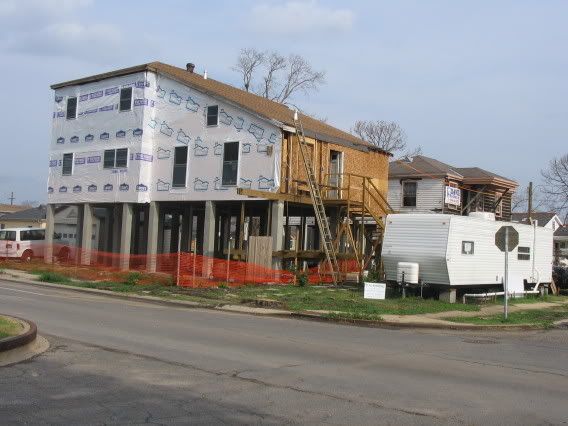
Just across the infamous London Avenue Canal from my current house is the neighborhood of Burbank Gardens. That’s where my Darling Wife and I bought our first house while I was still a student at the University of New Orleans.
The houses there are older and smaller than those of my home in Vista Park, but the people are just as nice. The major difference is that Vista Park is pretty much all slab on grade construction, whereas most houses in Burbank Gardens are on raised piers.
My little wood framed house was on piers about 2-1/2 feet off the ground.
We were living there on May 8, 1995, when an unprecedented 20 inches of rain came pouring down on New Orleans. The water in Burbank Gardens came up several porch steps, but did not get into the houses on our street, thanks to that raised construction.
This time was different.
This time, 30 inches was nowhere near high enough to escape the flooding. My former house and every other house in the neighborhood were substantially damaged by rising water.
I visited some of my former neighbors to see how they are getting along. What I saw is nothing short of amazing. Several of them are hard at work fixing up their houses, houses that are now 10 to 12 feet off the ground.
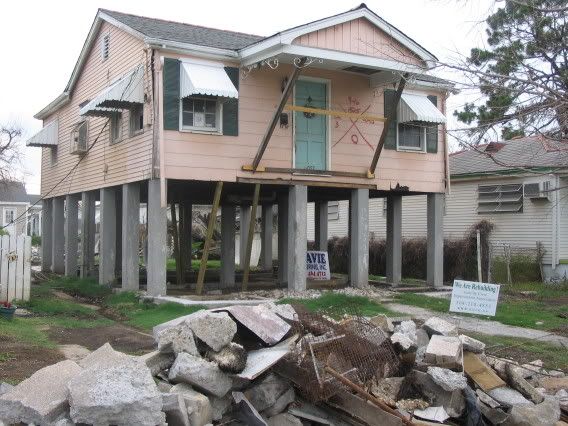
Having a raised pier house turns out to be useful in the aftermath of Hurricane Katrina anyway. Raising a house that’s already on piers is as simple as 1, 2, 3:
1. Slide beams under the house and jack it up to the sky.
2. Construct columns.
3. Lower the house onto the columns.
Oh, and one more thing: build a big-ass staircase.
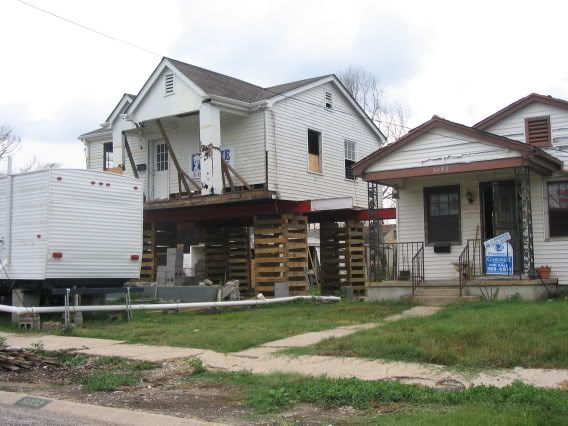
The photos here are of houses still being worked on. Most people are planning to at least partially close in the lower parts of their houses so that they won’t look like fishing camps when they’re done. Several said they are going to put a garage door and monumental steps leading to a porch at the front door.
I like to think of New Orleans as rising out of the current crisis and adversity we now face. And rise we shall, just like my friends in Burbank Gardens.
Wednesday, June 28, 2006
Of Mowers and Men
I went back to my house on Sunday. I pulled that old lawnmower out of the shed. I fiddled with it for about an hour. No go.
So I drove around the neighborhood to see what’s been happening. There’s another house gone at the other end of the block, and new piles of debris on the next street—looks like a group in a van with Indiana plates working one house.
And then I drove past Pratt Park—a wide, grassy playground with a really nice playscape in the middle. I saw a couple people working, and pulled up.

I was greeted by Casey of the Blue Shed. Casey’s former house was on Pratt. The London Avenue Canal levee was his backyard. Although the levee opened about a block away, the destruction of his house was just as potent, and he has since demolished what remained of his home.
But he kept the shed.
Drive down Pratt today, and you’ll see a smooth sand-covered lot with a pretty blue shed tucked back in the corner. He now signs emails to our neighborhood listserv as “The Blue Shed.”
Casey has become a man with a mission. With no house to fix up, and recognizing the inability of the New Orleans to keep up with its parks, Casey adopted Pratt Park.
Nobody asked him to do it. He just sent out an email one day, saying something like, “I’m going to clean up the park. Anyone who wants to join me is welcome.” He’s been working at the park pretty much every Sunday since then; sometimes with help, sometimes on his own.
On this bright hot day, Casey was getting high-powered help from another neighbor. Using a gas-powered power washer, Hale was meticulously removing the baked-on film of Hurricane Katrina’s flood. Moving in carefully planned rows, Hale wielded the water-wand like a craftsman creating art.
Hale hasn’t yet decided what to do with his house, and only recently moved his wife and two young children back from Colorado to Metairie, right next door to New Orleans. When we talked about the future of the city, he put it this way: “There will be no single chicken emerging from one egg. New Orleans is going to rebuild over time so that there will be many chickens and many eggs all around the city.”
I think I agreed with him.
Now I’ve blogged about Hale before. He’s the rocket scientist that was very popular in our neighborhood because of his willingness to share his home-brewed beer. Hale is a mechanical engineer, so unlike yours truly the civil engineer, he was able to get his flooded power tools going again.
I said to Casey, “What can I do to help?”
“Well, you can paint those climbing bars over there, or you can cut grass.”
I think we all know what I chose!
Call me crazy, but I proceeded to have a whole lot of fun working a push mower through an expanse of grass about half the size of a football field!
As I pushed it along, I thought about us three neighbors, Casey, Hale and Tim. Three guys who pretty much lost it all in the hurricane, but who all found a reason, and the spirit, to come back.
Heck, Hale doesn’t even know if he’s coming back to Vista Park, but here he is, on his day off, working in the hot sun.
And when I got home, I found more than one offer of a loaned lawnmower in my email and in comments on this blog. Offers of aid and assistance from people I’ve never met, except through the cold glow of a computer hooked to the Internet.
I ask you, who would deny such people the right to rebuild their city? Who would dare tell such civic-minded, proud, pick-yourself-up-by-the-bootstraps Americans that theirs was a lost cause?

Yet another neighbor, April, heard of Casey’s efforts and took her children to Pratt Park to see for herself. I post some pictures she took here.
April reports, “My kids played on the equipment and the swings this evening and people from Edgewater Baptist were out there having a picnic!! Oh it made me want to be home so bad, I just wish I could close my eyes and walk back across the street on Pressburg and be home......but not yet.”
I failed to get my mower started on Sunday. And it was probably the best thing that could have happened.
So I drove around the neighborhood to see what’s been happening. There’s another house gone at the other end of the block, and new piles of debris on the next street—looks like a group in a van with Indiana plates working one house.
And then I drove past Pratt Park—a wide, grassy playground with a really nice playscape in the middle. I saw a couple people working, and pulled up.

I was greeted by Casey of the Blue Shed. Casey’s former house was on Pratt. The London Avenue Canal levee was his backyard. Although the levee opened about a block away, the destruction of his house was just as potent, and he has since demolished what remained of his home.
But he kept the shed.
Drive down Pratt today, and you’ll see a smooth sand-covered lot with a pretty blue shed tucked back in the corner. He now signs emails to our neighborhood listserv as “The Blue Shed.”
Casey has become a man with a mission. With no house to fix up, and recognizing the inability of the New Orleans to keep up with its parks, Casey adopted Pratt Park.
Nobody asked him to do it. He just sent out an email one day, saying something like, “I’m going to clean up the park. Anyone who wants to join me is welcome.” He’s been working at the park pretty much every Sunday since then; sometimes with help, sometimes on his own.
On this bright hot day, Casey was getting high-powered help from another neighbor. Using a gas-powered power washer, Hale was meticulously removing the baked-on film of Hurricane Katrina’s flood. Moving in carefully planned rows, Hale wielded the water-wand like a craftsman creating art.
Hale hasn’t yet decided what to do with his house, and only recently moved his wife and two young children back from Colorado to Metairie, right next door to New Orleans. When we talked about the future of the city, he put it this way: “There will be no single chicken emerging from one egg. New Orleans is going to rebuild over time so that there will be many chickens and many eggs all around the city.”
I think I agreed with him.
Now I’ve blogged about Hale before. He’s the rocket scientist that was very popular in our neighborhood because of his willingness to share his home-brewed beer. Hale is a mechanical engineer, so unlike yours truly the civil engineer, he was able to get his flooded power tools going again.
I said to Casey, “What can I do to help?”
“Well, you can paint those climbing bars over there, or you can cut grass.”
I think we all know what I chose!
Call me crazy, but I proceeded to have a whole lot of fun working a push mower through an expanse of grass about half the size of a football field!
As I pushed it along, I thought about us three neighbors, Casey, Hale and Tim. Three guys who pretty much lost it all in the hurricane, but who all found a reason, and the spirit, to come back.
Heck, Hale doesn’t even know if he’s coming back to Vista Park, but here he is, on his day off, working in the hot sun.
And when I got home, I found more than one offer of a loaned lawnmower in my email and in comments on this blog. Offers of aid and assistance from people I’ve never met, except through the cold glow of a computer hooked to the Internet.
I ask you, who would deny such people the right to rebuild their city? Who would dare tell such civic-minded, proud, pick-yourself-up-by-the-bootstraps Americans that theirs was a lost cause?

Yet another neighbor, April, heard of Casey’s efforts and took her children to Pratt Park to see for herself. I post some pictures she took here.
April reports, “My kids played on the equipment and the swings this evening and people from Edgewater Baptist were out there having a picnic!! Oh it made me want to be home so bad, I just wish I could close my eyes and walk back across the street on Pressburg and be home......but not yet.”
I failed to get my mower started on Sunday. And it was probably the best thing that could have happened.
Saturday, June 24, 2006
Ode to a Lawnmower
On Father's Day, I visited my twice destroyed house. I went to cut the grass.
By "twice destroyed," I mean first destroyed by Hurricane Katrina, and then by fire.
By "cut the grass," I mean I wanted to mow down the overgrown grass, weeds and other vegetation that has enjoyed unbridled liberty in my yard for going on 10 months.
My lawnmower had been trapped in our shed when we evacuated New Orleans ahead of the storm. It sat under water for two or more weeks and remained in the waterlogged shed for several months before I finally pulled it out into the daylight sometime in January.
It was not a pretty sight. My trusty stallion of motorized efficiency had been transformed into a rusty reminder of watery destruction. My first instinct was to ditch it and I left it out in the backyard, exposed to the weather and easy pickings for looters and thieves.
But some days later, I began to think that perhaps there was still some life in that machine. It’s not that old, and it always started up with one or two pulls.
About three weeks ago, I had gone to the house with a purpose: start that mower.
Not an easy task, as you can imagine.
I started out by dousing every exposed moving part with 3-in-1 oil. Wheels, kill cable, choke, pulley and flywheel were all thoroughly drowned. At first the pull chord was stiff and did not retract on its own. But repeated operation and more oil and I worked it loose so that it almost worked like before the storm.
I drained the oil and gas tank, refilled them and put in a new spark plug. I removed the air filter but I did not have a replacement for it.
I figured that was enough, so I started to pull the chord purposefully. I pulled it about 20 times, and then I pulled it about 20 times more.
No luck.
So I used the “old school” fix: I pulled out the spark plug and poured gas directly into the cylinder. I put it back together and pulled the chord again. This time, gasoline and water sputtered from the muffler. The more I pulled, the more it sputtered.
But nothing ignited. Not a single chug. I pulled the chord until I was out of enthusiasm for the job, and then I pulled it some more.
That was earlier this month. I finally relented and put it back in our shed.

I went back on Father’s Day, hopeful that I could get that mower started, hopeful that I would be able to cut the grass.
Again, I pulled and pulled the chord. I took out the plug and could definitely smell the gas. But it did not budge. It did not crank or fire even one rotation. I put it back in the shed for another try on another day.
I’m not ready to give up.
I know that mower is just a rusted heap now. Why do I care if it ever runs again? And my lawn, my overgrown, weed-riddled lawn in front of my flooded, burned, and hopeless house on my decimated street just a short walk from the London Avenue Canal breach—why do I worry about how it looks?
Cutting the grass is a chore, a sweaty, mindless job I should be glad I don’t have to do right now.
But, damn it, I do care. That’s still my house, even if Katrina killed it, even if fire trashed its remains. That’s my neighborhood, too. I don’t want people passing by my house and saying, “What a dump.”
And I’m feeling like I’m still not in control of my destiny. Coming up on 10 months, and I’m still living at the whim of nature, government bureaucracy and insurance companies. I can’t even get my own lawnmower to start when I want it to!
This is life in post-K New Orleans, I suppose. We’re all in crazy motion, but who’s at the wheel? Who’s really in charge? We’re speeding forward through time, but to what destination?
And because I haven’t been able to get that lawnmower started, nature rules my yard. Heartless, indifferent nature destroyed our city, and almost 10 months later, we remain in her grip.
I will try again tomorrow.
By "twice destroyed," I mean first destroyed by Hurricane Katrina, and then by fire.
By "cut the grass," I mean I wanted to mow down the overgrown grass, weeds and other vegetation that has enjoyed unbridled liberty in my yard for going on 10 months.
My lawnmower had been trapped in our shed when we evacuated New Orleans ahead of the storm. It sat under water for two or more weeks and remained in the waterlogged shed for several months before I finally pulled it out into the daylight sometime in January.
It was not a pretty sight. My trusty stallion of motorized efficiency had been transformed into a rusty reminder of watery destruction. My first instinct was to ditch it and I left it out in the backyard, exposed to the weather and easy pickings for looters and thieves.
But some days later, I began to think that perhaps there was still some life in that machine. It’s not that old, and it always started up with one or two pulls.
About three weeks ago, I had gone to the house with a purpose: start that mower.
Not an easy task, as you can imagine.
I started out by dousing every exposed moving part with 3-in-1 oil. Wheels, kill cable, choke, pulley and flywheel were all thoroughly drowned. At first the pull chord was stiff and did not retract on its own. But repeated operation and more oil and I worked it loose so that it almost worked like before the storm.
I drained the oil and gas tank, refilled them and put in a new spark plug. I removed the air filter but I did not have a replacement for it.
I figured that was enough, so I started to pull the chord purposefully. I pulled it about 20 times, and then I pulled it about 20 times more.
No luck.
So I used the “old school” fix: I pulled out the spark plug and poured gas directly into the cylinder. I put it back together and pulled the chord again. This time, gasoline and water sputtered from the muffler. The more I pulled, the more it sputtered.
But nothing ignited. Not a single chug. I pulled the chord until I was out of enthusiasm for the job, and then I pulled it some more.
That was earlier this month. I finally relented and put it back in our shed.
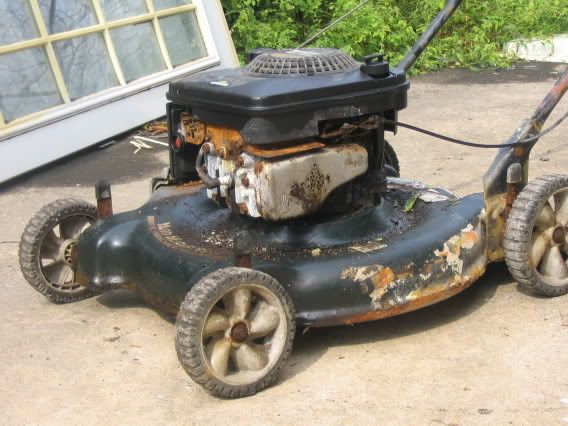
I went back on Father’s Day, hopeful that I could get that mower started, hopeful that I would be able to cut the grass.
Again, I pulled and pulled the chord. I took out the plug and could definitely smell the gas. But it did not budge. It did not crank or fire even one rotation. I put it back in the shed for another try on another day.
I’m not ready to give up.
I know that mower is just a rusted heap now. Why do I care if it ever runs again? And my lawn, my overgrown, weed-riddled lawn in front of my flooded, burned, and hopeless house on my decimated street just a short walk from the London Avenue Canal breach—why do I worry about how it looks?
Cutting the grass is a chore, a sweaty, mindless job I should be glad I don’t have to do right now.
But, damn it, I do care. That’s still my house, even if Katrina killed it, even if fire trashed its remains. That’s my neighborhood, too. I don’t want people passing by my house and saying, “What a dump.”
And I’m feeling like I’m still not in control of my destiny. Coming up on 10 months, and I’m still living at the whim of nature, government bureaucracy and insurance companies. I can’t even get my own lawnmower to start when I want it to!
This is life in post-K New Orleans, I suppose. We’re all in crazy motion, but who’s at the wheel? Who’s really in charge? We’re speeding forward through time, but to what destination?
And because I haven’t been able to get that lawnmower started, nature rules my yard. Heartless, indifferent nature destroyed our city, and almost 10 months later, we remain in her grip.
I will try again tomorrow.
Thursday, June 22, 2006
Seeking targets of opportunity
A Gentilly neighbor emailed today with official confirmation: National Guard soldiers were spotted patrolling the area. She saw it herself.
I'm not living on my flooded street in Vista Park: for now, I'm in the vibrant Riverbend part of town. But it's good news to hear that soldiers are on patrol in the area. It's good news that they are present and visible in the most damaged areas of the city.
The first day on the job and they've already started to make an impact. According to a local television station WDSU, Police arrested three people for looting in the Lakeview area yesterday, the first full day the soldiers were on the job.
The looters were charged with stealing copper pipe used for plumbing. Unfortunately, there are scum who are stealing the pieces of our homes almost as fast as we rebuild them.
And here's the kicker: only one of the suspects is a local. Two of them are from OUT OF TOWN.
Yes, New Orleans in the aftermath of Hurricane Katrina is in many ways a wild and lawless city, but hopefully the National Guard presence will restore some order and deter the OUT OF TOWN criminals who are taking advantage of us in this desperate time.
I'm not living on my flooded street in Vista Park: for now, I'm in the vibrant Riverbend part of town. But it's good news to hear that soldiers are on patrol in the area. It's good news that they are present and visible in the most damaged areas of the city.
The first day on the job and they've already started to make an impact. According to a local television station WDSU, Police arrested three people for looting in the Lakeview area yesterday, the first full day the soldiers were on the job.
The looters were charged with stealing copper pipe used for plumbing. Unfortunately, there are scum who are stealing the pieces of our homes almost as fast as we rebuild them.
And here's the kicker: only one of the suspects is a local. Two of them are from OUT OF TOWN.
Yes, New Orleans in the aftermath of Hurricane Katrina is in many ways a wild and lawless city, but hopefully the National Guard presence will restore some order and deter the OUT OF TOWN criminals who are taking advantage of us in this desperate time.
Sunday, June 18, 2006
What does your yard sign say?
There is no election underway in New Orleans right now, but there are plenty of yard signs: signs declaring a homeowner’s intention to rebuild, signs advertising damaged homes for sale, signs offering construction, demolition and tree removal services.
In the decimated areas left almost uninhabited since Hurricane Katrina, it seems yard signs are an important mode of communication. It is ironic that in this age of mass media, the Internet, cell phones and text messaging, simple placards remain powerful and vital.
Click to see the larger photos.
What does your yard sign say?


In the decimated areas left almost uninhabited since Hurricane Katrina, it seems yard signs are an important mode of communication. It is ironic that in this age of mass media, the Internet, cell phones and text messaging, simple placards remain powerful and vital.
Click to see the larger photos.
What does your yard sign say?


Thursday, June 15, 2006
Vacation
I'm not here, not really, not right now.
I know that sounds crazy in the virtual world of the Internet, but it's true.
As I write, I am nowhere near my home in Louisiana. I'm in South Carolina.
I suspect loyal readers usually imagine me sitting at a computer in my apartment in the Sliver by the River in the still-heavily damaged city of New Orleans. I'm sure they imagine me listening to WWOZ and drinking an Abita Restoration Ale while I wax poetic about the life and times of my family, my city, and my cats. And usually, that would be an accurate portrayal.
But for now, I'm at the Hilton Head Island Public Library, typing out a small entry in the blog of my life since Hurricane Katrina.
The weather, except for the rainy day Tropical Depression Alberto came over, has been fabulous. Days at the beach, feeling the wind of the Atlantic Ocean, imagining Africa just over the horizon...
But my thoughts remain in New Orleans. I was watching the waves this morning, small, gently breaking waves rolling in and running up the white sand beach, and I began to imagine larger, more powerful waves. I began to imagine 10-foot, 20-foot, 40-foot-tall waves of salt water, crashing and pounding and booming on the fragile shore, pulling shovelsful of sand loose with each successive attack. In military terms, successive assaults are called waves--an apt description to be sure.
I imagined my home state being attacked and our outer defenses being pulled apart by the beating ocean, indifferent Mother Nature ordering wave after wave against the ramparts we call barrier islands, and levees, and floodwalls.
The waves do not come in at regular intervals. No, that would be too simple. We could devise a defense too easily against such a threat (this is the engineer in me talking now). But the almost random interval and height of waves as they race up onto the sandy shore mean that no place is safe, no protection secure.
With a sigh, I am reminded again that it is not an easy thing to do. Living so close to nature, so intertwined with the oceans and rivers that give us life, is not at all a simple proposition. Those same forces and elements that power our lives can and will turn against us.
The philosopher Hendrix instructs us: "And so castles made of sand fall into the sea eventually."
My Precious Daughter has made friends with a girl from Kentucky. They dig and play in the surf and know nothing of the worry I have. They build their castles by dripping sand through their fingers. They know those castles will be gone tomorrow. They know that tonight, nature will send the sea up to wash all their work away.
But they build anyway, and enjoy them while they last.
I know that sounds crazy in the virtual world of the Internet, but it's true.
As I write, I am nowhere near my home in Louisiana. I'm in South Carolina.
I suspect loyal readers usually imagine me sitting at a computer in my apartment in the Sliver by the River in the still-heavily damaged city of New Orleans. I'm sure they imagine me listening to WWOZ and drinking an Abita Restoration Ale while I wax poetic about the life and times of my family, my city, and my cats. And usually, that would be an accurate portrayal.
But for now, I'm at the Hilton Head Island Public Library, typing out a small entry in the blog of my life since Hurricane Katrina.
The weather, except for the rainy day Tropical Depression Alberto came over, has been fabulous. Days at the beach, feeling the wind of the Atlantic Ocean, imagining Africa just over the horizon...
But my thoughts remain in New Orleans. I was watching the waves this morning, small, gently breaking waves rolling in and running up the white sand beach, and I began to imagine larger, more powerful waves. I began to imagine 10-foot, 20-foot, 40-foot-tall waves of salt water, crashing and pounding and booming on the fragile shore, pulling shovelsful of sand loose with each successive attack. In military terms, successive assaults are called waves--an apt description to be sure.
I imagined my home state being attacked and our outer defenses being pulled apart by the beating ocean, indifferent Mother Nature ordering wave after wave against the ramparts we call barrier islands, and levees, and floodwalls.
The waves do not come in at regular intervals. No, that would be too simple. We could devise a defense too easily against such a threat (this is the engineer in me talking now). But the almost random interval and height of waves as they race up onto the sandy shore mean that no place is safe, no protection secure.
With a sigh, I am reminded again that it is not an easy thing to do. Living so close to nature, so intertwined with the oceans and rivers that give us life, is not at all a simple proposition. Those same forces and elements that power our lives can and will turn against us.
The philosopher Hendrix instructs us: "And so castles made of sand fall into the sea eventually."
My Precious Daughter has made friends with a girl from Kentucky. They dig and play in the surf and know nothing of the worry I have. They build their castles by dripping sand through their fingers. They know those castles will be gone tomorrow. They know that tonight, nature will send the sea up to wash all their work away.
But they build anyway, and enjoy them while they last.
Subscribe to:
Posts (Atom)