A neighbor from Vista Park had another letter in The Times Picayune today.
KC is one of the few people in New Orleans who truly understands the risk of living here. As he rebuilds his home just a few hundred feet from the London Avenue Canal breach, KC has been tireless in his efforts to get the word out: We Are Not OK.
Just one small point I need to make about KC's letter: the Dutch design goal is to provide for a MINIMUM 1,250-year event, mostly in farm or less-developed areas of the county. Highly populated urban or industrial regions get 10,000-year protection (0.01 percent chance of exceedence per year).
But KC is cold correct when he points out who is responsible to manage the residual risks: individual citizens.
Monday, October 20, 2008


Friday, October 17, 2008
From the seat of my pants
Driving in Orange County, California turned out to be quite an amazing experience for someone from New Orleans.
Bumps, potholes and anything that would add vibration to travel on the city streets simply do not exist in Orange County. Specifically, I was driving in Santa Ana this week, the city where John Wayne Airport (yes, it’s named after the Duke) is located.
It took a few moments for me to comprehend the beauty of the silky smooth roads there. I was driving a rental car, so my first thought was that the car had a really nice ride and excellent seats. But as I looked down the pristine roadway of perfectly manicured black asphalt, it dawned on me: these are really nice streets.
Perhaps you have to be a civil engineer to fully appreciate what a well built and impeccably maintained road is all about. But perhaps the experience is not so cerebral and requires nothing more than buttocks accustomed to the constant rumble of unraveling asphalt and cracked concrete of an aging, neglected city like New Orleans.
As I drove along, I began to look for potholes or any sign of distress that would tell me I was driving in a real city, a city like my own sweet Crescent City that struggles to keep up with street maintenance. It was a fruitless search.
Making my way toward my hotel, I turned off the major thoroughfare onto a more local street, again hoping—yes, hoping—that I would find the urban decay that was so much a part of home. Again, nothing but smooth, disturbance-free travel.
A few blocks on, I came upon a small traffic jam. A-Ha, I thought, they may have beautiful streets, but they still can’t efficiently convey the full flow of weekday traffic. As we merged over into a single line of cars, I saw up ahead the common trappings of roadway work: large orange warning signs and the ubiquitous traffic cones. Drawing closer, I saw a pair of paving machines and men in bright safety vests moving hot asphalt about with shovels.
And painted in block letters on the equipment were the letters “SAPW,” Santa Ana Public Works.
The city actually had their own in-house crew resurfacing streets. Even though the street for a mile in either direction was, to my best judgment, in excellent serviceable condition, here they were fixing whatever minor imperfections they had found with all haste.
I pulled up to the hotel a few blocks later and parked the car. After settling into my room, I opened the curtains to look over the vista. Down the hill was an unbroken quilt of urbanized terrain. Hotels, gas stations, shops, banks and houses blended into an unbroken cityscape down the slope to the Pacific Ocean in the distance. Weaving them all together were the streets, those vital threads of commerce and communication, the very lifelines of the modern city.
It is no accident that we talk about our roads in biological terminology. No organic community will grow or thrive or be healthy without adequately functional arteries. Living as I have for most of my life in New Orleans, I guess I had developed low expectations for what high quality streets looked like or even how maintaining excellent streets could even be possible.
But what my mind had lazily never considered or dreamed possible, my buttocks discovered and exclaimed: it is not simply a fantasy to have streets in good repair.
Various professional and trade organizations as well as government highway officials have warned us for years that poorly maintained roads cost the public a lot of money—more even than the money our politicians might think they are “saving” by permanently deferring maintenance. Every mile we drive over pocked and damaged roadway takes a toll on our cars in maintenance, lost travel time and reduced fuel efficiency.
And I will add that every mile we drive on the pitiful streets of New Orleans dulls what should be our collective community outrage over the sad condition of this most basic city service. It lulls us into the dangerous mindset that, “That’s just how things are here. There’s no point in trying to fix this or any other of our city’s problems.”
As defeating and destructive and that thinking is, I realized perhaps an even greater damage done to us by our pathetic streets comes in the reverse situation to my recent trip to Orange County.
As awed as I was by the quality of their streets, what must the visitor to New Orleans think of OUR roadways? And what must they conclude about the viability of OUR city? Who wants to live in a city or invest in a city that can’t even fill the potholes?
It’s a jarring thought, even more jarring than driving down a local street here.
Bumps, potholes and anything that would add vibration to travel on the city streets simply do not exist in Orange County. Specifically, I was driving in Santa Ana this week, the city where John Wayne Airport (yes, it’s named after the Duke) is located.
It took a few moments for me to comprehend the beauty of the silky smooth roads there. I was driving a rental car, so my first thought was that the car had a really nice ride and excellent seats. But as I looked down the pristine roadway of perfectly manicured black asphalt, it dawned on me: these are really nice streets.
Perhaps you have to be a civil engineer to fully appreciate what a well built and impeccably maintained road is all about. But perhaps the experience is not so cerebral and requires nothing more than buttocks accustomed to the constant rumble of unraveling asphalt and cracked concrete of an aging, neglected city like New Orleans.
As I drove along, I began to look for potholes or any sign of distress that would tell me I was driving in a real city, a city like my own sweet Crescent City that struggles to keep up with street maintenance. It was a fruitless search.
Making my way toward my hotel, I turned off the major thoroughfare onto a more local street, again hoping—yes, hoping—that I would find the urban decay that was so much a part of home. Again, nothing but smooth, disturbance-free travel.
A few blocks on, I came upon a small traffic jam. A-Ha, I thought, they may have beautiful streets, but they still can’t efficiently convey the full flow of weekday traffic. As we merged over into a single line of cars, I saw up ahead the common trappings of roadway work: large orange warning signs and the ubiquitous traffic cones. Drawing closer, I saw a pair of paving machines and men in bright safety vests moving hot asphalt about with shovels.
And painted in block letters on the equipment were the letters “SAPW,” Santa Ana Public Works.
The city actually had their own in-house crew resurfacing streets. Even though the street for a mile in either direction was, to my best judgment, in excellent serviceable condition, here they were fixing whatever minor imperfections they had found with all haste.
I pulled up to the hotel a few blocks later and parked the car. After settling into my room, I opened the curtains to look over the vista. Down the hill was an unbroken quilt of urbanized terrain. Hotels, gas stations, shops, banks and houses blended into an unbroken cityscape down the slope to the Pacific Ocean in the distance. Weaving them all together were the streets, those vital threads of commerce and communication, the very lifelines of the modern city.
It is no accident that we talk about our roads in biological terminology. No organic community will grow or thrive or be healthy without adequately functional arteries. Living as I have for most of my life in New Orleans, I guess I had developed low expectations for what high quality streets looked like or even how maintaining excellent streets could even be possible.
But what my mind had lazily never considered or dreamed possible, my buttocks discovered and exclaimed: it is not simply a fantasy to have streets in good repair.
Various professional and trade organizations as well as government highway officials have warned us for years that poorly maintained roads cost the public a lot of money—more even than the money our politicians might think they are “saving” by permanently deferring maintenance. Every mile we drive over pocked and damaged roadway takes a toll on our cars in maintenance, lost travel time and reduced fuel efficiency.
And I will add that every mile we drive on the pitiful streets of New Orleans dulls what should be our collective community outrage over the sad condition of this most basic city service. It lulls us into the dangerous mindset that, “That’s just how things are here. There’s no point in trying to fix this or any other of our city’s problems.”
As defeating and destructive and that thinking is, I realized perhaps an even greater damage done to us by our pathetic streets comes in the reverse situation to my recent trip to Orange County.
As awed as I was by the quality of their streets, what must the visitor to New Orleans think of OUR roadways? And what must they conclude about the viability of OUR city? Who wants to live in a city or invest in a city that can’t even fill the potholes?
It’s a jarring thought, even more jarring than driving down a local street here.
Monday, September 29, 2008
My biker friend
In those dark days following Hurricane Katrina few things were certain. Among them, I knew I must return to the city as soon as possible. I also knew I had no place to live when I did.
In an incredible turn of luck, a friend introduced me to a UNO professor named David. Luck, seemingly in short supply in September 2005, became suddenly plentiful. Not only did David have a house that probably had not flooded, he was not planning to return with his family for a few months. David told me I could have free use his house for as long as I needed. And luckier still, he had evacuated to within a 45-minute drive of where we were in Virginia. I picked up the keys as I headed back to the city in late September.
I lived in David's house for about a month and he has never asked for anything in return.
Next week, David will once again be pedaling his generosity as he participates in this year's National Multiple Sclerosis Society Bike Tour. It's a 150-mile ride to raise money for those who cannot ride for themselves. David will join with a thousand or more cyclists in a mass demonstration of care. When I heard he was looking for sponsors, I did not hesitate to toss a few dollars into his hat.
If you'd like to make a donation or join the team, please visit the National MS Society Bike Event page. Let David know we all support his efforts and his dedication.
In an incredible turn of luck, a friend introduced me to a UNO professor named David. Luck, seemingly in short supply in September 2005, became suddenly plentiful. Not only did David have a house that probably had not flooded, he was not planning to return with his family for a few months. David told me I could have free use his house for as long as I needed. And luckier still, he had evacuated to within a 45-minute drive of where we were in Virginia. I picked up the keys as I headed back to the city in late September.
I lived in David's house for about a month and he has never asked for anything in return.
Next week, David will once again be pedaling his generosity as he participates in this year's National Multiple Sclerosis Society Bike Tour. It's a 150-mile ride to raise money for those who cannot ride for themselves. David will join with a thousand or more cyclists in a mass demonstration of care. When I heard he was looking for sponsors, I did not hesitate to toss a few dollars into his hat.
If you'd like to make a donation or join the team, please visit the National MS Society Bike Event page. Let David know we all support his efforts and his dedication.
Sunday, September 21, 2008
'Tis the Season
Hurricane season continues, at least according to scientists, until November 30.
While I'm sure they put a lot of thought into selecting that date, it remains rather arbitrary. There's no reason why hurricanes can't develop and strike after that date (and they certainly have). Nature has relentlessly resisted all our attempts to fit the seasons into neat little boxes on our calendars since long before Roy Rogers sang, "Don't Fence Me In."
The good news for the people of coastal Texas and Louisiana recently whacked by Gustav and Ike is that statistically at least they are in the clear. Scientists say there's two more months of hurricane season, but the worst part of hurricane season is over. Those on the wet and battered coast have reason to be optimistic as they continue to clean up, repair and rebuild what they can.
My Darling Wife forwarded this little bit of hurricane season levity via an infinite string of forwarded emails. I don't know how long it's been making the rounds, but I think it's the first time I've seen it and I think it's a clever contrast.
So here now are the Top Ten Reasons Hurricane Season Is Like Christmas:
Number Ten: Decorating the house (with plywood).
Number Nine: Dragging out boxes that haven't been used since last season.
Number Eight: Last minute shopping in crowded stores.
Number Seven: Regular TV shows preempted for "Specials."
Number Six: Family coming to stay with you.
Number Five: Family and friends from out of state calling you.
Number Four: Buying food you don't normally buy . . . and in large quantities.
Number Three: Days off from work.
Number Two: Candles.
And the Number One reason Hurricane Season is like Christmas:
At some point you're probably going to have a tree in your house!
While I'm sure they put a lot of thought into selecting that date, it remains rather arbitrary. There's no reason why hurricanes can't develop and strike after that date (and they certainly have). Nature has relentlessly resisted all our attempts to fit the seasons into neat little boxes on our calendars since long before Roy Rogers sang, "Don't Fence Me In."
The good news for the people of coastal Texas and Louisiana recently whacked by Gustav and Ike is that statistically at least they are in the clear. Scientists say there's two more months of hurricane season, but the worst part of hurricane season is over. Those on the wet and battered coast have reason to be optimistic as they continue to clean up, repair and rebuild what they can.
My Darling Wife forwarded this little bit of hurricane season levity via an infinite string of forwarded emails. I don't know how long it's been making the rounds, but I think it's the first time I've seen it and I think it's a clever contrast.
So here now are the Top Ten Reasons Hurricane Season Is Like Christmas:
Number Ten: Decorating the house (with plywood).
Number Nine: Dragging out boxes that haven't been used since last season.
Number Eight: Last minute shopping in crowded stores.
Number Seven: Regular TV shows preempted for "Specials."
Number Six: Family coming to stay with you.
Number Five: Family and friends from out of state calling you.
Number Four: Buying food you don't normally buy . . . and in large quantities.
Number Three: Days off from work.
Number Two: Candles.
And the Number One reason Hurricane Season is like Christmas:
At some point you're probably going to have a tree in your house!
Sunday, September 14, 2008
Evacuation is the wise choice
There's been some ongoing discussion around town about whether or not people would evacuate should another hurricane turn toward New Orleans. The one thing everyone agrees about is that evacuating is unpleasant and costly.
But that's not the point. Evacuation is a matter of safety. That is, it could be the difference between life and death.
To help the more stubborn arrive at a fully informed decision, I've created an Evacuation Decision Matrix. Please click on it for a closer view.

Feel free to print it out for easy reference if you need to. For those wanting a more detailed comparison, check out this story from The Galveston County Daily News. They say experience is the best teacher. In the case of hurricanes, it's even better if you can learn from the experience of others.
But that's not the point. Evacuation is a matter of safety. That is, it could be the difference between life and death.
To help the more stubborn arrive at a fully informed decision, I've created an Evacuation Decision Matrix. Please click on it for a closer view.
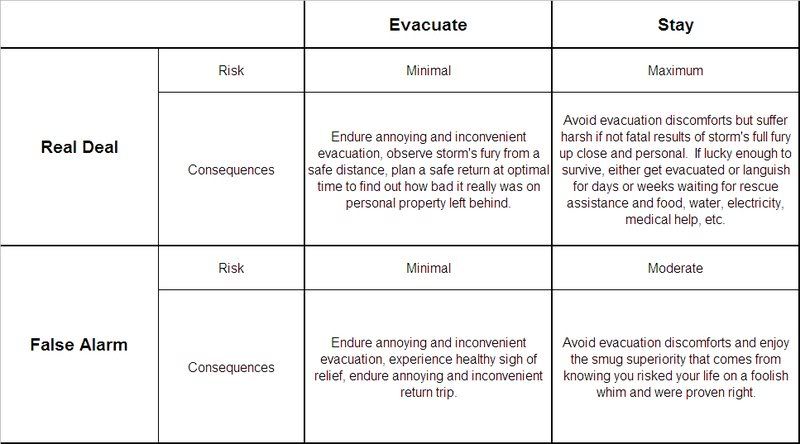
Feel free to print it out for easy reference if you need to. For those wanting a more detailed comparison, check out this story from The Galveston County Daily News. They say experience is the best teacher. In the case of hurricanes, it's even better if you can learn from the experience of others.
Friday, September 12, 2008
Outlook grim as Ike approaches
That's the title of reporter's blog entry from The Galveston County Daily News at 8:00 pm Friday night:
"I hope that the staff at the National Hurricane Center and the local National Weather Service are wrong...
"...[W]e are facing the highest tidal surge since at least the 1900 Storm and possibly even exceeding that if the highest projected tidal surge materializes...
"If the surge threat is not enough, the National Weather Service is calling for 80-95 mph sustained winds with gusts to 105-mph. Hurricane force winds are expected to last for an incredible 8-10 hours on Galveston Island..."
When hurricanes lurk in the Gulf, everyone hopes it doesn't come his or her way and everyone is relieved when a hurricane misses their community.
But no matter where these monsters make landfall, no one is really happy. No one can feel glad knowing what is happening to Galveston tonight.
Our hearts are with Texas tonight.
"I hope that the staff at the National Hurricane Center and the local National Weather Service are wrong...
"...[W]e are facing the highest tidal surge since at least the 1900 Storm and possibly even exceeding that if the highest projected tidal surge materializes...
"If the surge threat is not enough, the National Weather Service is calling for 80-95 mph sustained winds with gusts to 105-mph. Hurricane force winds are expected to last for an incredible 8-10 hours on Galveston Island..."
When hurricanes lurk in the Gulf, everyone hopes it doesn't come his or her way and everyone is relieved when a hurricane misses their community.
But no matter where these monsters make landfall, no one is really happy. No one can feel glad knowing what is happening to Galveston tonight.
Our hearts are with Texas tonight.
Saturday, September 06, 2008
Running a long race
Back home, power on, minor damage to the house and yard. We didn't have Internet, so I haven't been able to post an update for a few days.
In New Orleans, Hurricane Gustav will not be remembered for doing billions in physical damage. The majority of my friends and neighbors will remember Gustav for leaving everyone's nerves frayed. Indeed, some have already proclaimed they will not evacuate again.
I've collected a few of the reactions from friends which I think paint the picture well.
"House is a wreck, but I'm comfy and wired now, and oddly exhausted. I think my airplane rubber band unwound. Pent up survival adrenaline all left me in a rush."
"[Road Home] gave all us employees an emergency number on a laminated card to put in with our ID badges. Yer supposed to call it to find out about work. They said they'd have it going, no matter what. Of course, it doesn't work."
"After cleaning up shards, branches and debris off the gallery just now, I started crying. When [my husband] asked me why, I said I feel like I just got done running a long race and don't know if I have to run another one."
"I am soooo tired. I too just wander around the house and don't see any point in doing anything. Depression I guess but in reality, there really is no point in cleaning the house if I have to leave again in 4 days."
Goodbye, Gustav. Hello, Ike.
In New Orleans, Hurricane Gustav will not be remembered for doing billions in physical damage. The majority of my friends and neighbors will remember Gustav for leaving everyone's nerves frayed. Indeed, some have already proclaimed they will not evacuate again.
I've collected a few of the reactions from friends which I think paint the picture well.
"House is a wreck, but I'm comfy and wired now, and oddly exhausted. I think my airplane rubber band unwound. Pent up survival adrenaline all left me in a rush."
"[Road Home] gave all us employees an emergency number on a laminated card to put in with our ID badges. Yer supposed to call it to find out about work. They said they'd have it going, no matter what. Of course, it doesn't work."
"After cleaning up shards, branches and debris off the gallery just now, I started crying. When [my husband] asked me why, I said I feel like I just got done running a long race and don't know if I have to run another one."
"I am soooo tired. I too just wander around the house and don't see any point in doing anything. Depression I guess but in reality, there really is no point in cleaning the house if I have to leave again in 4 days."
Goodbye, Gustav. Hello, Ike.
Tuesday, September 02, 2008
Notes from the road
Evacuated to Greenville, Mississippi, waiting and hoping for the best for us and all our friends and family.
Yesterday we ventured out into this little town to get lunch at a local restaurant called Tabb's Barbecue. My Darling Wife had seen an advertisement describing it as, "The best dang barbecue in the whole dang delta." We found it tucked in the middle of a typical strip shopping mall.
And as you could have guessed, it was filled with red checked tablecloths spread over wooden furniture. Each table was outfitted with a roll of paper towels and squirt bottles of barbecue sauce. There was also the obligatory vintage farm tools and product logos nailed up on the walls.
I ordered the pulled pork platter and split it with our Precious Daughter. All-in-all a nice meal, but it was hard to forget the current crisis besieging South Louisiana. Especially because the decor included framed photographs of The Great Flood of 1927. Yes, Greenville is situated on the same river as New Orleans and so they have their history of misery by flooding, too.
Today I saw a story from the AP with this line from hizzoner: "I would not do a thing differently," Nagin said. "I'd probably call Gustav, instead of the mother of all storms, maybe the mother-in-law or the ugly sister of all storms."
Except of course, Gustav is a MAN'S NAME, so HE would not be the mother, mother-in-law nor sister of anything or anyone. Try again, Ray.
News from the neighborhood is almost all good: branches and a tree or two but otherwise all in tact. No power as of this afternoon according to some who remain there.
I've been using Twitter to keep in touch with the NOLA Bloggers and credit them with helping maintain my sanity through this. As I noted in another post, the mainstream media made a total mess of this one. Had it not been for the fact-checking and on-the-scene "tweets" from the hearty NOLA Bloggers I'm sure I would be an emotional wreck right now.
Yesterday we ventured out into this little town to get lunch at a local restaurant called Tabb's Barbecue. My Darling Wife had seen an advertisement describing it as, "The best dang barbecue in the whole dang delta." We found it tucked in the middle of a typical strip shopping mall.
And as you could have guessed, it was filled with red checked tablecloths spread over wooden furniture. Each table was outfitted with a roll of paper towels and squirt bottles of barbecue sauce. There was also the obligatory vintage farm tools and product logos nailed up on the walls.
I ordered the pulled pork platter and split it with our Precious Daughter. All-in-all a nice meal, but it was hard to forget the current crisis besieging South Louisiana. Especially because the decor included framed photographs of The Great Flood of 1927. Yes, Greenville is situated on the same river as New Orleans and so they have their history of misery by flooding, too.
Today I saw a story from the AP with this line from hizzoner: "I would not do a thing differently," Nagin said. "I'd probably call Gustav, instead of the mother of all storms, maybe the mother-in-law or the ugly sister of all storms."
Except of course, Gustav is a MAN'S NAME, so HE would not be the mother, mother-in-law nor sister of anything or anyone. Try again, Ray.
News from the neighborhood is almost all good: branches and a tree or two but otherwise all in tact. No power as of this afternoon according to some who remain there.
I've been using Twitter to keep in touch with the NOLA Bloggers and credit them with helping maintain my sanity through this. As I noted in another post, the mainstream media made a total mess of this one. Had it not been for the fact-checking and on-the-scene "tweets" from the hearty NOLA Bloggers I'm sure I would be an emotional wreck right now.
Monday, September 01, 2008
MSM = BS
If you're like me, you've suspected it for quite some time. The main stream media (msm) often don't have a clue.
But does that stop them from broadcasting?
Absolutely not.
Last night I saw a weatherman from Anywhere-but-Louisiana standing in front of a beautiful satellite montage photo of greater New Orleans. As he spoke and gestured dramatically about the likely path and power of Hurricane Gustav, the photo rotated and zoomed in that fancy Google Earth way that makes you wonder how the heck we got along without this stuff before. As the graphics were doing their thing, the weatherguy continued to talk about the potential storm surge and the threat to St. Bernard. And right smack in the middle of the graphic was "St. Bernard" with its levees all highlighted and easy to see.
Except it wasn't St. Bernard he was showing us--it was New Orleans East.
Doubtless the dramatically gesticulating dude did not know 7th Ward from 9th Ward, either, but who cares? It's just news for goodness sake.
Today, CNN was reporting breaches in the Industrial Canal. Except there were no breaches.
And later, there was a phoned-in interview with someone from the Corps' public affairs office to explain why the London Avenue Canal gates were being closed. There was discussion of the safe water elevation and the need to coordinate pumping with S&WB. During the interview CNN decided to show footage of the Industrial Canal with water to the top of the wall and waves and wind splashing and spraying over the wall. So I'd bet most of America looking at that broadcast thought they were looking at the London Canal floodwalls.
As Maitri advises, "PLEASE PLEASE PLEASE DO NOT WATCH CNN AND FOX NEWS!" and she gives a nice link to web page that allows you to watch feeds from four local television stations all at once. Easy and accurate.
Get your news from people who know what they're reporting about.
But does that stop them from broadcasting?
Absolutely not.
Last night I saw a weatherman from Anywhere-but-Louisiana standing in front of a beautiful satellite montage photo of greater New Orleans. As he spoke and gestured dramatically about the likely path and power of Hurricane Gustav, the photo rotated and zoomed in that fancy Google Earth way that makes you wonder how the heck we got along without this stuff before. As the graphics were doing their thing, the weatherguy continued to talk about the potential storm surge and the threat to St. Bernard. And right smack in the middle of the graphic was "St. Bernard" with its levees all highlighted and easy to see.
Except it wasn't St. Bernard he was showing us--it was New Orleans East.
Doubtless the dramatically gesticulating dude did not know 7th Ward from 9th Ward, either, but who cares? It's just news for goodness sake.
Today, CNN was reporting breaches in the Industrial Canal. Except there were no breaches.
And later, there was a phoned-in interview with someone from the Corps' public affairs office to explain why the London Avenue Canal gates were being closed. There was discussion of the safe water elevation and the need to coordinate pumping with S&WB. During the interview CNN decided to show footage of the Industrial Canal with water to the top of the wall and waves and wind splashing and spraying over the wall. So I'd bet most of America looking at that broadcast thought they were looking at the London Canal floodwalls.
As Maitri advises, "PLEASE PLEASE PLEASE DO NOT WATCH CNN AND FOX NEWS!" and she gives a nice link to web page that allows you to watch feeds from four local television stations all at once. Easy and accurate.
Get your news from people who know what they're reporting about.
Sunday, August 31, 2008
Again
I've loss count how many times we've evacuated. Georges, Ivan, Katrina, others I suppose. And now Gustav.
Jarvis DeBerry has an excellent perspective in The Times-Picayune today, writing about the fear of losing again what we've only just regained after losing it three years ago.
We only just moved into our new home in May, just 4 months ago. As we readied to leave in the predawn hours this morning, my Darling Wife stood in the kitchen and covered her face with her hands. I know what she was thinking; she was terrified that after so much effort, so much work and expense, we were still having to evacuate from an oncoming hurricane. We were still not safe.
A moment later she was ready to go, and as we drove out of the city, we held hands.
Jarvis DeBerry has an excellent perspective in The Times-Picayune today, writing about the fear of losing again what we've only just regained after losing it three years ago.
We only just moved into our new home in May, just 4 months ago. As we readied to leave in the predawn hours this morning, my Darling Wife stood in the kitchen and covered her face with her hands. I know what she was thinking; she was terrified that after so much effort, so much work and expense, we were still having to evacuate from an oncoming hurricane. We were still not safe.
A moment later she was ready to go, and as we drove out of the city, we held hands.
Saturday, August 30, 2008
Hurricane Katrina Quiz: Third Anniversary
Friday, August 29, 2008
New Orleans, Hurricane Katrina, 3 years

From New Orleans and in solidarity with my fellow bloggers, please remember.
http://animamundi.typepad.com/animamundi/2008/08/three-years-and.html
http://adrastos.blog-city.com/three_years.htm
http://www.dsbnola.com/?p=350
http://blogofneworleans.com/blog/2008/08/29/082905-082908/
http://myrants.blog-city.com/8292008.htm
http://humidcity.com/2008/08/29/remember/
http://gentillygirl.com/2008/08/29/third-anniversary/
http://www.first-draft.com/2008/08/hurricane-katri.html
http://www.first-draft.com/2008/08/hurricane-katri.html
http://vatul.net/blog/index.php/1896/
http://noladishu.blogspot.com/2008/08/katrinaversary.html
http://www.suspect-device.com/blog/?p=2468
http://www.scottharney.com/2008/08/29/3-years/
http://prytaniawaterline.com/blog/2008/08/29/remember/
http://some-came-running.blogspot.com/2008/08/sunrise-on-mississippi.html
http://thanks-katrina.blogspot.com/2008/08/katrina-three-years-later.html
http://toulousestreet.wordpress.com/2008/08/29/remember-3/
http://musicandcats.com/2008/08/remember-2/
Subscribe to:
Posts (Atom)