Tuesday, April 18, 2006
FIRE!
A little after noon today, my Darling Wife called me with these frantic words.
She had gone to the house to check on the plumber's work. Our comfortable house in Vista Park on the north end of New Orleans is scheduled for termination, probably early next month. We plan to live on site in a FEMA travel trailer while we rebuild, so we hired a plumber to make the sewer and water connections available to us even after the house is knocked down and carted away.
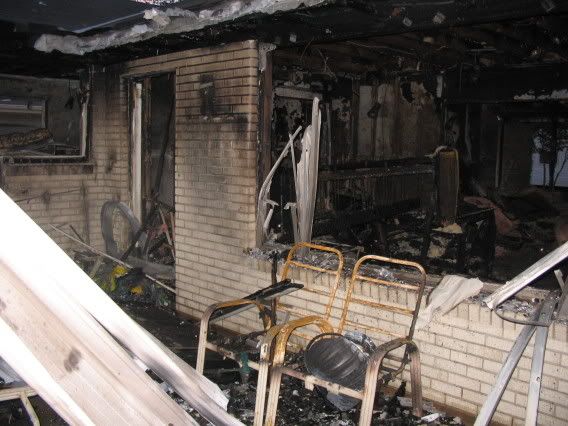
"It's all black and burned and the patio cover is down," she said.
I listened breathlessly as she walked around the property, describing what she was seeing.
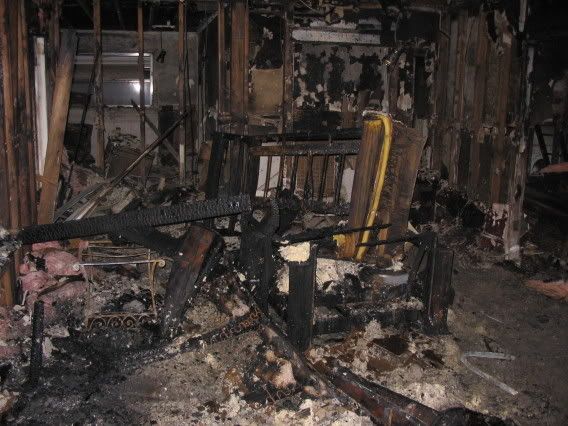
"It's black. The kitchen's black, the sofa is just black springs..."
A neighbor down the street had gone outside early to enjoy the morning air. It's been getting up to near 90 for the past few days, so mornings are the best time to be outside. She saw the smoke and called 911. It was about 7 am.
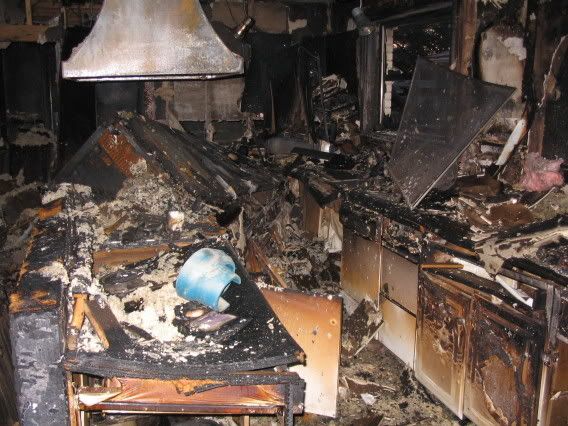
Four fire trucks responded. They quickly had the fire under control, but as firefighters are trained to do, they tore out walls and ceilings to make sure it was all thoroughly doused. And they broke all the windows.
My Darling Wife was very upset by the sight. I had to remind her that the house was, well, dead already. What difference did it make? She was upset that there could be a fire at our house, our home, and we did not even know about it. She also wondered who would do this. Who started this fire?
I gave her the phone number to the Fire Department and asked her to call and ask for details.
She called me back a little while later, a little calmer, but still upset. The Fire Department told her an investigation had been started, and that we would receive a copy of the report in two weeks or so.
The neighbor who called it in told my Darling Wife that the firefighters on the scene said it probably started in the attic. We don't know how any fire might get started on its own in our house, especially since the electricity and gas have been disconnected. We can only speculate that a vagrant or vagrants of some sort were there and caused a fire. Was it an accident? We may never know.
I went to see for myself this evening and took these photos. It's hard to believe that after so much destruction there could be more destruction, but there it is.
The incident drove home a worry we all have in post-K New Orleans. That thousands of empty, rotting houses remain standing in row after row of flooded neighborhoods. That those houses are easy refuge for vagrants, criminals and delinquents. That a careless or deliberate fire could erupt from any of them at any time.
The good news here is that the New Orleans Fire Department responded quickly and effectively. I did not see it, but our neighbor said they did a fabulous job all around. When we do return to our still sparsely-populated street, at least I know that someone will come if we ever have to dial 911.
In the end, no one was hurt, and we had already taken everything we could salvage, so it's hard to say we suffered any damage. I've often said our house is "toast;" I just didn't mean it so literally.
To think that just yesterday I was blogging about how good things were going in spite of the beating we took from Katrina!
Monday, April 17, 2006
FEMAville
Some good news today. SBA, the Small Business Administration, has approved me for a low-interest loan. Now mind you, I am not a small business, and neither is my family, but in the bureaucracy of the United States Government which I lack sufficient brain power to comprehend, individuals who are victims of properly declared natural disasters can get personal loans to rebuild and replace their homes and possessions.
So the nice SBA loan officer informed me that we will be offered a loan at the special post-K rate of 2.687 percent. Compare that to current market home loan rates of near 6 percent, and you see why I'm happy. Prior to the flood, I had a loan of 5.125 percent.
There's still a lot of paperwork to be done, estimates and building permits and we-can-only-imagine setbacks and slowdowns to come, but if we are able to finance the entire new house at that rate, we're going to be A.O.K.
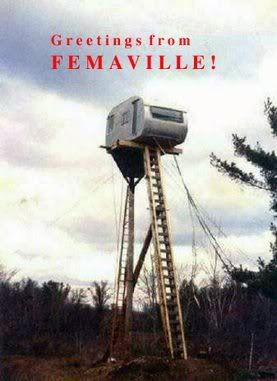
On another note, I found this photo of what New Orleans is going to look like in the immediate future. Yes, travel trailers will be everywhere, but the wiser pioneers will make sure to raise their wheeled wigwams to stay safe from any future flooding this hurricane season.
A long climb to get home, yes, but then I'll be able to leave for work like the guy in that automobile commercial--with a parachute!
Friday, April 14, 2006
The next Mayor
With all we've been through these past months since Hurricane Katrina, I can tell you that I'm looking for a new vision for our grand city. I'm looking for someone who can inspire us to do the impossible. I'm looking for a mayor who won't make embarrassing statements to the press, or to anyone else for that matter. I'm looking for a mayor who commands respect and admiration and will be an ambassador to the world.
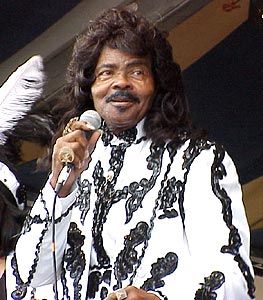
There are more than two dozen people seeking the job this year, but the only one who comes close to filling my criteria is none other than the Emperor of the Universe himself: Ernie K-Doe.
K-Doe you may recall recorded one of the greatest songs in rock'n'roll history, "Mother-in-Law." The Allen Toussaint-penned tale of woe hit No. 1 on the Billboard Hot 100 chart in May of 1961, and also reigned on top of the R&B chart for 5 consecutive weeks.
An R&B artist for mayor? Think about it: K-Doe has name recognition. He's got fans from every economic group, every ethnic background, and every religious persuasion. If it were not for the fact that K-Doe died five years ago, he'd be a shoo-in.
Heck, if you think about it, that's probably not gonna stop him!
His widow, the ever-flamboyant Miss Antoinette, does her level best to keep the memory and unbridled spirit of K-Doe's life alive and kicking. She announced her departed husband's bid for the city's top spot at a rally here the other day.
I used to listen to K-Doe when he deejayed on WWOZ radio here. K-Doe was often drunk, or at least he sure sounded like he was. He had the habit of cutting in on songs to comment on the lyrics, ad-lib new lyrics, or just to shout out a hello to friends and neighbors. His favorite topic was, naturally, his own greatness, and he would encourage himself all the way, shouting out "Burn, K-Doe, Burn!"
With K-Doe as mayor, New Orleanians will know that nothing is impossible, that no goal is too high, that if even death can't stop K-Doe, shaking off a bitchy hurricane can be as easy as twisting the cap off a bottle of bourbon.
Vote, K-Doe, Vote!
Now I know many will think this is a crazy idea. They will say, "A dead singer for mayor? That dog won't hunt."
Okay then, how about this one, running for the City Council?
Wednesday, April 12, 2006
Just doing what I can to help
"This is Tony from FEMA," the distant voice said. "Can you meet me at your site to arrange for your travel trailer?"
Absolutely. Any day, any time, I told him.
"Can you be there at 3:30?"
Sure, I said, as I glanced at the clock and realized that was just 35 minutes from now. Difficult, but doable.
In post-K New Orleans, FEMA is the new E.F. Hutton. You don't put these guys on hold. You don't ever ask to reschedule. You have to be ready when they're ready.
I was ready.
And then Tony asked the question I most dreaded.
"Do you know where your sewer cleanout is located?"
Oops. I was not ready. I've blogged about the importance of this one little piece of pipe before. And I knew that one day I too would need to find this elusive Holy Grail of utilities. But I had not done it yet. I had not even started to search for it.
A neighbor down the street had recently turned his flat front yard into a diorama of WWI France. It had taken Reggie days to locate that all important cleanout. I started sweating just thinking about it.
I spoke with dread. "No, I don't know where my sewer cleanout is."
Tony did not seem as concerned as I was. "Write this number down." He rattled off the phone number to the New Orleans Sewerage & Water Board. He told me to call and ask for the location of the cleanout. He said if I could get that info from the city, and if I could locate it on site right away, then there would be no delay.
I was dizzy with the impossibility of it all. First, get useful info from a city agency over the telephone. Second, travel across town to make an appointment. Third, find the buried treasure based on coordinates provided by a city agency.
I thought, I have a better chance of being elected Pope.
But this was no time for negativity. When the unthinkable happens, you learn that all limits are artificial.
"See you there," I said confidently.
I called my Darling Wife and told her I'd pick her up on the way to the house. "I'll be waiting for you outside," she said. Gotta love her spirit!
Since October, my Darling Wife and our Precious Daughter have been living in a nice, two-bedroom apartment in Riverbend. Comfortable and safe, it's on the second floor in a neighborhood that didn't even get water in the street, much less in any of the houses. We are quite simply as high and as safely dry as anyone in this fair city could be at this point in time.
And we're paying dearly for it--I don't care to admit just how much. Let's just say that the FEMA rental assistance is not even covering half of it, and it's not exactly Park Avenue here. That's why we're eager to get into a travel trailer. That's why we long to squeeze two adults, one child, two cats, and what's left of our belongings into a space about as big as your typical living room.
I picked her up and I keyed the cell phone for the New Orleans Sewerage & Water Board. I was pleasantly surprised when the phone was answered on the second ring.
"I need to get the location of my sewer cleanout!" I'm sure I must have sounded desperate, more like someone calling 9-11 than the local water board.
"Okay, what's the address?" a friendly voice responded.
Surely this was not really happening. Was I not going to be transferred five times? Was I not going to be told that Mr. Slothington, who is the only person in the entire bureaucracy who has permission to access the information I needed, was on an extended lunch break?
Was I not going to be told that personal and sensitive information, such as the location of someone's sewer cleanout, could not be given out on the phone in post-9/11 America, and that I would have to go down there in person and spend the better part of a day waiting in line so that I could be told that I would need to come back tomorrow and stand in another line????
Nope.
After holding less than a minute, the friendly voice returned with measurements. "It's five feet from your front property line and 27 feet from the dividing property line on the north side." I repeated the coordinates out loud and asked my Darling Wife to jot it down.
I thanked the lady profusely. "Who knew this would be so easy?" I said.
"We do this all the time," she said.
Amazed, I blubbered my gratitude and told her I would never speak ill of the Sewerage & Water Board again.
Some minutes later, we found a pick-up truck parked in front of our water-stained, brick veneer house.
"Did you get the location of the cleanout?" Tony immediately asked, getting right to business.
I produced the information, and Tony produced a tape measure. We started digging.
Two out of three, I mused to myself. We got the information from the city, and we made it back to the house on time. Can luck like this continue?
After turning several shovels of dirt, Tony told me to stop. "I don't think this is the right location."
Anger, disappointment and shame swept over me in quick succession. My Darling Wife and Precious Daughter were depending on me to find the cleanout, to meet FEMA requirements, to allow Tony to complete the paper work, to get us a travel trailer, to live on-site while we rebuild our house and our lives. It all came down to me and a garden shovel, and I was about to fail.
Tony went back to the truck and pulled out the tool that would save the day: a metal detector. It had a tubular body and a black box of electronics mounted on top with a couple knobs and switches. Tony quickly turned the tuning knob and with a gentle sweeping motion as one would use a scythe, he began to scan our front lawn.
The metal detector squealed and squawked in ways totally incomprehensible to me, but that seemed meaningful to him. Tony moved back and forth near the hole I had just dug, and then stopped. He kicked at the weeds growing there and scanned the spot with the metal detector again. Then he dug a divot in the dirt with his boot heel just one foot away from the first hole. "Dig here," he said.
I put the spade to work, and after digging for a few minutes, I hit a solid metal object. "I think that's it," I said.
"That's it," said Tony with the confidence of one who has done this a hundred times before.
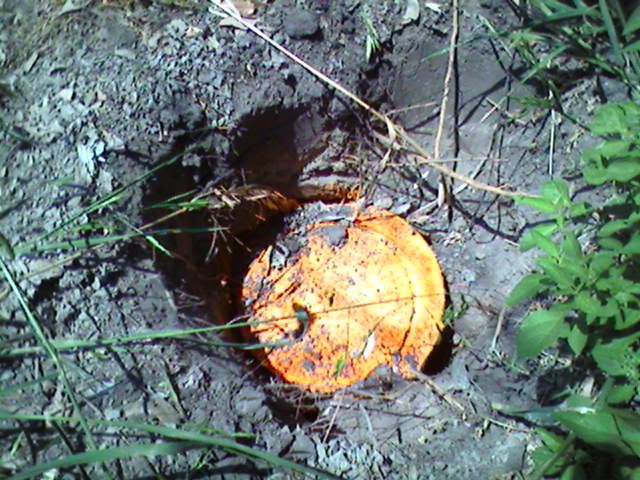
Soon, we were looking at the cap of the elusive sewer cleanout, and I admit to feeling a bit like Indiana Jones at the pride and wonder I felt in discovering it. Its metal cover was imprinted with the same moon and stars motif that we commonly see on water meters here. It was rusty, dirty, and perhaps the most beautiful thing I had seen in my yard since Hurricane Katrina.
Tony, of course, was not as emotional and proceeded to spray it with fluorescent orange paint.
We signed some forms to give FEMA permission to install a travel trailer on our property, and we were on our way in short order. No estimate on when, but soon, we were told, soon FEMA will deliver a trailer.
And I learned once again that stereotypes are almost always wrong. I had called a city agency and received prompt, courteous, and very nearly accurate information. I had been helped by a FEMA employee who knew exactly what to do, how to do it, and was about as helpful as I could ever have hoped.
Before we left, I told Tony that I was going to have to change my tune about FEMA since he had done such a good job and had been so helpful.
"I'm from here, too," he said. "I'm just doing what I can to help people."
Thanks again, Tony.
Monday, April 10, 2006
Delivering encouragement
The US Postal Service took a beating in Hurricane Katrina just like the rest of us in New Orleans. And like us, they've struggled to get back to that elusive place we call "normal." A recent story in The Times-Picayune heralds the reopening of the local mail processing center. Count this as an important mile marker on the road to recovery.
For months, we had to go to a central station to pick up the mail. I blogged about that experience in November of last year. Back then, we were finding mail in the box at our apartment in the "sliver by the river" perhaps once a week. In January, it may have been two or more times a week. By mid February, we started seeing mail on a daily basis.
Old mail--typically out-of-date bills and special offers--but regular mail delivery nonetheless.
About a month ago, my wife received the special holiday issue of Family Fun magazine. The cover alerted us to the great holiday gift ideas inside. Better late than never, as they say, but what was important for us was that it signaled the return of magazines.
Soon after that, I received the November, December and January issues of one of my magazines all in one week.
The only thing we don't have at this point is junk mail. And I confess, I miss that, too. I liked that there were people who wanted me to have 10 DVDs for a penny. I liked knowing that Quality Paperback Book Club wanted me to have 6 books for a dollar, with no long-term obligation. And I'm worried that Publishers Clearinghouse may be trying to find me with a guaranteed winning number, but my future fortune is going unclaimed because the Post Office has a petty grudge against Bulk Rate mail.
In the ghost town of Vista Park, the neighborhood where we used to live, the Post Office has told us that house-to-house delivery will not return for a while. As people return to live in travel trailers or a few in actual houses, USPS is setting up community mail boxes in every block.
This is a temporary situation, we are told, but many of my neighbors take a more cynical view. They know that newer subdivisions everywhere in the country either have community boxes like these, or they have mailboxes at the curb. Letter Carriers who walk a route are going the way of newspaper boys on bicycles and milkmen leaving bottles on the doorstep.
Progress can be good or bad, it seems. But in New Orleans, I find all progress encouraging.
Sunday, April 09, 2006
Nature is not on our side
Up until a few months ago, New Orleans was teeming with biological activities of many kinds. Humans, of course, were the dominant influence on the landscape. But there were plenty of trees in this urban forest. Gardens and lawns, domestic animals and wild squirrels and birds as well.
When the water was finally pumped away, the landscape revealed was drastically changed.
But as the expression goes, “Nature abhors a vacuum.” Where humans once reigned, mold and fungus moved right on in our domestic castles. Where carefully planned gardens and tidy lawns once covered the land, a chaotic quilt of wildflowers and weeds blankets over all.
Life, once removed and destroyed, has returned.
Nature does not care. To her, the world is just one big snow-globe of life. Every now and then, she shakes it violently just for the heck of it.
There’s a good reason the moral way of treating animals is known as “humane.” Left to the ways of nature, there is tremendous suffering in the animal kingdom. We humans, and perhaps some few other species, actually care.
Before I drive off every reader with these philosophical musings, let me get to the point of this blog: I was at my fatally damaged house today admiring the butterflies.
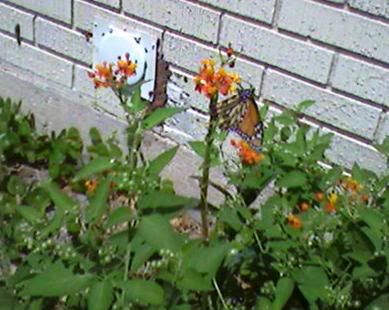
My Darling Wife had always made sure we had plenty of milkweed in our garden. It’s the food of choice for Monarchs, she taught me. Well, since Katrina, the milkweed has been growing like, well, weeds. And the Monarchs are taking full advantage of it.
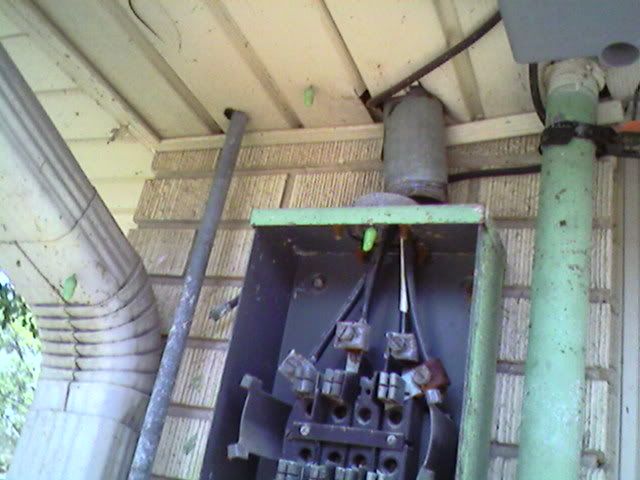
Fat little caterpillars are abundant. When they’ve gorged their chubby black and yellow striped bodies to the point of bursting, they climb to some convenient place and hang to become chrysalides. I was at the house today, and I counted 10 of the little green sacks with gold buttons.
The lawn and the garden are overgrown and out of control. The house is ransacked by floodwater. But nature does not care.
The electrical meter was removed weeks ago by the power company, sad evidence of how life here has changed. But to a butterfly-to-be, it’s just another place to closet up for the metamorphosis.
We, too, are working through the changes in our lives. Many of us are hanging in the “J” position right now, waiting to emerge from the pupa stage, hoping for the best.
We know that nature is not on our side—nature is on no one’s side because she’s perfectly indifferent. It’s up to us to make this happen. It’s going to be up to us to make it work. We have to care.
And it won’t be easy, because if there’s one thing I’ve learned about “Mother Nature, it’s that she really is a “mother.”
Friday, April 07, 2006
Elevating information
In the excellent post, If You Tell A Lie Big Enough And Keep Repeating It..., Seymour exposes the ignorance of elected officials and others who go around saying that New Orleans is more than 10 feet below sea level. Well, it ain't. So get your facts straight, Senator Bennett, or quit talking about things you know nothing about.
I encourage everyone to share this valuable information widely.
Thursday, April 06, 2006
Reflections on vinyl
Things like my albums. I'm talking 12-inch vinyl discs, lovingly stored in paper sleeves tucked into cardboard jackets. What we used to call "LPs" for long-playing records. I had a whole bunch of Beatles records, and lots of 70's and 80's pop.
Sure, I know I can easily replace those Beatles records with newly burned CDs, but it's just not the same. Records were 12-inches in diameter, so the covers were big, too. A lot of them opened up so that you got plenty of photos, notes and lyrics. The tiny art and booklets they put in CDs just don't compare.
And there were a lot of albums in my collection that simply cannot be replaced in the laser age. I had a copy of "N.O. Experience Necessary," a compilation of local new-wave and punk bands from the late 70's. You just can't buy anything by The Mechanics, The Driveways and The Backstabbers nowadays.
I had a full set of Blondie, too. I could probably get "Parallel Lines" on disc, and I might even be able to get "Plastic Letters" and the debut "Blondie," but it would not be the same. And all my DEVO albums--gone. In a way, De-evolution finally caught up with the spudboys.
I had some fun stuff, too. Like "The Story of Star Wars," which was a combination of the movie soundtrack and narration from "Episode IV: A New Hope." When I bought that album, we had no idea there would be sequels and prequels. Luckily, I played that one for my Precious Daughter a few months before the storm, so at least she got to hear it one time.
Books are something else I miss. I'll never replace my high school year book. And I'll never replace my Army Basic Training photo book. Who will ever believe I fired an M-60 machine gun without those pictures to prove it?
I had a few autographed books, too. Nobody really, really famous, but they were special to me anyway. For instance, I had a signed copy of Mel Leavitt's "History of New Orleans."
I lost a lot of furniture in the flood, but it's not the same. We had two almost new sofas in our house, and a fine dining table. These items alone were worth thousands of dollars more than my entire collection of books and record albums. But I just don't pine for my furniture. I don't find myself wistfully thinking, "Man, I'll never sleep in that bed ever again." I don't long to sit in the big blue chair and put my feet up on the ottoman. I guess those things can all be easily replaced.
I should not complain, though. We all got out alive, healthy and untraumatized. And as I wrote a while back, I was able to salvage some of my CD collection, even if they are somewhat smelly. But that was just part of my music collection. I have virtually nothing pre-1988 when I joined the digital music revolution.
I can't help it--I miss my albums. It makes me sad to know that I will probably never again drop a needle into the groove of "Serfin' USA" by Bas Clas, or rock to the frenzied energy of The Angry Samoans.
One record I did not have, and I'll be glad if I never hear again, is anything by Katrina and the Waves. I bet you can guess why!
Tuesday, April 04, 2006
In the news
To rise again, family home must fall
I've seen more than one blogger in the paper since Katrina. Let's hope it continues.
Friday, March 31, 2006
Janet's Video Diary 26 March 2006
Thursday, March 30, 2006
Less than 8 inches of water
And that's how much water the MRGO contributes to hurricane storm surge.
I know it's incredibly popular to say that St. Bernard and the Lower Ninth Ward flooded because of the evil Mississippi River Gulf Outlet. I know that the press, politicians and people from all over blame the MRGO for the catastrophic flooding that occurred there, but the science of the situation says otherwise.
Everything I write now is detailed in a paper titled, "Note on the Influence of the Mississippi River Gulf Outlet on Hurricane Induced Storm Surge in New Orleans and Vicinity." You can read if for yourself here.
Both before and after Katrina, engineers and scientists investigated the impacts of the MRGO on hurricane protection. Using the latest computer modeling and laser surveying techniques, they ran a variety of hurricanes through a digital rendering of southeast Louisiana. They ran the existing conditions, and then they ran the model with the MRGO completely filled to marsh elevation. They also ran it with a gate closure at the southern end of the MRGO. They ran hurricane models that mimicked Betsy, Katrina and other historical and synthetic storms.
And here is the result: the difference in storm surge with the MRGO was, at most, less than 8 inches. In most places, the difference was less than 4 inches.
Hardly a smoking gun, is it?
The primary author of the paper I refer to is Dr. Joannes Westerink of Notre Dame, a worldwide authority in hydraulic modeling. It is part of the government's official IPET investigation of what went wrong in hurricanes Katrina and Rita.
I expect critics of the Corps and the IPET investigation will want to dismiss this report as a whitewash of the effects of the MRGO. But they should know that the Louisiana Department of Natural Resources, often at odds with the Corps of Engineers, conducted their own model runs and came up with almost identical results.
How can this be? How can The Times-Picayune and public perception be so far off from the reality?
Well, part of the problem is simply a lack of understanding of hurricanes and hydraulics among the public. And it certainly doesn't help when newspapers and politicians jump on the bandwagon to ride public opinion for profit and populism. We all need to learn more before we form opinions on important matters.
Part of the blame falls on the Corps of Engineers, too. The Corps has not done a good job of educating their customers, the American public, about what they do and why they do it. The paper I cite is an example of this lack of communication and engagement with the public. Why haven't these findings been more prominently announced?
I think the average person can grasp why the MRGO contributes less than 8 inches to large storm surges. The simple explanation is that for events like Katrina, the storm surge is so high that water is flowing outside of the channel. When there's 18 feet of water moving toward St. Bernard and New Orleans, it just doesn't matter that there's a shipping channel down at elevation 1 or 2. The water is spread out miles wide in front of an advancing hurricane, so even the 1,000 feet wide MRGO gets lost in the massive storm surge.
Now, I'm not defending the MRGO or saying it should remain. There may well be other problems related to this channel that should be addressed.
What I am saying is that the magnitude of flooding, death and destruction was brought by Hurricane Katrina without the help of or need of assistance from the MRGO.
I think we should be talking about what to do with the MRGO. But let's stick to the facts and listen to the science.
Thursday, March 23, 2006
Hurricanes: the enemy
Esbii Ogholoh, writing from Kenner, Louisiana, reminds us that our representatives in Washington took an oath to defend us from all enemies, foreign and domestic.
"Here we have an enemy -- the hurricane -- that threatens to harm the United States of America each year. Yet we are debating whether we deserve to be protected or defended," he writes.
Amen, Brother Ogholoh!
If Al-Qaeda had attacked New Orleans, killed 1,300 and destroyed more than 200,000 homes and businesses, would Washington bureaucrats be talking about cost-to-benefit ratios? Would they be saying that it's the victims' own fault for living in a "dangerous" place?
Perhaps we need to rename the storms. Maybe if we start calling it "Osama Katrina" they will quit the quibbling and get down to business. Maybe if we were attacked by "Rita bin Laden" the President and Congress would understand and fulfill their duty to protect us.
Hurricanes are a clear and present danger to Americans, as real and deadly as any terrorist. We need our leaders to recognize this.