
Saturday, July 19, 2008


Friday, July 11, 2008
A space oddity?
It was 29 years ago today that America's first space station, Skylab, came falling down to Earth. Some people at the office were talking about it and I recalled that it was quite a newsworthy event.
Pat O'Brien's even created a potent cocktail to commemorate the event. They called it the "Skylab Fallout."
But I was surprised to find I was the only person in the group who had ever heard of it.
Surely other people recall getting knocked dizzy in the French Quarter by a Skylab Fallout!
Pat O'Brien's even created a potent cocktail to commemorate the event. They called it the "Skylab Fallout."
But I was surprised to find I was the only person in the group who had ever heard of it.
Surely other people recall getting knocked dizzy in the French Quarter by a Skylab Fallout!
Wednesday, July 09, 2008
Exposed weaknesses
At the Rising Tide 2 conference, writer and panelist Joshua Clark commented that Hurricane Katrina exposed many weaknesses in our lives. I wrote it down back when I first heard it last August, and I've been thinking about it here and there since.
The idea stuck with me.
As an engineer, I recognize how minor flaws can become major problems under certain conditions. A hairline crack in concrete can let in moisture. That moisture can cause rust in reinforcing steel, which in turn exerts pressures that will further crack the encasing concrete.
Weaknesses can go undetected for weeks, months, years, and then... a bridge falls, or a tower crane buckles, or a floodwall bends and bows to failure.
Engineers also understand that loads transfer from one part of a structure to another. If one connection of a truss fails, it might not result in an immediate collapse. The load will be transferred to another connection, much the same way a current of electricity will seek the shortest path to ground, or water the swiftest path to the ocean. This load transfer is automatic and instantaneous.
If the new connection can't hold the load, it too will fail and send the load to the next connection. Sometimes this transfer/failure/transfer cycle happens quickly--resulting in a successive collapse. Sometimes, it goes undetected for a while.
I've been thinking about the load of Hurricane Katrina on us, our lives, our community, and our support system. When something fails to hold up, do the others race in to help? And if the load and stress of this disaster and the rebuilding process pile on, will we stay strong, or will we suffer sudden or rapid successive collapse in our lives?
You could say we've already seen this happen at the District Attorney's office. Inefficiencies, blunders and scandals accumulated and brought down Eddie Jordan's office and career. It started out small, but grew over many months until the ability of the public to stomach the news had been completely diminished. It was a textbook illustration of the expression, "The straw that broke the camel's back."
I also think we see this happening with housing. With so many displaced from their homes, demand for rentals and rental rates are up dramatically. Amazingly the federal government and the city decided this was the time to tear down most public housing projects. The stress of housing has transferred from one market to the next, so that we can truly say there is a housing crisis in New Orleans.
Families feel the strain, too. The recent death of NOLA blogger Ashley Morris shows us how the burdens of life are distributed. The stress and strain was quickly transferred--shared--throughout the Morris family's circle of friends. Several NOLA blogger stepped in mightily to help them bear the load.
And the Morris family survives.
So I think I'd like to add a thought to Joshua Clark's observation. Katrina exposed weaknesses, yes, but she also revealed our strengths.
And not just as a matter of contrast. Just because one floodwall fell over and the one next to it did not is no reason to think that remaining floodwall is somehow representative of an ideal design; it just means it was at least a tiny bit better than the one that fell.
No, I'm thinking that New Orleans is a city of many strengths--strengths that were there all along, but we overlooked them or forgot them in the day-to-day journey of life.
Sense of community, love of neighborhood and civic pride are some examples. Would we say that these have sprung full-grown from our wounded city? Or isn't it more likely we had these things all along? I think it took several feet of flood water to push these powerful sentiments to the surface. And to this day if anybody says a cross word to us about being "stupid to live below sea level" you can bet they'll get both barrels of love right back.
Like travelers on a yellow brick road, we've been through hell and high water just to find out that what we were searching for we had all along.
I know we'll never forget that awful August three years ago, when unforgiving nature exposed and exploited all our weaknesses.
But I also hope we'll remember our discovered strengths, and that it's because of those strengths that we're still here.
The idea stuck with me.
As an engineer, I recognize how minor flaws can become major problems under certain conditions. A hairline crack in concrete can let in moisture. That moisture can cause rust in reinforcing steel, which in turn exerts pressures that will further crack the encasing concrete.
Weaknesses can go undetected for weeks, months, years, and then... a bridge falls, or a tower crane buckles, or a floodwall bends and bows to failure.
Engineers also understand that loads transfer from one part of a structure to another. If one connection of a truss fails, it might not result in an immediate collapse. The load will be transferred to another connection, much the same way a current of electricity will seek the shortest path to ground, or water the swiftest path to the ocean. This load transfer is automatic and instantaneous.
If the new connection can't hold the load, it too will fail and send the load to the next connection. Sometimes this transfer/failure/transfer cycle happens quickly--resulting in a successive collapse. Sometimes, it goes undetected for a while.
I've been thinking about the load of Hurricane Katrina on us, our lives, our community, and our support system. When something fails to hold up, do the others race in to help? And if the load and stress of this disaster and the rebuilding process pile on, will we stay strong, or will we suffer sudden or rapid successive collapse in our lives?
You could say we've already seen this happen at the District Attorney's office. Inefficiencies, blunders and scandals accumulated and brought down Eddie Jordan's office and career. It started out small, but grew over many months until the ability of the public to stomach the news had been completely diminished. It was a textbook illustration of the expression, "The straw that broke the camel's back."
I also think we see this happening with housing. With so many displaced from their homes, demand for rentals and rental rates are up dramatically. Amazingly the federal government and the city decided this was the time to tear down most public housing projects. The stress of housing has transferred from one market to the next, so that we can truly say there is a housing crisis in New Orleans.
Families feel the strain, too. The recent death of NOLA blogger Ashley Morris shows us how the burdens of life are distributed. The stress and strain was quickly transferred--shared--throughout the Morris family's circle of friends. Several NOLA blogger stepped in mightily to help them bear the load.
And the Morris family survives.
So I think I'd like to add a thought to Joshua Clark's observation. Katrina exposed weaknesses, yes, but she also revealed our strengths.
And not just as a matter of contrast. Just because one floodwall fell over and the one next to it did not is no reason to think that remaining floodwall is somehow representative of an ideal design; it just means it was at least a tiny bit better than the one that fell.
No, I'm thinking that New Orleans is a city of many strengths--strengths that were there all along, but we overlooked them or forgot them in the day-to-day journey of life.
Sense of community, love of neighborhood and civic pride are some examples. Would we say that these have sprung full-grown from our wounded city? Or isn't it more likely we had these things all along? I think it took several feet of flood water to push these powerful sentiments to the surface. And to this day if anybody says a cross word to us about being "stupid to live below sea level" you can bet they'll get both barrels of love right back.
Like travelers on a yellow brick road, we've been through hell and high water just to find out that what we were searching for we had all along.
I know we'll never forget that awful August three years ago, when unforgiving nature exposed and exploited all our weaknesses.
But I also hope we'll remember our discovered strengths, and that it's because of those strengths that we're still here.
Tuesday, July 01, 2008
"Those tiles will be replaced"
That's what Entergy V.P. Rusty Burroughs said. His letter of apologies and promises was printed in the newspaper.
And so two months later, NOLA Blogger Oyster goes back to check and finds...
ENTERGY HAS DONE NOTHING.
And so two months later, NOLA Blogger Oyster goes back to check and finds...
ENTERGY HAS DONE NOTHING.
Friday, June 27, 2008
Back on track
I don't know who had the idea or made it happen, but they deserve praise.
This week the streetcars returned to Carrollton Avenue. For the first time since Hurricane Katrina tried to drown New Orleans, you can ride a streetcar from Claiborne Avenue to Canal Street via the world famous St. Charles Avenue streetcar line.

And somebody had the wisdom and forethought to put up these signs.
Automobiles cross paths with the streetcars at each of dozens of cross streets cutting across the neutral ground. After an absence just shy of three years, automobile drivers have likely fallen out of the habit of looking out for the streetcars. Hopefully these signs will remind drivers to be on the lookout.
This is positive and proactive and I like it.
Compare this to the stoplight camera scheme.
In the past few months the City of New Orleans and its neighbor in Metairie both installed cameras at intersections to catch drivers crossing through red lights. The goal, government officials said, is to improve public safety. Additional revenue brought by fines, government officials said, is just coincidental to the plan.
But what are the rules about crossing under a yellow light? Is anyone really sure? Ask any two drivers about traffic light rules and you'll get three different answers about what is legal and illegal when it comes to yellow and red lights. Where is the effort to educate the driving public of what is safe and unsafe? Where is the public education on the correct rules for traffic lights?
Apparently, nobody thought it necessary to provide information. They just put up cameras and started mailing invoices. The plan, it seems, is that once a driver is forced to write a check, he'll learn.
This is why I was so pleased with the "Back on Track" signs. They inform and educate in order to promote safety, and that is the way it should be.
This week the streetcars returned to Carrollton Avenue. For the first time since Hurricane Katrina tried to drown New Orleans, you can ride a streetcar from Claiborne Avenue to Canal Street via the world famous St. Charles Avenue streetcar line.
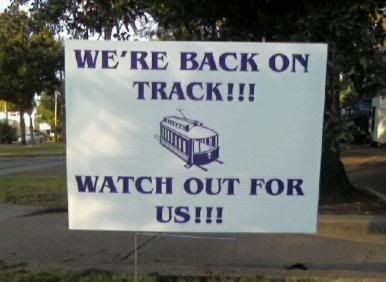
And somebody had the wisdom and forethought to put up these signs.
Automobiles cross paths with the streetcars at each of dozens of cross streets cutting across the neutral ground. After an absence just shy of three years, automobile drivers have likely fallen out of the habit of looking out for the streetcars. Hopefully these signs will remind drivers to be on the lookout.
This is positive and proactive and I like it.
Compare this to the stoplight camera scheme.
In the past few months the City of New Orleans and its neighbor in Metairie both installed cameras at intersections to catch drivers crossing through red lights. The goal, government officials said, is to improve public safety. Additional revenue brought by fines, government officials said, is just coincidental to the plan.
But what are the rules about crossing under a yellow light? Is anyone really sure? Ask any two drivers about traffic light rules and you'll get three different answers about what is legal and illegal when it comes to yellow and red lights. Where is the effort to educate the driving public of what is safe and unsafe? Where is the public education on the correct rules for traffic lights?
Apparently, nobody thought it necessary to provide information. They just put up cameras and started mailing invoices. The plan, it seems, is that once a driver is forced to write a check, he'll learn.
This is why I was so pleased with the "Back on Track" signs. They inform and educate in order to promote safety, and that is the way it should be.
Monday, June 09, 2008
Cats at home
Hurricanes Katrina and Rita were tough on a lot of people, but they were also tough on our animals. You could say that for our pets Callie and Smudge, it was a complete cat-astrophe!
(Okay, okay, a very bad pun. Last one, I promise.)
Callie and Smudge are our two remaining cats. Prior to the storm we had four cats and took every one of them with us when we fled town in the middle of the night almost three years ago. Packed into cat carriers, stacked on the back seat next to our Precious Daughter, I think it's safe to say they were pretty traumatized in those first days.
They did not watch the round-the-clock news coverage of the storm, the wall failures, the flooding, the failed relief effort, the bodies abandoned around the city, the desperate cries of help from the Superdome and convention center. They could not comprehend the enormous force of nature bearing down upon the city nor the necessity of driving away in the middle of the night. It must have scared the heck out of them.
If even a slender parallel can be drawn between the experience of our cats with the suffering of our neighbors here, it would be in the uncertainty. After the flood, thousands of displaced citizens were herded onto busses with no indication of where they were going or what awaited them once they got there: I imagine this is what our cats experienced, too.
We evacuated with four cats, but we gave two away. In those first few days when we realized we could not go home--we had no home to go to--we were very fortunate to have several options as we were invited to stay with close relatives. But we knew having so many pets would be a burden on our hosts. We knew that the coming months of moving from place to place would be difficult on our older cats. A difficult decision, but we put two of our cats up for adoption in Dallas. They're still there.
Our journey with the two remaining cats took us from Texas to Virginia and back to New Orleans where we've lived in two temporary homes until we finally settled in our new house just in the last few weeks.
I've blogged about my furry friends before, as at each stop in our journey they've had to learn, adjust and adapt to their new surroundings. They seem to have handled it well. How can I tell? They eat and sleep and seem to be in every way the same cats we've had for these several years.
Here at the new house, it's not just a new place. It's filled with all new furniture and beds and bedding. I had thought it would take them a while to adjust since almost everything here is new and strange. Well, there's US, but you know what I mean.
And as expected, they did slink cautiously around for the first day and hid under the bed for most of the next two days. But it wasn't long before they were lounging on our new king-sized bed as if they had been born into such privilege.

Callie, with her exquisite long and puffy coat of calico-spotted fur, looks especially content when she rolls halfway on her back and stretches her paws out over her head. It's tempting to want to rub her soft white belly when she does this, but anyone who approaches is quickly rebuffed with a warning glare of her golden eyes.

Smudge, always the more passive of the two, prefers to curl her thin body up in a tight spiral when she's taking a power nap. She's a short-hair Siamese, and her favorite sleeping pose is to coil her brown tail around her mostly white body and put a paw over her closely-set blue eyes.
Seeing them this way on the bed or enjoying the cool hardwood floors, I know they're comfortable. I know that they've accepted (yet again) the place their keepers have carried them to. I know they feel at home and they're happy to be here.
And I can tell you that it makes me feel cat-egorically happy, too.
(Oops! Just couldn't stop myself.)
(Okay, okay, a very bad pun. Last one, I promise.)
Callie and Smudge are our two remaining cats. Prior to the storm we had four cats and took every one of them with us when we fled town in the middle of the night almost three years ago. Packed into cat carriers, stacked on the back seat next to our Precious Daughter, I think it's safe to say they were pretty traumatized in those first days.
They did not watch the round-the-clock news coverage of the storm, the wall failures, the flooding, the failed relief effort, the bodies abandoned around the city, the desperate cries of help from the Superdome and convention center. They could not comprehend the enormous force of nature bearing down upon the city nor the necessity of driving away in the middle of the night. It must have scared the heck out of them.
If even a slender parallel can be drawn between the experience of our cats with the suffering of our neighbors here, it would be in the uncertainty. After the flood, thousands of displaced citizens were herded onto busses with no indication of where they were going or what awaited them once they got there: I imagine this is what our cats experienced, too.
We evacuated with four cats, but we gave two away. In those first few days when we realized we could not go home--we had no home to go to--we were very fortunate to have several options as we were invited to stay with close relatives. But we knew having so many pets would be a burden on our hosts. We knew that the coming months of moving from place to place would be difficult on our older cats. A difficult decision, but we put two of our cats up for adoption in Dallas. They're still there.
Our journey with the two remaining cats took us from Texas to Virginia and back to New Orleans where we've lived in two temporary homes until we finally settled in our new house just in the last few weeks.
I've blogged about my furry friends before, as at each stop in our journey they've had to learn, adjust and adapt to their new surroundings. They seem to have handled it well. How can I tell? They eat and sleep and seem to be in every way the same cats we've had for these several years.
Here at the new house, it's not just a new place. It's filled with all new furniture and beds and bedding. I had thought it would take them a while to adjust since almost everything here is new and strange. Well, there's US, but you know what I mean.
And as expected, they did slink cautiously around for the first day and hid under the bed for most of the next two days. But it wasn't long before they were lounging on our new king-sized bed as if they had been born into such privilege.
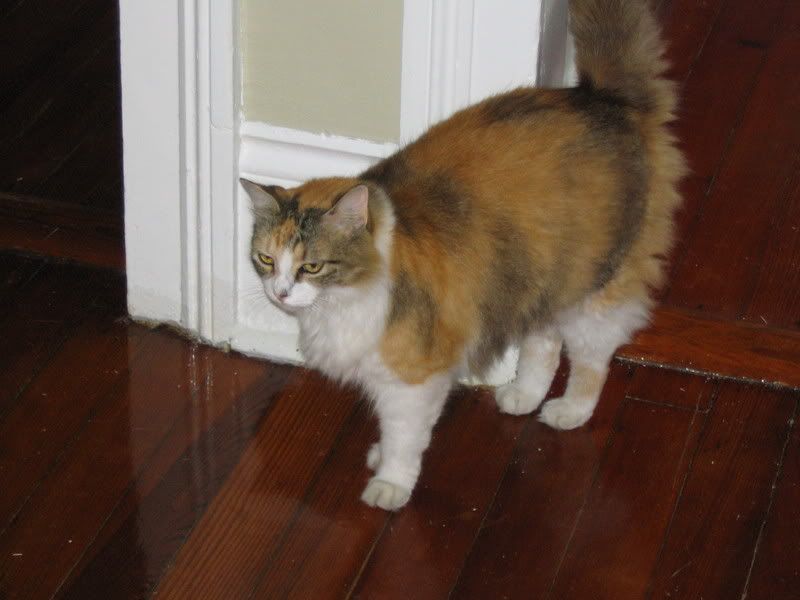
Callie, with her exquisite long and puffy coat of calico-spotted fur, looks especially content when she rolls halfway on her back and stretches her paws out over her head. It's tempting to want to rub her soft white belly when she does this, but anyone who approaches is quickly rebuffed with a warning glare of her golden eyes.
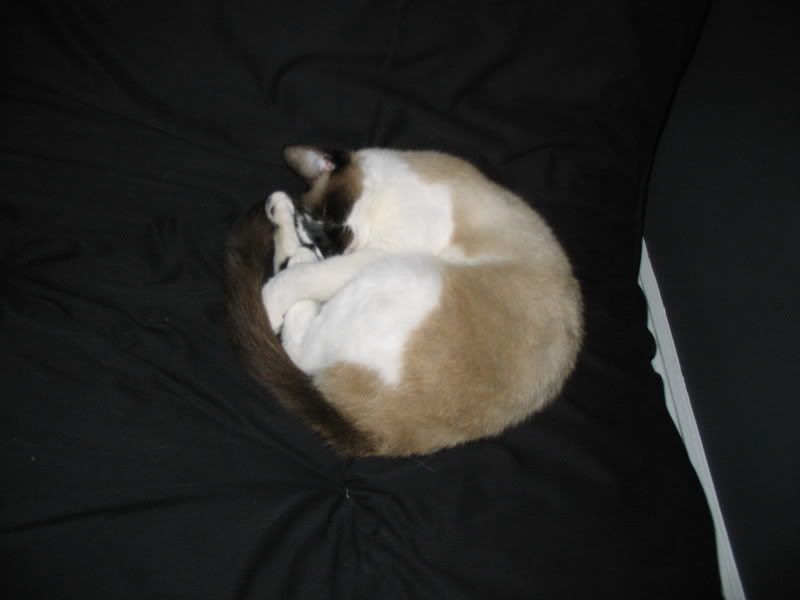
Smudge, always the more passive of the two, prefers to curl her thin body up in a tight spiral when she's taking a power nap. She's a short-hair Siamese, and her favorite sleeping pose is to coil her brown tail around her mostly white body and put a paw over her closely-set blue eyes.
Seeing them this way on the bed or enjoying the cool hardwood floors, I know they're comfortable. I know that they've accepted (yet again) the place their keepers have carried them to. I know they feel at home and they're happy to be here.
And I can tell you that it makes me feel cat-egorically happy, too.
(Oops! Just couldn't stop myself.)
Wednesday, June 04, 2008
Storm driven
Massachusetts gets it:
New rules requiring sturdier construction of coastal homes may help protect against wind damage - but at a cost
Texas does not:
Texas building codes lag behind Gulf neighbors
Discuss amongst yourselves.
New rules requiring sturdier construction of coastal homes may help protect against wind damage - but at a cost
Texas does not:
Texas building codes lag behind Gulf neighbors
Discuss amongst yourselves.
Tuesday, June 03, 2008
Eternal vigilance
We were all talking about the high water on the Mississippi River a few weeks ago. Since then, the river stage at New Orleans rose to 17.0, Bonnet Carre Spillway was opened, millions of gallons of water were shunted into Lake Pontchartrain, the river stage finally began to fall, and Bonnet Carre Spillway was closed.
In sum, an exciting and rare event.
But that's not why we paid so much attention. A few weeks ago, nobody was expressing awe at the rarity of the event.
We were worried.
We worried that the Mississippi River levees might not hold, or that the spillway diversion might not be enough, or that if the river ever got loose... Well, let's just say Hurricane Katrina and every other catastrophe in the nearly 300-year history of this city would have been knocked one notch down the list of worst disasters.
But I think all this worrying is good. When we worry, we pay attention. When we worry, we acknowledge the importance of maintaining a strong system of protections, and we encourage thinking about consequences and contingencies.
There's the old expression, "When we fail to plan, we plan to fail."
But even more relevant is this expression from the time of the American Revolution: "Eternal vigilance is the price of liberty."
"Vigilance" as in keeping watch over the state and federal agencies who design, build and maintain the levees, walls and gates. "Vigilance" as in keeping apace with changing technology and scientific understanding of the threats. "Vigilance" as in maintaining the urgency and critical life-safety purpose of the protections.
"Eternal" as in always and forever. When the last load of clay is dumped and spread and compacted on that final levee, the job will still not be done. Maintenance must be ongoing and uninterrupted. Designs must be checked periodically to assure effectiveness under changing coastal conditions. The work must go on.
We all have our parts in this effort. Government will establish standards and enforce rules, and citizens must support and in fact encourage the prosecution of work.
And we who live behind these walls and levees know that if we stop paying attention, all kinds of bad things will happen.
Not "can happen" but "will happen."
If we are not vigilant, money for the required work will get diverted elsewhere. If we are not vigilant, the goal of effective, resilient flood protection will become the goal of bringing in a marginal project on schedule and under budget. If we are not vigilant, the carefully calculated decisions of safety-oriented engineers will be replaced with the whims of policy wonks and accountants, political appointees and the NIMBY neighborhood associations.
Am I preaching to the choir here?
Let's hope so. Let's hope that just shy of three years since that horrible event we're still laser focused on what really counts to this water-tested community. Let's hope we can keep that focus for 30 years or 60 years or 90 years and more, because that's what it will take.
We're eternally vulnerable, so we've got to be eternally vigilant.
In sum, an exciting and rare event.
But that's not why we paid so much attention. A few weeks ago, nobody was expressing awe at the rarity of the event.
We were worried.
We worried that the Mississippi River levees might not hold, or that the spillway diversion might not be enough, or that if the river ever got loose... Well, let's just say Hurricane Katrina and every other catastrophe in the nearly 300-year history of this city would have been knocked one notch down the list of worst disasters.
But I think all this worrying is good. When we worry, we pay attention. When we worry, we acknowledge the importance of maintaining a strong system of protections, and we encourage thinking about consequences and contingencies.
There's the old expression, "When we fail to plan, we plan to fail."
But even more relevant is this expression from the time of the American Revolution: "Eternal vigilance is the price of liberty."
"Vigilance" as in keeping watch over the state and federal agencies who design, build and maintain the levees, walls and gates. "Vigilance" as in keeping apace with changing technology and scientific understanding of the threats. "Vigilance" as in maintaining the urgency and critical life-safety purpose of the protections.
"Eternal" as in always and forever. When the last load of clay is dumped and spread and compacted on that final levee, the job will still not be done. Maintenance must be ongoing and uninterrupted. Designs must be checked periodically to assure effectiveness under changing coastal conditions. The work must go on.
We all have our parts in this effort. Government will establish standards and enforce rules, and citizens must support and in fact encourage the prosecution of work.
And we who live behind these walls and levees know that if we stop paying attention, all kinds of bad things will happen.
Not "can happen" but "will happen."
If we are not vigilant, money for the required work will get diverted elsewhere. If we are not vigilant, the goal of effective, resilient flood protection will become the goal of bringing in a marginal project on schedule and under budget. If we are not vigilant, the carefully calculated decisions of safety-oriented engineers will be replaced with the whims of policy wonks and accountants, political appointees and the NIMBY neighborhood associations.
Am I preaching to the choir here?
Let's hope so. Let's hope that just shy of three years since that horrible event we're still laser focused on what really counts to this water-tested community. Let's hope we can keep that focus for 30 years or 60 years or 90 years and more, because that's what it will take.
We're eternally vulnerable, so we've got to be eternally vigilant.
Thursday, May 29, 2008
Yes, all of the above
Where is the optimism I had two years ago? In the immediate aftermath of Hurricane Katrina, I was sorry for myself, but not sad. When I saw the carcass of what was once our home--dank, molded and smelling like a garbage truck--I was filled with sadness, but not remorse.
I don't know if that makes sense to anyone except me, but it's how I used to feel.
And somehow, I was defiant. I was determined. I was optimistic. I started writing this blog to express those sentiments to myself, my family and friends, and the world.
Now that we have a new house and we officially sold our vacant property to the Road Home, I feel very different.
I feel tired, and beaten, and a bit depressed about it.
Am I tired because this has been going on for so damn long? Is it because our particular "Road Home" has been a winding, uphill trek of more than two and half years? Is it the long hours I've been working, saddled with the "time off" spent working on the "new" house?
Am I beaten because I originally envisioned a new house on our property in Vista Park, rising high above the ground to escape future floods and strapped down at every stud to resist powerful winds? Is it because I had to take down that sign we had out front for the past year, the one that proudly proclaimed, "We're rebuilding"?
Am I depressed because I see the slow, painful progress of my once beautiful neighborhood, and I know that I am doing nothing to help? Am I shook up by my neighbors who have not elevated their homes but merely nailed up new sheetrock, as if the basic flood protection here, still under construction, was in fact bulletproof and finished? Does it bother me that national newspapers print smug and insulting stories of our struggle to recover from a disaster of biblical proportions, while local media uncritically print and broadcast the unsubstantiated allegations of angry and irrational critics?
Yes, all of the above.
I tell myself things will get better. I tell myself my life will be easier in a few weeks once we've fully unpacked and settled into our new home, leaving behind forever the tiny lifestyle of a FEMA travel trailer. I tell myself that buying a house and investing in New Orleans is a positive act of helping with the recovery.
I tell myself that the unreasoned scorn of strangers outside of Louisiana is not important, that their anger is theirs own alone. I tell myself that New Orleans was created by outcasts, misfits and adventurers, and that the only proper way to rebuild it will be with the help of outcasts, misfits and adventurers.
And I make it a rule never to lie to myself.
More than two years after the water went down, I still have a house full of love, appreciation and support. I still live in one of the great cities of the world. I still have a lot to look forward to.
Oh, there's that optimism!
I don't know if that makes sense to anyone except me, but it's how I used to feel.
And somehow, I was defiant. I was determined. I was optimistic. I started writing this blog to express those sentiments to myself, my family and friends, and the world.
Now that we have a new house and we officially sold our vacant property to the Road Home, I feel very different.
I feel tired, and beaten, and a bit depressed about it.
Am I tired because this has been going on for so damn long? Is it because our particular "Road Home" has been a winding, uphill trek of more than two and half years? Is it the long hours I've been working, saddled with the "time off" spent working on the "new" house?
Am I beaten because I originally envisioned a new house on our property in Vista Park, rising high above the ground to escape future floods and strapped down at every stud to resist powerful winds? Is it because I had to take down that sign we had out front for the past year, the one that proudly proclaimed, "We're rebuilding"?
Am I depressed because I see the slow, painful progress of my once beautiful neighborhood, and I know that I am doing nothing to help? Am I shook up by my neighbors who have not elevated their homes but merely nailed up new sheetrock, as if the basic flood protection here, still under construction, was in fact bulletproof and finished? Does it bother me that national newspapers print smug and insulting stories of our struggle to recover from a disaster of biblical proportions, while local media uncritically print and broadcast the unsubstantiated allegations of angry and irrational critics?
Yes, all of the above.
I tell myself things will get better. I tell myself my life will be easier in a few weeks once we've fully unpacked and settled into our new home, leaving behind forever the tiny lifestyle of a FEMA travel trailer. I tell myself that buying a house and investing in New Orleans is a positive act of helping with the recovery.
I tell myself that the unreasoned scorn of strangers outside of Louisiana is not important, that their anger is theirs own alone. I tell myself that New Orleans was created by outcasts, misfits and adventurers, and that the only proper way to rebuild it will be with the help of outcasts, misfits and adventurers.
And I make it a rule never to lie to myself.
More than two years after the water went down, I still have a house full of love, appreciation and support. I still live in one of the great cities of the world. I still have a lot to look forward to.
Oh, there's that optimism!
Tuesday, May 20, 2008
Vagaries of government decisionmakers and whims of developers
"One guy is building 12 feet in the air because he's freaked out. The next guy is building at eight feet because that's the new flood regs. The next guy is building at four feet because he's grandfathered in [to the pre-Katrina code requirements], and the next guy is building right on the beach because he knew somebody at city hall and was able to get away with it."
Except for the beach part, you could almost imagine this is about Louisiana.
But it's not: it's coastal Mississippi.
Read the full story from The Christian Science Monitor.
Except for the beach part, you could almost imagine this is about Louisiana.
But it's not: it's coastal Mississippi.
Read the full story from The Christian Science Monitor.
Saturday, May 17, 2008
The essential luxury
Here is what I like about our new home: Hot water.
Oh sure, there are hardwood floors, a king size bed and the breeze-swept balcony with a view of the New Orleans skyline. My Darling Wife loves the high ceilings and fans and our Precious Daughter is enjoying her red and black room with full-length mirrors on the closet doors.
But for me, the greatest improvement in quality of life is the new bathroom.
Let me explain.
Here's how my mornings used to go: My alarm would go off. I would turn on the hot water heater. I would reset my alarm for 15 minutes. I would go back to bed. My alarm would go off again. I would get ready to shower. I would stoop slightly and step into the tub. I would remain bent because if I stood straight my head would hit the ceiling of the trailer. I would shower and shave as quickly as possible, because the trailer hot water tank only held about 6 gallons and it usually lasted about 15 minutes.
That's how it was for about 22 months in the FEMA Travel Trailer.
Here's how my morning goes now: My alarm goes off. I get ready to shower. I stand up and no stooping or bending is required. I stand under the strong spray of hot water for as long as I please. I emerge happy.
If clean water is one of the hallmarks of a civilized living, hot water is one of its essential luxuries.
Oh, I could probably wax poetic about the essential nature of water versus the sensuous pleasure of a hot shower, or even the paradoxical relationship we have with water since it was, after all, a water event that plunged us all into this long journey of misery in the first place.
But I'll let that alone for now.
I suppose at one time or another we've all been deprived of the luxury of a hot shower. Whether camping or during a power or gas outage, we probably had to deal with the inconvenience of little or no hot water for a day or two.
Well that's nothing. Try it for 22 consecutive months.
And then you'll know why my favorite part of the new house is all wet.
Oh sure, there are hardwood floors, a king size bed and the breeze-swept balcony with a view of the New Orleans skyline. My Darling Wife loves the high ceilings and fans and our Precious Daughter is enjoying her red and black room with full-length mirrors on the closet doors.
But for me, the greatest improvement in quality of life is the new bathroom.
Let me explain.
Here's how my mornings used to go: My alarm would go off. I would turn on the hot water heater. I would reset my alarm for 15 minutes. I would go back to bed. My alarm would go off again. I would get ready to shower. I would stoop slightly and step into the tub. I would remain bent because if I stood straight my head would hit the ceiling of the trailer. I would shower and shave as quickly as possible, because the trailer hot water tank only held about 6 gallons and it usually lasted about 15 minutes.
That's how it was for about 22 months in the FEMA Travel Trailer.
Here's how my morning goes now: My alarm goes off. I get ready to shower. I stand up and no stooping or bending is required. I stand under the strong spray of hot water for as long as I please. I emerge happy.
If clean water is one of the hallmarks of a civilized living, hot water is one of its essential luxuries.
Oh, I could probably wax poetic about the essential nature of water versus the sensuous pleasure of a hot shower, or even the paradoxical relationship we have with water since it was, after all, a water event that plunged us all into this long journey of misery in the first place.
But I'll let that alone for now.
I suppose at one time or another we've all been deprived of the luxury of a hot shower. Whether camping or during a power or gas outage, we probably had to deal with the inconvenience of little or no hot water for a day or two.
Well that's nothing. Try it for 22 consecutive months.
And then you'll know why my favorite part of the new house is all wet.
Thursday, May 01, 2008
Unambiguously home
There is a line that runs through all our lives here. It marks the place where everything changed.
It is first and foremost the water line. Thirty-two months ago, every house, pole, tree, car and street sign in the flooded parts of New Orleans bore the line. We've washed that ugly stain from most of our homes now, but the line remains. I can still see the line in my own neighborhood--the line that separates what survives from what dies.
Everyone knows that to survive, you must stay above the water line. That water line was the subject of a song by Paul Soniat. He sings about how a lot of lives "fell below the water line" in 2005. A lot of relationships, jobs and schools fell below the water line and did not reemerge.
The City of New Orleans is ignoring the water line. At City Hall, the only line they notice is the imaginary line drawn on the flood insurance maps. All they seem to care about is the Base Flood Elevation, that magical line that will allow you to get a building permit, and the best flood insurance rate, and the peace of mind we all crave. Or not.
There are other lines.
There is the line on the calendar that separates our lives in time. It is a line that separates the lives of the people of New Orleans into pre-K and post-K. It starkly separates our lives between how we lived before August 29, 2005, and after. In far too many cases, it starkly separates life and survivors from the dead.
And surviving the hurricane and flood was not an end; it was the beginning of the survivor saga. Fellow blogger Karen Gadbois wrote to me, "Funny how this storm has turned us all into other things." She sees how people have changed where they live, where they work, where they go to school. She knows people who are doing things they never dreamed and never planned to do. But they crossed the line in time and they changed.
For instance, we all know a lot more about flood maps and how to navigate insurance claims than we did before. I always thought I was up to speed on insurance, but you never really know until something happens. You never really know what lurks in the fine print until you get a form letter from the insurance company that matter-of-factly describes what is covered and for how much.
And having traversed that timeline in 2005, we all know more about tropical weather forecasting than ever before. During the past two anxious hurricane seasons, everyone here was keenly aware of every puff of rainy weather in the Gulf of Mexico or Atlantic.
Another NOLA blogger, Mark Folse said, "I don't think anyone without AMS certification knew anything about Invests, etc. until after K. Now we're all looking at computer model tracks and wondering about the reliability of this model over that, thinking about sea surface temp, wind shear, etc."
When we crossed that line, we all became armchair meteorologists, studying the maps and reading the reports and checking the computer modeling. I haven't heard of any fantasy forecasting leagues starting up yet, but surely one cannot be far from forming.
And then there is the line for help. Lines of people at the Road Home closing center. Lines of citizens at City Hall trying to get permits, or to talk sense to their Assessors. Lines at the hardware stores.
Now my family is approaching yet another line, a line that will officially denote our passage from Post-K to Post-Post-K. We bought a new house and we're moving in this weekend. For the first time since Katrina filled our city with despair, we will have a roof over our heads that we can call our own. We will sleep in beds that belong to us and us alone. We will change our voter registration and discard stationary with our "old" address on it.
We fled the city and our home in August 2005, seeking shelter with family in Texas and Virginia, brief stays in friends' undamaged houses in Harahan and uptown New Orleans, a few months in an expensive apartment in the Sliver by the River, and almost 22 months in a FEMA Travel Trailer.
We bounced around quite a bit, but only now are we landing safely in a place we can unambiguously call, "home."
My family for the past almost three years has been somewhat controlled by a broken line on the highway, a line on a map, a line on the calendar, a line to get help, a line of credit to replace what was lost, and of course, the water line.
Most of these stories are recorded in the lines on our faces. I'm hoping that by this time next week, the dominant line on my face will be a smile.
It is first and foremost the water line. Thirty-two months ago, every house, pole, tree, car and street sign in the flooded parts of New Orleans bore the line. We've washed that ugly stain from most of our homes now, but the line remains. I can still see the line in my own neighborhood--the line that separates what survives from what dies.
Everyone knows that to survive, you must stay above the water line. That water line was the subject of a song by Paul Soniat. He sings about how a lot of lives "fell below the water line" in 2005. A lot of relationships, jobs and schools fell below the water line and did not reemerge.
The City of New Orleans is ignoring the water line. At City Hall, the only line they notice is the imaginary line drawn on the flood insurance maps. All they seem to care about is the Base Flood Elevation, that magical line that will allow you to get a building permit, and the best flood insurance rate, and the peace of mind we all crave. Or not.
There are other lines.
There is the line on the calendar that separates our lives in time. It is a line that separates the lives of the people of New Orleans into pre-K and post-K. It starkly separates our lives between how we lived before August 29, 2005, and after. In far too many cases, it starkly separates life and survivors from the dead.
And surviving the hurricane and flood was not an end; it was the beginning of the survivor saga. Fellow blogger Karen Gadbois wrote to me, "Funny how this storm has turned us all into other things." She sees how people have changed where they live, where they work, where they go to school. She knows people who are doing things they never dreamed and never planned to do. But they crossed the line in time and they changed.
For instance, we all know a lot more about flood maps and how to navigate insurance claims than we did before. I always thought I was up to speed on insurance, but you never really know until something happens. You never really know what lurks in the fine print until you get a form letter from the insurance company that matter-of-factly describes what is covered and for how much.
And having traversed that timeline in 2005, we all know more about tropical weather forecasting than ever before. During the past two anxious hurricane seasons, everyone here was keenly aware of every puff of rainy weather in the Gulf of Mexico or Atlantic.
Another NOLA blogger, Mark Folse said, "I don't think anyone without AMS certification knew anything about Invests, etc. until after K. Now we're all looking at computer model tracks and wondering about the reliability of this model over that, thinking about sea surface temp, wind shear, etc."
When we crossed that line, we all became armchair meteorologists, studying the maps and reading the reports and checking the computer modeling. I haven't heard of any fantasy forecasting leagues starting up yet, but surely one cannot be far from forming.
And then there is the line for help. Lines of people at the Road Home closing center. Lines of citizens at City Hall trying to get permits, or to talk sense to their Assessors. Lines at the hardware stores.
Now my family is approaching yet another line, a line that will officially denote our passage from Post-K to Post-Post-K. We bought a new house and we're moving in this weekend. For the first time since Katrina filled our city with despair, we will have a roof over our heads that we can call our own. We will sleep in beds that belong to us and us alone. We will change our voter registration and discard stationary with our "old" address on it.
We fled the city and our home in August 2005, seeking shelter with family in Texas and Virginia, brief stays in friends' undamaged houses in Harahan and uptown New Orleans, a few months in an expensive apartment in the Sliver by the River, and almost 22 months in a FEMA Travel Trailer.
We bounced around quite a bit, but only now are we landing safely in a place we can unambiguously call, "home."
My family for the past almost three years has been somewhat controlled by a broken line on the highway, a line on a map, a line on the calendar, a line to get help, a line of credit to replace what was lost, and of course, the water line.
Most of these stories are recorded in the lines on our faces. I'm hoping that by this time next week, the dominant line on my face will be a smile.
Subscribe to:
Posts (Atom)