Here is the irrefutable fact about creation and destruction in the natural universe: destruction is fast and easy, but creation takes time.
It takes years to grow a tree, but you can cut it down with a chainsaw in a matter of minutes.
It takes months of gestation and years of nurturing, nutrition and support to produce an adult human being. But you can snuff out his life with bullet faster than he can emit a scream.
It took years of planning, design and financing, as well as millions of man-hours to build the World Trade Center Towers in Manhattan. But it took barely a dozen religious terrorists less than two hours to completely destroy both of them with two jumbo jets.
Destruction is always faster and easier than construction.
So why do so many people lament about "the slow recovery of New Orleans?" Is it because they don't understand this simple rule about creation and destruction?
More likely it is because they do not appreciate the magnitude of the destruction.
We're not talking about a few dozen houses clipped by a twister. We're not talking about a few lost shingles and some fallen trees.
We're talking whole subdivisions in which every house was flooded. Almost 400 of them in my own Vista Park neighborhood alone. To the roof. For more than two weeks.
All this destruction in a matter of days. Most of it in the span of a few hours.
I've heard it estimated that 200,000 homes just in Louisiana suffered severe or major damage due to Hurricanes Katrina and Rita. How long does it take to repair and rebuild that many homes? One year? Two?
According to the US Census Bureau (Manufacturing, Mining and Construction Statistics), 1.6 million new single family homes were constructed in the entire United States in 2005.
So 200,000 new houses is about 12 percent of the home-building capacity of the entire nation. It would take a monumental shift in building resources to make that happen. Stretch it out to two years, and it would take locating 6 percent of the nation's home-building resources in this one state for two years to rebuild that many houses.
Could we really expect that many houses to get built in a state that is home to less than 2 percent of the US population?
As the expression goes, "Rome was not built in a day." And New Orleans will not be rebuilt in a year, or two, or even three.
So let's do ourselves a favor and quick talking about why things are going slowly, or why things are taking so long to get done. Every day we move forward is a good day. Every month we measure progress is a good month. Every year we stand taller and defiant against the forces of nature and the indifference or incompetence of politicians is a good year.
Here is one irrefutable fact about New Orleans: WE ARE STILL HERE.
Saturday, July 14, 2007


Friday, June 29, 2007
Calm
Regular readers of Chris Rose know that the locally revered writer for The Times-Picayune sought professional counseling to deal with depression last year. Rose credited his return to functionality to medicines prescribed to alter his mental state.
Over lunch recently, some colleagues admitted they, too, rely upon medicine bottle maintenance to keep their cars between the lines. Funny thing is, none of them lost a house to Hurricanes Katrina or Rita. I'm pretty sure none of them experienced even minor flooding. And I was the only one at the table that day who sleeps in a FEMA Travel Trailer.
They joked, "Tim, you must be taking more pills than all of us put together!"
People are amazed at how calm I am. I can’t explain how or why, but I’ve always had an attitude that there’s always hope for tomorrow, and of course, it could always be worse. I’ve been called Pollyannaish for this point of view. I’ve also been called Scarlett’s twin brother.
I remember being this way even as a young lad. I remember one morning on the school bus when we were involved in a minor accident. I may have been in fourth or fifth grade. My little sister was sitting next to me when the bus driver slammed on the brakes and we went flying forward for lack of safety belts.
The moment the bus came to a stop, children all around began crying. My own sister had a bloody nose after hitting the seat in front of us. I remember looking at it and, not seeing any cuts or protruding cartilage, calmly telling her to pinch it and hold her head back. I assured her that it would all be okay and that her injury was minor. As the bus driver made his way down the isle to check on each passenger, I told him I was taking care of her and that she was alright.
Nobody went to the hospital, and no one required medical assistance of any kind that I recall. After a few minutes, we continued to school and nothing more came of it as far as I know. But I remember wondering at the time why so many children were crying when there were no serious injuries.
More recently, I attended a class at the University of Tennessee in Project Management and Teambuilding. As part of the training, we did a mock bridge building project and I was made the project leader of one of the teams. One of our instructors was a retired Army colonel--a large man with a booming voice. I probably attracted his attention once or twice in class by asking sticky questions or outright challenging him.
Anyway, the whole point of the exercise was to give us a simple task that gets bogged down with every kind of problem imaginable to see how we would respond. The instructor played the role of the project sponsor, who was looking over my shoulder the whole time, making stupid suggestions, asking interminable questions and generally just getting in the way of my task. I responded by being as diplomatic as possible, and tried to keep focused on the goal.
About 30 minutes into the exercise, he got right into my face and was telling me that the way I was doing things was going to doom the project and that I had better listen to his suggestions. I told him, “Sir, I appreciate your input, but in this instance I think we should do it my way.”
His eyes grew large and his hands balled up in fists. And then he said, “Doggone it, how can you stay so calm when I’m throwing everything I’ve got at you?”
“Well, it helps to remember that this is just an exercise,” I said.
Since last year, family, colleagues at work and neighbors have variously expressed a similar sentiment. “How can you stay so calm?” they’ve asked. “If I was in your shoes, I’d be a nervous wreck!” they’ve said.
My answer is similar to my response to the retired Army colonel: “Well, it helps to remember that everything I’ve lost is just things. I still have my family, and I have to do my best to keep them happy and safe.”
What good would it do to break down and cry over lost possessions? What good would it do to mourn the loss of money and property? My Darling Wife and I decided early on that we would remain forward looking. We decided that we should teach our Precious Daughter a most important lesson in the aftermath of Hurricane Katrina: Don’t despair. Keep hope. Work to make things better.
I am not claiming to be super-human. I have had my bouts with fear and frustration, financial worries and physical and emotional stress. But at the end of the day I must keep going, and I am confident that we will be okay. We have survived so much already, this sometimes just seems like an exercise.
And truth be told, we were never at any time in any mortal danger. We evacuated early. We never missed a meal, never worried that we would not have a safe place to sleep. Even our pets have had a relatively easy ride compared to many.
All that we lost was things, so perhaps my calm disposition is not all that remarkable after all. Under the circumstances, I find it easy to play the “Glad Game.”
Over lunch recently, some colleagues admitted they, too, rely upon medicine bottle maintenance to keep their cars between the lines. Funny thing is, none of them lost a house to Hurricanes Katrina or Rita. I'm pretty sure none of them experienced even minor flooding. And I was the only one at the table that day who sleeps in a FEMA Travel Trailer.
They joked, "Tim, you must be taking more pills than all of us put together!"
People are amazed at how calm I am. I can’t explain how or why, but I’ve always had an attitude that there’s always hope for tomorrow, and of course, it could always be worse. I’ve been called Pollyannaish for this point of view. I’ve also been called Scarlett’s twin brother.
I remember being this way even as a young lad. I remember one morning on the school bus when we were involved in a minor accident. I may have been in fourth or fifth grade. My little sister was sitting next to me when the bus driver slammed on the brakes and we went flying forward for lack of safety belts.
The moment the bus came to a stop, children all around began crying. My own sister had a bloody nose after hitting the seat in front of us. I remember looking at it and, not seeing any cuts or protruding cartilage, calmly telling her to pinch it and hold her head back. I assured her that it would all be okay and that her injury was minor. As the bus driver made his way down the isle to check on each passenger, I told him I was taking care of her and that she was alright.
Nobody went to the hospital, and no one required medical assistance of any kind that I recall. After a few minutes, we continued to school and nothing more came of it as far as I know. But I remember wondering at the time why so many children were crying when there were no serious injuries.
More recently, I attended a class at the University of Tennessee in Project Management and Teambuilding. As part of the training, we did a mock bridge building project and I was made the project leader of one of the teams. One of our instructors was a retired Army colonel--a large man with a booming voice. I probably attracted his attention once or twice in class by asking sticky questions or outright challenging him.
Anyway, the whole point of the exercise was to give us a simple task that gets bogged down with every kind of problem imaginable to see how we would respond. The instructor played the role of the project sponsor, who was looking over my shoulder the whole time, making stupid suggestions, asking interminable questions and generally just getting in the way of my task. I responded by being as diplomatic as possible, and tried to keep focused on the goal.
About 30 minutes into the exercise, he got right into my face and was telling me that the way I was doing things was going to doom the project and that I had better listen to his suggestions. I told him, “Sir, I appreciate your input, but in this instance I think we should do it my way.”
His eyes grew large and his hands balled up in fists. And then he said, “Doggone it, how can you stay so calm when I’m throwing everything I’ve got at you?”
“Well, it helps to remember that this is just an exercise,” I said.
Since last year, family, colleagues at work and neighbors have variously expressed a similar sentiment. “How can you stay so calm?” they’ve asked. “If I was in your shoes, I’d be a nervous wreck!” they’ve said.
My answer is similar to my response to the retired Army colonel: “Well, it helps to remember that everything I’ve lost is just things. I still have my family, and I have to do my best to keep them happy and safe.”
What good would it do to break down and cry over lost possessions? What good would it do to mourn the loss of money and property? My Darling Wife and I decided early on that we would remain forward looking. We decided that we should teach our Precious Daughter a most important lesson in the aftermath of Hurricane Katrina: Don’t despair. Keep hope. Work to make things better.
I am not claiming to be super-human. I have had my bouts with fear and frustration, financial worries and physical and emotional stress. But at the end of the day I must keep going, and I am confident that we will be okay. We have survived so much already, this sometimes just seems like an exercise.
And truth be told, we were never at any time in any mortal danger. We evacuated early. We never missed a meal, never worried that we would not have a safe place to sleep. Even our pets have had a relatively easy ride compared to many.
All that we lost was things, so perhaps my calm disposition is not all that remarkable after all. Under the circumstances, I find it easy to play the “Glad Game.”
Wednesday, June 13, 2007
Unlevel protection
The American Society of Civil Engineers released a very readable analysis of the Hurricane Katrina catastrophe last week. Maitri, a blogger and scientist with a curious mind, first made note of it on her blog. (The Times-Picayune finally noticed it Tuesday.)
The report is wide-ranging, and no doubt everyone who reads it will find something of passionate importance. Mine is this: level of protection.
As I have complained for months, greater New Orleans is doomed to flood again and again because of the very low level of protection. Congress and the president have deemed our fair city worthy of only a 100-year level of protection, a standard so low that commercial insurance writers are all but totally abandoning the area. We are rapidly approaching the point at which only government-backed insurance programs will be willing to take such risks.
ASCE notices this, too.
ASCE compared the level of protection we get with the level of protection afforded to Americans who live and work in the shadow of dams. They point out that dams are not designed merely based on frequency and availability of flood insurance--they are designed for LIFE SAFETY.
Let me say that again for the speed-readers and those of you in the back: THEY ARE DESIGNED FOR LIFE SAFETY.
ASCE points out that the federal Bureau of Reclamation's guidelines for public protection consider both the probable frequency of a catastrophic event and the likely loss of life. Simply stated, events that are both frequent and result in large losses of life are unacceptable.
Here's ASCE's example of unacceptable: "the historical performance of the hurricane protection system: a catastrophic failure, resulting in approximately 1,000 fatalities, which occurred once in 40 years of operation."
Applying the methodology for dam safety to hurricane levees, ASCE concludes:
"...if the hurricane protection system had been treated as a major dam, it would have needed to be designed so that the likelihood of failure would occur roughly once in 100,000 years to once in 1,000,000 years of operation."
Something to ponder as we await the release of the IPET Risk and Reliability Report.
The report is wide-ranging, and no doubt everyone who reads it will find something of passionate importance. Mine is this: level of protection.
As I have complained for months, greater New Orleans is doomed to flood again and again because of the very low level of protection. Congress and the president have deemed our fair city worthy of only a 100-year level of protection, a standard so low that commercial insurance writers are all but totally abandoning the area. We are rapidly approaching the point at which only government-backed insurance programs will be willing to take such risks.
ASCE notices this, too.
ASCE compared the level of protection we get with the level of protection afforded to Americans who live and work in the shadow of dams. They point out that dams are not designed merely based on frequency and availability of flood insurance--they are designed for LIFE SAFETY.
Let me say that again for the speed-readers and those of you in the back: THEY ARE DESIGNED FOR LIFE SAFETY.
ASCE points out that the federal Bureau of Reclamation's guidelines for public protection consider both the probable frequency of a catastrophic event and the likely loss of life. Simply stated, events that are both frequent and result in large losses of life are unacceptable.
Here's ASCE's example of unacceptable: "the historical performance of the hurricane protection system: a catastrophic failure, resulting in approximately 1,000 fatalities, which occurred once in 40 years of operation."
Applying the methodology for dam safety to hurricane levees, ASCE concludes:
"...if the hurricane protection system had been treated as a major dam, it would have needed to be designed so that the likelihood of failure would occur roughly once in 100,000 years to once in 1,000,000 years of operation."
Something to ponder as we await the release of the IPET Risk and Reliability Report.
Tuesday, June 12, 2007
It really is all about the food
Tom Fitzmorris, local celebrity/restaurant critic, wrote about the joy he experienced when quintessential neighborhood eatery Mandina's reopened earlier this year. He describes his stroll through the flood-damaged area:
When I reached Canal Street on North Cortez, a streetcar rolled by. When it passed, it revealed the neon lights of Mandina's, lighting up the corner as it has for decades, as if nothing had happened.
The sight of that spread a smile across my face. I've rejoiced in the reopening of dozens of important eateries around town, but rarely did one made me feel this good.
I shared that thought with a man I didn't know who was waiting for a table to open up inside. "I live in the neighborhood," he said. "But I didn't really start working on my house until I knew for sure that Mandina's was coming back."
Tom's website is called The New Orleans Menu.
When I reached Canal Street on North Cortez, a streetcar rolled by. When it passed, it revealed the neon lights of Mandina's, lighting up the corner as it has for decades, as if nothing had happened.
The sight of that spread a smile across my face. I've rejoiced in the reopening of dozens of important eateries around town, but rarely did one made me feel this good.
I shared that thought with a man I didn't know who was waiting for a table to open up inside. "I live in the neighborhood," he said. "But I didn't really start working on my house until I knew for sure that Mandina's was coming back."
Tom's website is called The New Orleans Menu.
Wednesday, June 06, 2007
The sun sets on Cabrini Church
They say you have to break some eggs if you want to make an omelet. The curved concrete shell that covered Saint Frances Cabrini Church proved somewhat more resistant than an eggshell, but it cracked and shattered nonetheless.
It marks the end of an era, that’s for sure.
I was still at work on Tuesday when my Darling Wife called me with the news. “They’re tearing down the church. A bunch of people are parked by the side of the road watching it.”
About an hour later I passed there on the way home. There certainly were a lot of people there. Many I recognized as neighbors from down the street from me. Some had simply come out from their houses across Paris Avenue. One lady leaned on the rail of her FEMA Travel Trailer and saw all she needed to see.

A lot of cameras. A lot of elderly ladies with long faces. A lot of men with their hands on their hips, shaking their heads as if to say, “What can you do? Nothing.”
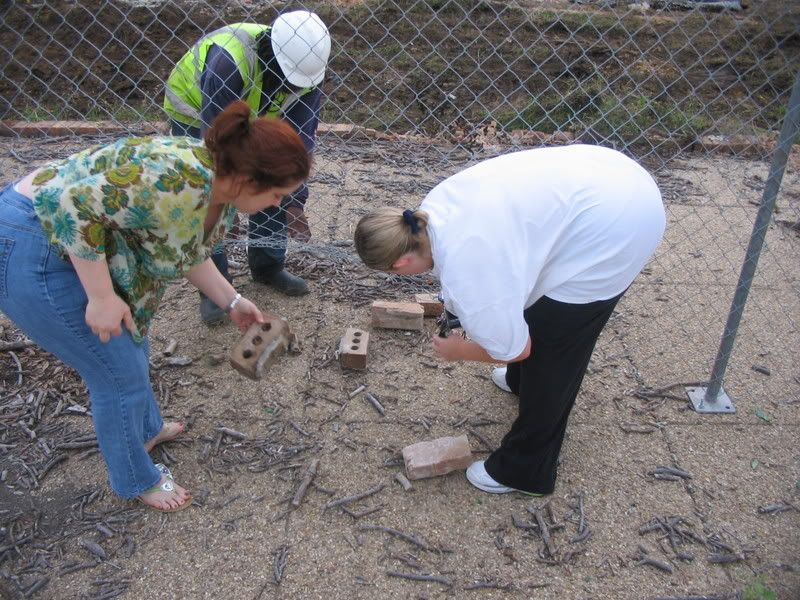
By the time I arrived, the machines had stopped for the day. A few workers were still on site getting ready to wrap up the day. I saw one of them gather some bricks in her arms. Several feet away, two ladies waited outside the construction fence. The worker dropped the bricks by the fence and pulled it up from the bottom. “I got three for each of you,” she said. The two women scrambled to collect their souvenirs.

One of my neighbors, Kenny, was there. He and his wife were photographed by The Times-Picayune as they watched the church where they were married get smashed apart. “It’s sad, but it’s good,” she said. “It’s a new beginning.”
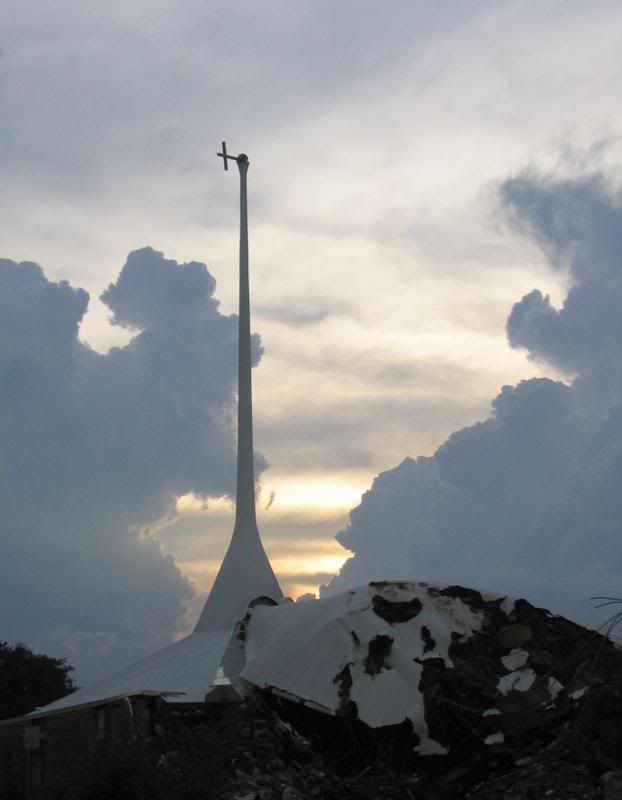
I also snapped a few photographs as the sun set on Cabrini Church. The broken cross still hung from her sleek spire. (Trivia: the cross was broken by Hurricane Cindy a few weeks before any of us had even heard of Katrina. All Hurricane Katrina did was turn the cross to point in another direction.)
There were no last-minute heroics as far as I could tell. The wrecking ball worked the landmark building into rubble without any of the theatrics that had occurred some weeks ago when the plan to demolish the church had been announced. But there were many sad faces on the street that day.

There were a few Holy Cross shirts in the crowd as well. Some had brought lawn chairs and set up on the neutral ground to watch the show. They were the happy ones this day, as the useless hulk of concrete and brick was finally being removed from the site. Holy Cross has announced plans to build its new school on the site, with no room for 40-some-year-old church. The school plans to erect all new buildings, albeit with architecture that echoes the traditions of their 130-year-old campus they are abandoning in the Lower Ninth Ward.
I wonder if I’m the only one who sees irony in that.
I love my neighborhood, Vista Park. But by a strange twist of logic, I think we’re tearing down the wrong building.
Throughout the neighborhood are slab-on-grade, ranch style, suburban American houses. They were constructed before there ever was a FEMA or a National Flood Insurance Program. Consequently, pretty much all of them are below the 100-year Base Flood Elevation. Somehow, the owners of many of them think it appropriate to fix ‘em up and move right back in. They made no effort whatsoever to elevate or flood proof their homes.
Cabrini Church, on the other hand, was a landmark, a genuine statement of architecture as it was practiced in the 1960’s. Its owners decided it was not worthy of renovation, and they labored tirelessly with government agencies to clear the way for demolition.
It seems to me the church should be spared and the houses demolished and replaced—not the other way around.
I wonder if I’m the only one who sees irony in that.
Ultimately, this is just one man’s opinion. I don’t own a share in Cabrini Church or Holy Cross. You didn’t see me picketing or writing impassioned letters to the newspaper over this. It’s not for me to say.
I will simply note in this blog that in the first days of June 2007, the skyline of Gentilly was permanently changed, and that many more changes are rapidly coming.
It marks the beginning of an era, that’s for sure.
It marks the end of an era, that’s for sure.
I was still at work on Tuesday when my Darling Wife called me with the news. “They’re tearing down the church. A bunch of people are parked by the side of the road watching it.”
About an hour later I passed there on the way home. There certainly were a lot of people there. Many I recognized as neighbors from down the street from me. Some had simply come out from their houses across Paris Avenue. One lady leaned on the rail of her FEMA Travel Trailer and saw all she needed to see.
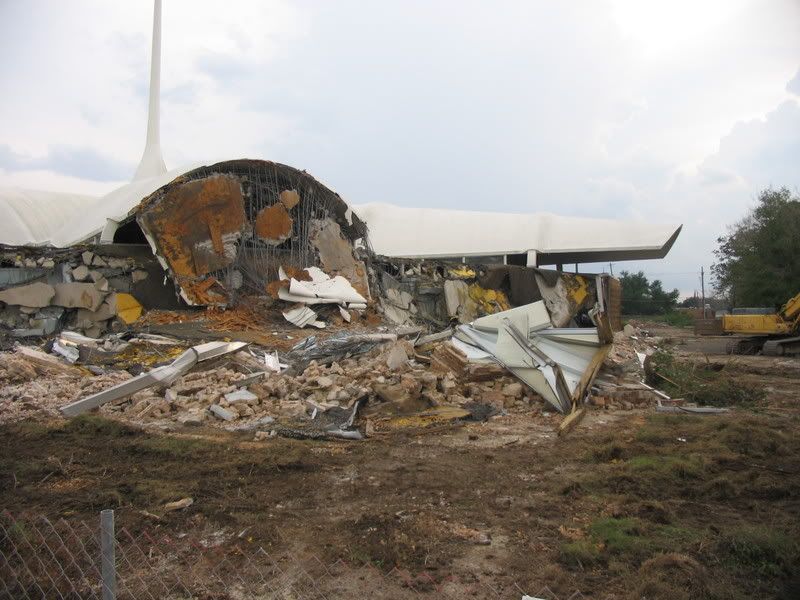
A lot of cameras. A lot of elderly ladies with long faces. A lot of men with their hands on their hips, shaking their heads as if to say, “What can you do? Nothing.”
By the time I arrived, the machines had stopped for the day. A few workers were still on site getting ready to wrap up the day. I saw one of them gather some bricks in her arms. Several feet away, two ladies waited outside the construction fence. The worker dropped the bricks by the fence and pulled it up from the bottom. “I got three for each of you,” she said. The two women scrambled to collect their souvenirs.
One of my neighbors, Kenny, was there. He and his wife were photographed by The Times-Picayune as they watched the church where they were married get smashed apart. “It’s sad, but it’s good,” she said. “It’s a new beginning.”
I also snapped a few photographs as the sun set on Cabrini Church. The broken cross still hung from her sleek spire. (Trivia: the cross was broken by Hurricane Cindy a few weeks before any of us had even heard of Katrina. All Hurricane Katrina did was turn the cross to point in another direction.)
There were no last-minute heroics as far as I could tell. The wrecking ball worked the landmark building into rubble without any of the theatrics that had occurred some weeks ago when the plan to demolish the church had been announced. But there were many sad faces on the street that day.
There were a few Holy Cross shirts in the crowd as well. Some had brought lawn chairs and set up on the neutral ground to watch the show. They were the happy ones this day, as the useless hulk of concrete and brick was finally being removed from the site. Holy Cross has announced plans to build its new school on the site, with no room for 40-some-year-old church. The school plans to erect all new buildings, albeit with architecture that echoes the traditions of their 130-year-old campus they are abandoning in the Lower Ninth Ward.
I wonder if I’m the only one who sees irony in that.
I love my neighborhood, Vista Park. But by a strange twist of logic, I think we’re tearing down the wrong building.
Throughout the neighborhood are slab-on-grade, ranch style, suburban American houses. They were constructed before there ever was a FEMA or a National Flood Insurance Program. Consequently, pretty much all of them are below the 100-year Base Flood Elevation. Somehow, the owners of many of them think it appropriate to fix ‘em up and move right back in. They made no effort whatsoever to elevate or flood proof their homes.
Cabrini Church, on the other hand, was a landmark, a genuine statement of architecture as it was practiced in the 1960’s. Its owners decided it was not worthy of renovation, and they labored tirelessly with government agencies to clear the way for demolition.
It seems to me the church should be spared and the houses demolished and replaced—not the other way around.
I wonder if I’m the only one who sees irony in that.
Ultimately, this is just one man’s opinion. I don’t own a share in Cabrini Church or Holy Cross. You didn’t see me picketing or writing impassioned letters to the newspaper over this. It’s not for me to say.
I will simply note in this blog that in the first days of June 2007, the skyline of Gentilly was permanently changed, and that many more changes are rapidly coming.
It marks the beginning of an era, that’s for sure.
Tuesday, June 05, 2007
Tuesday, May 22, 2007

Tastes like shoddy engineering
UPDATE: National Geographic has taken down the video of Bob Bea putting gutter water into his mouth. The story remains at their web page, and the link button is still there, but it links to a different video now. Perhaps they realized how foolish and dangerous it is to taste gutter water, and perhaps they understand how irresponsible it is, especially for a man of science and someone who claims to be an engineer, to set such a poor example. The edited story is here.
------------
The last few days have not been good for those of us working to protect New Orleans from future disaster.
First, we get college professor Bob Bea, a man who purports to believe in the scientific method and rational engineering, performing a “taste test” of gutter water as an alleged engineering assessment of a nearby floodwall.
I am not making this up. Bea bent over and dipped his fingers into a puddle of water at the edge of the roadway and put them into his mouth—twice—in order to determine the salinity of the water. He then announced he had determined, by the taste, that the water had come from the nearby Industrial Canal. Bea concluded that the newly constructed wall in the Lower Ninth Ward was being undermined and was thus doomed to failure.
It’s all on the video from National Geographic News.
Bea did not indicate what ASTM standard he used to perform the taste test. Neither did he say when was the last time his tongue had been calibrated for salinity testing. But nonetheless, here he is, on video, putting dirty, perhaps biologically infested gutter water into his mouth.
Shame on Bea! What kind of scientist performs taste tests on dirty water? What kind of engineer sets such a poor example by putting potentially disease-filled water into his mouth? Notice in the video that the reporter immediately follows Bea’s despicable example. Let’s hope this does not inspire people around New Orleans to taste the gutter water near their homes as they mimic this alleged expert.
Second, we have John Barry, a member of the Southeast Louisiana Flood Protection Authority East board, repeating--as if it were well-established science--the unfounded but popular claim that a mile of marsh will “absorb” a foot of hurricane storm surge.
Barry wrote an excellent piece in The Washington Post this week about why we need New Orleans, and why America owes its brothers and sisters at the mouth of the Mississippi River the best hurricane protection we can afford.
He starts off on scientifically solid ground, recounting how the river built south Louisiana with sediment from the north. Barry goes on to explain how the river no longer carries the mud necessary to continue its work.
But then he repeats the myth of marsh as hurricane protection, stating as fact that “Each land mile over which a hurricane travels absorbs roughly a foot of storm surge.”
Not true.
The best research to date indicates that each mile over land reduces a hurricane storm surge by about 3 inches. And mind you, even this is really not all that conclusive—it could be much less.
Why is this important? Why would I want to knock Bea and Barry, who are obviously allies of New Orleans and who are out there fighting for a safer future for us?
Because the way I see it, shoddy science and ill-considered engineering are what got us into this mess in the first place. We don’t need any more of that.
If we’re going to have a safe and secure future, we have to proceed with the best information, the most accurate and scientifically valid information available. We need engineers and scientists to wear out their pencils working on this problem, and we need them to develop a rational, methodical plan to get us where we need to be.
What we don’t need is rumors, myths, new-age pseudo-science, and stunts. And unfortunately, that’s what we recently got from Bea and, to a lesser extent, Barry.
Let’s hope Bea doesn’t contract dysentery, and let’s hope he starts to act more like an engineer and less like a carnival side show act.
------------
The last few days have not been good for those of us working to protect New Orleans from future disaster.
First, we get college professor Bob Bea, a man who purports to believe in the scientific method and rational engineering, performing a “taste test” of gutter water as an alleged engineering assessment of a nearby floodwall.
I am not making this up. Bea bent over and dipped his fingers into a puddle of water at the edge of the roadway and put them into his mouth—twice—in order to determine the salinity of the water. He then announced he had determined, by the taste, that the water had come from the nearby Industrial Canal. Bea concluded that the newly constructed wall in the Lower Ninth Ward was being undermined and was thus doomed to failure.
It’s all on the video from National Geographic News.
Bea did not indicate what ASTM standard he used to perform the taste test. Neither did he say when was the last time his tongue had been calibrated for salinity testing. But nonetheless, here he is, on video, putting dirty, perhaps biologically infested gutter water into his mouth.
Shame on Bea! What kind of scientist performs taste tests on dirty water? What kind of engineer sets such a poor example by putting potentially disease-filled water into his mouth? Notice in the video that the reporter immediately follows Bea’s despicable example. Let’s hope this does not inspire people around New Orleans to taste the gutter water near their homes as they mimic this alleged expert.
Second, we have John Barry, a member of the Southeast Louisiana Flood Protection Authority East board, repeating--as if it were well-established science--the unfounded but popular claim that a mile of marsh will “absorb” a foot of hurricane storm surge.
Barry wrote an excellent piece in The Washington Post this week about why we need New Orleans, and why America owes its brothers and sisters at the mouth of the Mississippi River the best hurricane protection we can afford.
He starts off on scientifically solid ground, recounting how the river built south Louisiana with sediment from the north. Barry goes on to explain how the river no longer carries the mud necessary to continue its work.
But then he repeats the myth of marsh as hurricane protection, stating as fact that “Each land mile over which a hurricane travels absorbs roughly a foot of storm surge.”
Not true.
The best research to date indicates that each mile over land reduces a hurricane storm surge by about 3 inches. And mind you, even this is really not all that conclusive—it could be much less.
Why is this important? Why would I want to knock Bea and Barry, who are obviously allies of New Orleans and who are out there fighting for a safer future for us?
Because the way I see it, shoddy science and ill-considered engineering are what got us into this mess in the first place. We don’t need any more of that.
If we’re going to have a safe and secure future, we have to proceed with the best information, the most accurate and scientifically valid information available. We need engineers and scientists to wear out their pencils working on this problem, and we need them to develop a rational, methodical plan to get us where we need to be.
What we don’t need is rumors, myths, new-age pseudo-science, and stunts. And unfortunately, that’s what we recently got from Bea and, to a lesser extent, Barry.
Let’s hope Bea doesn’t contract dysentery, and let’s hope he starts to act more like an engineer and less like a carnival side show act.
Monday, May 14, 2007
Don’t Worry About The Government
Today is the birthday of David Byrne, who was not born in New Orleans.
I forgive him for that oversight, though. I've been a fan of his band Talking Heads from day one. In my post-Hurricane Katrina life, I no longer have the collection of vinyl albums and video tapes I had collected of this crazy, quirky, brainy group. But I remember it all.
A favorite of mine is the song "Don't Worry About The Government," a happy enough pop ditty with a simple arrangement of guitar, bass, drums and a belltone keyboard effect that sounds innocent and pure.
"I see the clouds that move across the sky
I see the wind that moves the clouds away
It moves the clouds over by the building
I pick the building that I want to live in…"
We all make choices. We pick our building--our community of comfort and support.
"...My building has every convenience
It's gonna make life easy for me
It's gonna be easy to get things done
I will relax alone with my loved ones…"
We're at home at home. We enjoy ourselves. We enjoy each other.
"...Loved ones, loved ones visit the building,
Take the highway, park and come up and see me
I'll be working, working but if you come visit
I'll put down what I'm doing, my friends are important…"
We work in buildings, too. We find meaningful, productive work, but we always have time for friends and family.
"...Don't you worry bout me
I wouldn't worry about me
Don't you worry bout me
Don't you worry bout me…"
The more you say, "Don't worry," the more I worry.
"...I see the states, across this big nation
I see the laws made in Washington, D.C.
I think of the ones I consider my favorites
I think of the people that are working for me
"Some civil servants are just like my loved ones
They work so hard and they try to be strong
I'm a lucky guy to live in my building
They own the buildings to help them along…"
The whole country is like a big building. We live and work, and we can count on each other. Don't worry about the government, because the people who work for government are just like you and me.
David Byrne wrote this in 1977, not long after Nixon had resigned and in the midst of "stagflation." Was he being optimistic, or sarcastic? Was he toying with socialism?
And what happens when your building gets severely damaged or destroyed? Will other buildings take you in? Will the government take steps to make sure that the buildings are strong?
Well, I say forget about it. It's just a pop song. It's just a little ditty to pass the time.
Don't you worry about me. I wouldn't worry about me. Don't you worry about me.
I forgive him for that oversight, though. I've been a fan of his band Talking Heads from day one. In my post-Hurricane Katrina life, I no longer have the collection of vinyl albums and video tapes I had collected of this crazy, quirky, brainy group. But I remember it all.
A favorite of mine is the song "Don't Worry About The Government," a happy enough pop ditty with a simple arrangement of guitar, bass, drums and a belltone keyboard effect that sounds innocent and pure.
"I see the clouds that move across the sky
I see the wind that moves the clouds away
It moves the clouds over by the building
I pick the building that I want to live in…"
We all make choices. We pick our building--our community of comfort and support.
"...My building has every convenience
It's gonna make life easy for me
It's gonna be easy to get things done
I will relax alone with my loved ones…"
We're at home at home. We enjoy ourselves. We enjoy each other.
"...Loved ones, loved ones visit the building,
Take the highway, park and come up and see me
I'll be working, working but if you come visit
I'll put down what I'm doing, my friends are important…"
We work in buildings, too. We find meaningful, productive work, but we always have time for friends and family.
"...Don't you worry bout me
I wouldn't worry about me
Don't you worry bout me
Don't you worry bout me…"
The more you say, "Don't worry," the more I worry.
"...I see the states, across this big nation
I see the laws made in Washington, D.C.
I think of the ones I consider my favorites
I think of the people that are working for me
"Some civil servants are just like my loved ones
They work so hard and they try to be strong
I'm a lucky guy to live in my building
They own the buildings to help them along…"
The whole country is like a big building. We live and work, and we can count on each other. Don't worry about the government, because the people who work for government are just like you and me.
David Byrne wrote this in 1977, not long after Nixon had resigned and in the midst of "stagflation." Was he being optimistic, or sarcastic? Was he toying with socialism?
And what happens when your building gets severely damaged or destroyed? Will other buildings take you in? Will the government take steps to make sure that the buildings are strong?
Well, I say forget about it. It's just a pop song. It's just a little ditty to pass the time.
Don't you worry about me. I wouldn't worry about me. Don't you worry about me.
Monday, April 23, 2007
The one-two punch
John lost his mother and brother in the past few months. You might say he lost them to Hurricane Katrina. In New Orleans, his story is not typical, but it is not all that uncommon either.
Sunday morning I wandered out of our FEMA Travel Trailer to look at the day. Across our vacant lot, across the lot next door made recently vacant as well, I saw John standing with his hands on his hips. I walked over to say hello.
The house that used to stand next to our vacant lot was knocked down last week. The backhoe arrived late one afternoon and parked in the front yard. When I got home from work the next day, nothing but brown dirt remained. The only evidence of the house was a few glass shards and chips of brick.
It's one of those odd circumstances of urban living. We moved here about 6 years before Katrina, before the flood washed the neighbors away. John lived just two doors away. But I don't recall ever meeting him before this day.
So as suddenly as the levees breached, as swiftly as the neighborhood had been doused, as quickly as that house between us had been ripped up and carted away, we stood there and talked as if we had been talking like this all along.
John told me that he had lived here since he was 10 years old. His mother and father had built one of the first homes in Vista Park. He said it was the second house on the whole street. He pointed to a white-brick house a few hundred feet away, telling me that was the only other one here back in the early days.
And now, John observed matter-of-factly, it's looking a lot like it did back then. Vacant land all around. A few houses and not much traffic.
John was soft-spoken and alert when I talked to him. But there was a slight slur as one side of his mouth lagged in movement. It was easy to guess that he was in his 60's; I wondered too if he had suffered a stroke recently.
The clear sky radiated a blueness that only occurs on the hottest days. The bright light of morning was tempered by the low humidity and light breeze of what was starting out to be a beautiful day. In stark contrast, John told me about the unhappy journey his life has become since that not-so-perfect-day in August 2005.
The Saturday before Katrina attacked, John and his elderly mother were planning to stay. They had stayed for Betsy. They had stayed for Camille. The street had never flooded and damage was mostly from a few fallen trees.
But Sunday morning John heard panic in the voices of the reporters and meteorologists on the TV. The hurricane had not turned. It was headed here. He heard desperation in the pleas of the Mayor and Governor. He decided to leave his childhood home, still expecting to come back in a few days. John took his mother to the north shore, to a house his brother owned on the relative high ground of St. Tammany Parish.
We all know what happened that Monday.
The weeks and months that followed have continued to be hard on John. Harder still on his family. His elderly mother was not able to return home, and his brother took up the job of filing the paperwork for insurance and government assistance. John was not specific--and I did not press for details--but at some point his brother was not able to go on. He killed himself less than a year after Katrina.
John's mother, now dealing with further grief, had to move to an assisted living facility. "She lasted six months," John says, so plainly that it startled me. As if her death from the one-two punch of a hurricane and a suicide was a given.
"And how about you?" I asked. "How are you getting along?"
He tells the same lie we all tell when asked. "Fine."
He purchased a condo in Metairie soon after the storm. John initially wanted to return here, had the house gutted and treated for mold. He's been keeping the lawn trim and made some inquiries with contractors.
But now he thinks not. "I don't need a three-bedroom house," he says. "And I don't have the energy to do the work anyway." His current plan is to sell it to The Road Home program, and he knows what will happen to his childhood home then: demolition.
He surveys the land around us. "I remember all these trees when they were first planted," he says with a mixture of pride and sadness. He smiles a crooked smile and shakes his head.
John lost his house in Katrina, and you could say he lost two family members, too. But more than that, he lost his home and probably all that remained of his youth and energy.
The rising waters drowned a lot more than just houses, and many, like John, are still treading to survive the flood. In New Orleans, his story is not typical, but it is not all that uncommon either.
Sunday morning I wandered out of our FEMA Travel Trailer to look at the day. Across our vacant lot, across the lot next door made recently vacant as well, I saw John standing with his hands on his hips. I walked over to say hello.
The house that used to stand next to our vacant lot was knocked down last week. The backhoe arrived late one afternoon and parked in the front yard. When I got home from work the next day, nothing but brown dirt remained. The only evidence of the house was a few glass shards and chips of brick.
It's one of those odd circumstances of urban living. We moved here about 6 years before Katrina, before the flood washed the neighbors away. John lived just two doors away. But I don't recall ever meeting him before this day.
So as suddenly as the levees breached, as swiftly as the neighborhood had been doused, as quickly as that house between us had been ripped up and carted away, we stood there and talked as if we had been talking like this all along.
John told me that he had lived here since he was 10 years old. His mother and father had built one of the first homes in Vista Park. He said it was the second house on the whole street. He pointed to a white-brick house a few hundred feet away, telling me that was the only other one here back in the early days.
And now, John observed matter-of-factly, it's looking a lot like it did back then. Vacant land all around. A few houses and not much traffic.
John was soft-spoken and alert when I talked to him. But there was a slight slur as one side of his mouth lagged in movement. It was easy to guess that he was in his 60's; I wondered too if he had suffered a stroke recently.
The clear sky radiated a blueness that only occurs on the hottest days. The bright light of morning was tempered by the low humidity and light breeze of what was starting out to be a beautiful day. In stark contrast, John told me about the unhappy journey his life has become since that not-so-perfect-day in August 2005.
The Saturday before Katrina attacked, John and his elderly mother were planning to stay. They had stayed for Betsy. They had stayed for Camille. The street had never flooded and damage was mostly from a few fallen trees.
But Sunday morning John heard panic in the voices of the reporters and meteorologists on the TV. The hurricane had not turned. It was headed here. He heard desperation in the pleas of the Mayor and Governor. He decided to leave his childhood home, still expecting to come back in a few days. John took his mother to the north shore, to a house his brother owned on the relative high ground of St. Tammany Parish.
We all know what happened that Monday.
The weeks and months that followed have continued to be hard on John. Harder still on his family. His elderly mother was not able to return home, and his brother took up the job of filing the paperwork for insurance and government assistance. John was not specific--and I did not press for details--but at some point his brother was not able to go on. He killed himself less than a year after Katrina.
John's mother, now dealing with further grief, had to move to an assisted living facility. "She lasted six months," John says, so plainly that it startled me. As if her death from the one-two punch of a hurricane and a suicide was a given.
"And how about you?" I asked. "How are you getting along?"
He tells the same lie we all tell when asked. "Fine."
He purchased a condo in Metairie soon after the storm. John initially wanted to return here, had the house gutted and treated for mold. He's been keeping the lawn trim and made some inquiries with contractors.
But now he thinks not. "I don't need a three-bedroom house," he says. "And I don't have the energy to do the work anyway." His current plan is to sell it to The Road Home program, and he knows what will happen to his childhood home then: demolition.
He surveys the land around us. "I remember all these trees when they were first planted," he says with a mixture of pride and sadness. He smiles a crooked smile and shakes his head.
John lost his house in Katrina, and you could say he lost two family members, too. But more than that, he lost his home and probably all that remained of his youth and energy.
The rising waters drowned a lot more than just houses, and many, like John, are still treading to survive the flood. In New Orleans, his story is not typical, but it is not all that uncommon either.
Wednesday, April 18, 2007
Of Leaders and Opportunists
Leaders inspire us with vision.
Leaders help us to become more than we thought we could ever be.
Leaders show us how we as a community can be greater than the sum of our parts.
Leaders are in short supply in New Orleans right now--or are they?
I guess it depends where you look.
Leaders help us to become more than we thought we could ever be.
Leaders show us how we as a community can be greater than the sum of our parts.
Leaders are in short supply in New Orleans right now--or are they?
I guess it depends where you look.
Tuesday, April 17, 2007
Correction and update
It was pointed out to me by both my Mom and my Darling Wife that I can't tell the difference between a thistle and a cleome. It's the latter that I captured in the photographs below. Oh well, I guess I should stick to engineering.
That's the correction; now the update.
I've noticed that I get at least one or two hits per day here from people searching for Camellia Grill. I find it hard to imagine that when one googles Camellia Grill, probably the most famous lunch-counter eatery in this city so famous for great food, they wind up at this non-culinary blog. Well, I do on occasion blog on food, because ultimately, it's always about the food in New Orleans. But that is far from the main topic here.
Anyway, the family was in the Riverbend neighborhood on Sunday so we walked by the tall white columns of Camellia Grill to see what was up. The doors were wide open, probably to let the place air out from a fresh coat of white paint. Relaxing comfortably on a chair off to one side was a bright-eyed fellow in painter's coveralls chatting cheerfully on a cell phone. He lowered the phone and announced, unprompted, "Open soon! Come back!" I'm as much a linguist as I am a gardener, so take it for what it's worth but I would guess his accent was Italian. In fact, he said next week.
We three peeked in to see what we could. The walls were bare and newly painted or spackled. The counter is still there and looks the same. The stainless grill equipment and shelving is still there and looks the same. Several stools looked as though their seats had been ripped off and were ready to receive new cushioning. My Darling Wife and I wondered if in fact it could be ready by next week. Still looked like a lot to do to us.
But as we turned to leave, I could've sworn I caught the delicious scent of frying bacon. Open soon! Come back!
That's the correction; now the update.
I've noticed that I get at least one or two hits per day here from people searching for Camellia Grill. I find it hard to imagine that when one googles Camellia Grill, probably the most famous lunch-counter eatery in this city so famous for great food, they wind up at this non-culinary blog. Well, I do on occasion blog on food, because ultimately, it's always about the food in New Orleans. But that is far from the main topic here.
Anyway, the family was in the Riverbend neighborhood on Sunday so we walked by the tall white columns of Camellia Grill to see what was up. The doors were wide open, probably to let the place air out from a fresh coat of white paint. Relaxing comfortably on a chair off to one side was a bright-eyed fellow in painter's coveralls chatting cheerfully on a cell phone. He lowered the phone and announced, unprompted, "Open soon! Come back!" I'm as much a linguist as I am a gardener, so take it for what it's worth but I would guess his accent was Italian. In fact, he said next week.
We three peeked in to see what we could. The walls were bare and newly painted or spackled. The counter is still there and looks the same. The stainless grill equipment and shelving is still there and looks the same. Several stools looked as though their seats had been ripped off and were ready to receive new cushioning. My Darling Wife and I wondered if in fact it could be ready by next week. Still looked like a lot to do to us.
But as we turned to leave, I could've sworn I caught the delicious scent of frying bacon. Open soon! Come back!
Subscribe to:
Posts (Atom)