Sunday, January 22, 2006

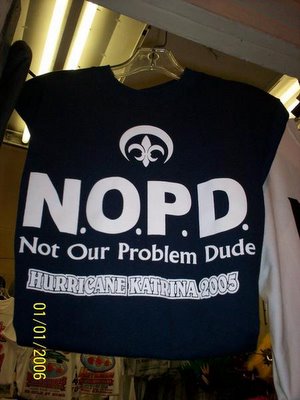
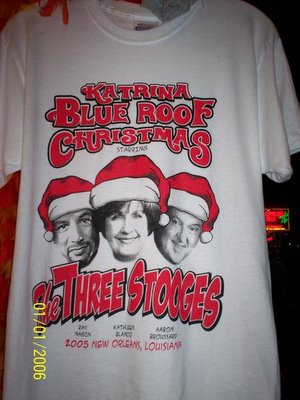
I saw it on a tee shirt

Some people love to laugh at us here in New Orleans. They think we're quintessentially dumb, drunk, lazy and corrupt.

Well, I'm here to tell you, it's nothing we haven't already said about ourselves.

Seriously. A big part of the fun of living here is being able to make fun of ourselves.

An example: a few years ago, the Young Leadership Council launched a campaign to improve our self-image. They took out advertising to remind everyone that New Orleans is a great place to live and work. The cornerstone of the campaign was the slogan printed on countless bumper stickers, "New Orleans: Proud to Call it Home."

Quickly the slogan was translated and adapted to different languages and cultural idioms, such as "La Nouvelle Orléans: C'est Chez Moi" and "New Orleans: Oy! Such a Home."

But then there was the witty variant, "New Orleans: Proud to Crawl Home." Yes, that sticker proved that many of our citizens cherished the party-all-night side of life here just as much as all the reasons to love New Orleans touted by the YLC. (Now that I think about it, I don't actually recall any of the reasons they gave!) I'm not sure what the final score was, but the "crawl" sticker certainly gave the original a run for the money.

The latest entry in tribute to the civic-minded campaign is this: "New Orleans: Proud to Swim Home." I have one on my car.

The t-shirt business also reflects our willingness, our need perhaps, to mock ourselves. Sure, there are plenty of "Make Levees, Not War" shirts out there, but there's also "I looted New Orleans and all I got was this t-shirt, a plasma TV and a Cadillac."

And a friend sent me some photos of some of the latest shirts being sold down in the Quarter.


Business is good, I hear, but who is buying these things? Tourists?

Nope, it's the locals. You might think we're dumb, drunk, lazy and corrupt, but at least we know how to maintain our sense of humor in a crisis.

Saturday, January 21, 2006

A voice of reason

Our local paper, The Times-Picayune, really hit the nail on the head with this one. In a an editorial called "Permitting everything," the paper calls attention to the folly of allowing almost everyone, no matter how flooded or low-lying the neighborhood, to just rebuild right back at the same elevation.

I complained about the short-sightedness of this a few days ago, too, and warned that we're dooming our own future.

I keep hearing about the new New Orleans. Still hoping to see it one day.

Therapeutic email

What would we do without Yahoo! Groups?

After Katrina drowned our tree-lined street and washed all our neighbors away, the people of New Orleans were scattered. Phones failed and conventional mail service ceased to exist. But thanks to email, we've been able to stay in touch.

I've been able to keep up with neighbors in other cities and other states. The Diaspora of just my small circle of friends extends from California and Colorado to Arkansas and North Carolina.

This interconnection allows us to not just keep up with the lives of friends and neighbors, but it also helps us share information about rebuilding, insurance and the ins-and-outs of dealing with FEMA.

And perhaps most important but least appreciated, it provides therapy. Everybody has a story to tell, and the simple act of telling one's story provides basic mental therapy in this time of stress and loss.

Just read this story from Alice recently shared with neighborhood Yahoo! Group:


I've been a basket case since the day after Katrina.

On August 29th, I drove down from Maryland. I stayed in Chattanooga to let Katrina pass, then I continued on to Picayune, dodging fallen trees on I-59, and somehow managed to make it through to pick up my Momma. Picayune was the last exit open; I-59 towards Louisiana was barricaded shut.

I got her out of there, and spent the night in Macon, GA, waiting for my brother in law to take her to Florida. We went to a drug store there in Macon, and outside was a little stray kitten, obviously starving. I decided I was going to take the kitten with me.

I was inside the store, buying supplies for the cat, when a clerk came up to me and asked if I was planning on taking the kitten - - because her momma was on her way to pick up the kitten. She asked, "Did I really want it?"

I was starting to reply, "No, not if your momma is going to take it," when I started crying. I'm talking, SOBBING. I couldn't stop. The woman just looked at me like I was mental, and I explained I had just come from the hurricane zone and I think I was just losing it. She understood, and touched my arm, and just let me cry.

At that point, I knew my city was flooded -- we had watched Nagin's press conference the night before on my sister's battery television -- and I seriously thought I might be losing my mind. Maybe it was the thought that the kitten was "one life I could save." I dunno.

I've been acting really loopy at work too, making strange decisions, and making no decisions -- being indecisive.

But I think you put your finger on it. I know my loved ones are alive, and I'm grateful for that, but we have lost much of what my Momma and Daddy worked for in New Orleans.


You can almost feel the relief Alice gets in being able to share her story with everyone on the listserv. And deep down, I think we all share her desire to go on, to continue no matter what comes.

Even after rescuing her mother, Alice feels the need to do more, to reach out even to a helpless cat. She reminds us again that charity and compassion are the highest of virtues, and despite what the talking heads on the TV say, there is no shortage of these virtues in America.

And for me, that's enough therapy for a week or more.

Thursday, January 19, 2006

Ripping the scab

Follow New Orleanian and blogger Mark Folse has posted the best analysis of Mayor Nagin's speech and the backlash it unleashed. In an insightful and emotional post called "Talking with the King," he writes:

The unintended outcome of the speech, both in its religious rhetoric and in its signature "chocolate" moment, was to rip the scab off of the huge gash that separates New Orleans into separate, warring camps: by race, by section, by church, by income. It's not all Nagin's fault. It's all of our fault, that we measure each other by skin color or the car we drive, or where we park that car on Sunday morning or at night.

I think he's 100% correct. The outcry from all quarters is indeed telling. What hizzoner said was incredibly mild compared to the anger and apparently festering hatred that erupted in response.

In a particularly powerful paragraph, Mark reminds us how indifferent Nature is to skin color, especially when she is manifest in the form of a hurricane like Katrina.

Chocolate City

Okay, okay, the airwaves and the blogosphere are burning up with commentary about New Orleans Mayor Ray Nagin's recent comments.

Yes, it was a poor choice of words.

Yes, he apologized.

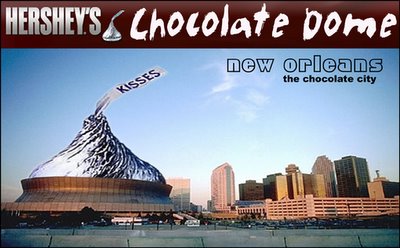
So like we humans always do when something unbelievable happens, first we deny it, then we get angry, then we accept it, then we satirize it and make joke after joke until you just can't stand it anymore! Like for instance, this one a friend emailed to me today:


Well I guess we deserved that one. We've been trying to sell the naming rights to the Superdome for years, and Hizzoner stepped right into that pile all on his own, if you know what I mean.

But the Mayor is a good man. He's not perfect. He misspoke and he took responsibility for the mistake he made. That's good enough for me. It's not like they caught him smoking crack cocaine or taking kickbacks like some other American mayors I could name.

Besides, I love chocolate--don't you?

Tuesday, January 17, 2006

Hard Decisions for New Orleans

That's the name of an editorial published the other day in The New York Times. The writer agrees with the sentiments of my recent post about the need to make better choices as we rebuild New Orleans.

Do we need better, higher, superior levees? Yes indeed. Do we need to elevate our homes to lessen the chances of repeat flooding? Yes indeed.

Does it make sense to restore a flood-ravaged house its exact pre-Katrina condition? Here's what The New York Times says:

"Even with a commitment from Washington to build optimal protection against the fiercest Category 5 storms - which hasn't happened yet - the work would take years to complete. Residents should not be encouraged to gamble with their insurance checks for political or emotional reasons."

To paraphrase General Honore, let's not get stuck on stupid. Partly out of ignorance and partly out of arrogance, we built the majority of our city below sea level, below the 100-year-flood elevation, below any reasonable measure of safety.

Now we're rushing to make the same mistakes again. Even as we curse the inadequate hurricane protection system, even as we hear the president dodge questions about federal commitment to significantly improving our levees, we just go on.

I love this city so much, it hurts to see all the destruction and suffering all around us. And it hurts to think that in 6 months, or in 2 years, or in 5 years, we'll have to go through it all over again.

Uh oh update

A few days ago, I posted about the uncomfortable situation I was in as I was trying to blog about my Darling Wife without using her actual name.

I asked for help from the blogging community, and I am happy to say I received a number of good suggestions. I also received a few zingers, but that's neither here nor three.

After culling through the many submittals, clearly the best suggestion and the ultimate winner (as if this were a contest) is "Darling Wife." In posts where multiple references are required, I was also told this can be abbreviated "DW". Doesn't that seem reasonable?

And so it will be henceforth that she will be known in this blog as my Darling Wife. I am confident she will be pleased with this choice. After all, this suggestion came from none other than DW herself!

Monday, January 16, 2006

A tradition of flooding

I've written before about how eagerly many people in New Orleans are repairing their flooded homes. A good thing you might say.

But most are just building back the same way it was before. Forgive me for saying this, neighbors and friends, but I think that's crazy.

I can't blame homeowners, who typically don't understand the science and engineering that goes into a hurricane protection system, the development of building codes or the establishment of a base flood elevation. They're just eager to get back home, and looking to protect their real estate investment.

No, the blame falls on city and federal government. The feds via FEMA run the federal flood insurance program. They establish rules, collect premiums and declare the minimum elevations for construction in flood-prone areas.

And the city issues building permits, which includes certification that structures comply with the rules and minimum elevation requirements handed down by FEMA.

So here's what's happening. The rules say that as long as your house is above the base flood elevation, you can rebuild just the same, no questions asked. I guess that's fair, but I sure wish the city and FEMA would at least encourage homeowners to raise their houses. I mean, as long as you're renovating it, and you've been bit by flooding once, why not elevate? If your house is the biggest investment of your life, and for most people it is, why not invest in protecting it?

The rules for houses below the base flood elevation are a little different. As long as your house is not damaged 50% or more by flooding, no problem, you can rebuild just the same, no questions asked. And no matter that you're below the required elevation, you can still get flood insurance. Such structures are "grandfathered." Again, I think we should at least be vigorously encouraging people to elevate their homes.

But why aren't we requiring people to raise their homes? Because anything less than half destroyed is not serious enough? If you worked in a factory and you lost an arm or a leg in the machinery, would you want the factory boss to say, "No problem, just go back to work. Unless you lose TWO OR MORE limbs there's no cause for concern"?

Just because Hurricane Katrina only put enough water in your house to destroy 45% of its value means nothing regarding future storms. A hurricane could come as early as this summer and cause even more flooding.

The final scenario involves homes below the base flood elevation that were damaged an amount equal or more than 50% of their value. The city will not issue a building permit to such homes, and even if you could get one, it is likely you could not get flood insurance. The good news is that these homeowners could get additional money above the basic coverage of their flood insurance policy to take measures to protect their homes from future flooding. Finally, a rule that makes sense to me, a rare event in my experience with the city and FEMA.

But here's the kicker that started off today's blog: There are a lot of homeowners who simply do not want to elevate their homes. Those that were given an initial assessment of 50% or more damage by city inspectors are now getting their damage assessments lowered. That's right, they've been going to city hall to appeal the damage assessment in droves, and I guess I should not be surprised, city hall is granting almost all appeals.

What this means is that most of flood-damaged New Orleans that is being rebuilt, is being put back just the same as before.

Now, I'm a huge proponent of better, higher, 1 in 10,000 year levees as anyone who visits here regularly knows.

But c'mon guys. We can't put all our eggs in one basket. We can't just blindly trust the levees to work all the time in all situations. We can't demand the federal government to pay for 100% of the hurricane protection and refuse to spend any of our own money to raise our houses by two or three or eight feet.

This, to me, is cheap and short-sighted. It's lunacy on a massive scale.

Don't take my word for it. Here's what Dr. Marc Levitan, a civil engineering professor at LSU and a member of the American Society of Civil Engineers told The Times-Picayune:

"If you build to base flood elevation, there's an alarmingly large chance that you'll be flooded at some point... You're just asking for problems. I strongly urge communities to seriously consider adopting local flood plain ordinances that take the FEMA maps as a minimum and add to that."

Dr. Levitan agrees with me that FEMA's 100-year flood standard is way too risky and urges building ABOVE the base flood elevation. And yet, as I noted earlier, there are many, many homeowners eagerly rebuilding their homes below the base elevation.

They're "grandfathered," which is a nice sounding term that serves to preserve tradition.

In this case, a tradition of flooded homes and businesses.

Sunday, January 15, 2006

Signaling little progress

Today's edition of The Times-Picayune reports on the lingering problem of inoperable traffic signals in New Orleans. They note,

"More than four months after Hurricane Katrina, fewer than half the 450 traffic lights in New Orleans are working, creating herky-jerky commutes across a stop-sign-dotted city and a daily reminder of the long wait for even basic services."

The story calls attention to the danger at such intersections, just as I wrote back in early December.

Some of these signals are in heavily damaged areas where their loss is little noticed. But others are in the bustling parts of the emerging post-K city, where their absence is sorely missed.

Friday, January 13, 2006

The fix we're in; the fix we need

What a delight is was today to read Michelle's post about the dilemma almost all New Orleanians are facing following Katrina. It's good to know someone out there understands!

On her faeriebell's blog site, she states the problem clearly. How can we rebuild our city without significantly improving the hurricane protection system?

Congress and the president have pledged to rebuild the levees back the way they were before the storm. It seems stupid to have to say this, but perhaps it's not as obvious to them as it is to me: What we had is not good enough!

She clearly defines the issue when she reminds us:

"The government's first priority should be protecting its citizens, whether it be from foreign terrorists or from natural disasters."

A great big "Yeah you rite!" from me. Although it's nice to get a little financial assistance from FEMA (thanks, buddies), and it's certainly helpful to commit money to community block grants and business development programs, what's the point without better hurricane protection?

Can you do us all a favor? If you have a blog, if you know someone who has a blog, if you ever post comments on blogs, could you please follow Michelle's lead and write something about how New Orleans needs significantly improved hurricane protection?

Fix the levees, and the people will return. Fix the levees, and the businesses will return. Fix the levees, and New Orleans will live again. Thanks!

Thursday, January 12, 2006

The Dutch Solution

Since Hurricane Katrina pushed a monster storm surge into Louisiana and Mississippi, we've been hearing a lot about the superior flood protection in the Netherlands.

This week, our Senator Mary Landrieu took 50 elected representatives and decision makers over there to see how it's done. They're getting the grand tour of that nation's state-of-the-art flood protections, looking for the magic formula they can take back to the US.

But the so-called "Dutch Solution" is really quite simple.

The Dutch are neither smarter nor more innovative than us. They have the same science and engineering we have here in the US. They use the same kinds of computers and design software as we do. Their flood protection consists of levees and gates, and ours does, too. Wouldn't you know it, water weighs 62.43 pounds per cubic foot in both Holland and America!

There's only two things different.

First, they set a high standard for protection. While we Americans plan to defend our coast from a 100-year event, the Netherlands builds to repel a 10,000-year storm surge. If you think about it, 1 in 100 is simply not good odds.

Second, they fund their projects to the teeth. The Times-Picayune reports that the Netherlands spends about $1.2 billion annually on maintenance of their system. The US provides about $150 million on the Gulf Coast. Clearly, the Dutch put their money where their mouth is. Are you paying attention, Congress and Mr. President?

So let's cut the dog and pony show.

Over 1,300 Americans are dead because of half-hearted measures. Are we going to prevent another catastrophic event by pledging to build and maintain significant hurricane protection for the Gulf Coast? And are we going to pledge the money and resources to make it happen?

The answer isn't in the Netherlands, it's in Washington, D.C.

Wednesday, January 11, 2006

A journey through time

On Sunday, I departed the sliver by the river, the New Orleans oasis that remains after Hurricane Katrina. I drove up Carrollton Avenue, a once scenic and bustling corridor that runs from the river to City Park and Bayou St. John. It's now largely a row of badly damaged homes and businesses with gradually increasing floodwater lines as you travel toward the park. I traveled into the dead zone, my neighborhood in Vista Park, just a few streets over from the London Avenue Canal breach.

It's like a journey through time, or going from urban America to a muddy village in South America. I took some pictures of the place I used to call home. I thought I should share.


This is the front of the house. I used to have a lush, green lawn and a garden bursting with plants and flowers.


And this used to be the kitchen, with white cabinets and white countertops. And, yes, red walls. That's my refrigerator in the back there. Lucky for you this photo isn't scratch and sniff.


Our living room. We had two sofas in there. The other floated into another room. Part of the wall fell off, don't ask me why. A picture of a cat painted by my daughter is the only picture still hanging.


And this is what used to be the master bedroom. Somehow my dresser floated on top of my bed. My Darling Wife thinks the fans look like wilted flowers. Mold, mildew, fungus, free to a good home.


My Darling Daughter's bunk beds. She wanted leopard sheets to compliment her collection of stuffed tigers. Her books are all over the floor.


We evacuated in my wife's car. Here's what happened to mine. Before Katrina, I was thinking I could get about a grand for it. I think I will have to come down in price now. The dark lines on the house show how where the water stayed for a while. I think the flood peaked within a foot of the ceiling.


Everything in the shed is ruined, too. My tool box and everything in it now wear a fine coat of rust. Couldn't even sell these at a garage sale.


Damaged photographs. These are pictures of my father and my girl when she was a newborn. These are not digital photos printed at home. They were professionally developed and printed the old fashioned way. At least I think they were. And yet, the colors run. All of our photos share this fate.

All these things seem so distant now. We used to live here, eat here, sleep here, entertain here. We used to have neighbors and block parties. All of these things now gone or destroyed almost beyond recognition. The water diligently got into everything, spoiled everything it touched.

This is like a journey through time. To a prior life that has since passed on. A house that is now a graveyard. Rooms, once filled with people and furnishings, now occupied by moldy memories and shattered chairs. No one can rest in peace here.